
Netanyahu says 'Israel' has 'other friends' beyond US, points to India
 3 Min Read
Israeli Prime Minister Benjamin Netanyahu said 'Israel' enjoys 'tremendous support' from India alongside its strong alliance with the US.
-
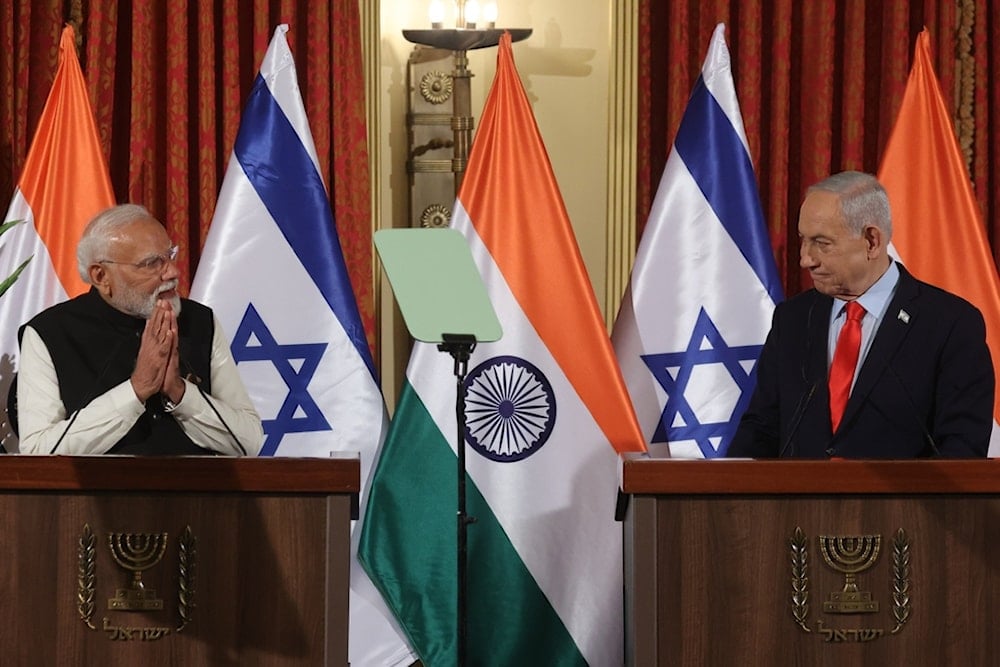
'Israel's' Prime Minister Benjamin Netanyahu, right, and his Indian counterpart Narendra Modi give a press conference in occupied al-Quds, Thursday, Feb. 26, 2026. (Gil Cohen Magen/Pool Photo via AP)
Israeli Prime Minister Benjamin Netanyahu said that "Israel" maintains strong international partnerships beyond the United States, highlighting India as a key supporter, while also reaffirming Washington’s central role as "Israel’s" closest ally.
Speaking in an interview with Fox News on Sunday, Netanyahu said "Israel" has “some other friends,” pointing in particular to India.
“We have some other friends, like a small country called India. You know, it has 1.4 billion people, and boy, do we have tremendous support there,” he said.
His remarks underscore expanding diplomatic and strategic ties between the occupation and New Delhi in recent years.
US remains 'Israel’s' closest ally
At the same time, Netanyahu stressed that the United States remains "Israel’s" most important partner, describing US President Donald Trump as "Israel’s" strongest supporter in the White House.
“Trump remains the greatest friend in the White House that Israel has ever had,” he said.
Netanyahu’s comments come after US Vice President JD Vance stated that the United States is "Israel’s" most powerful ally globally, while also suggesting that President Trump is uniquely sympathetic to "Israel" among world leaders.
Netanyahu said he respected Vance but noted that the two sides do not always agree on all issues, reflecting occasional differences within the broader US–"Israel" relationship.
Trump’s personal framing on US-Israeli relations
Yesterday, Trump stated that Benjamin Netanyahu “knows who the boss is,” as reported by Axios.
He added, “We get along very good. [Netanyahu] knows who the boss is,” presenting the interaction as a sign of close alignment between the two leaders.
The comments came as reports indicated Netanyahu may visit the White House in the coming weeks for talks expected to focus on Iran and broader regional tensions.
Trump also said that Iran-related negotiations had been temporarily paused due to funeral ceremonies for the martyred Leader of the Islamic Revolution, Sayyed Ali Khamenei, without giving a timeline for when talks might resume.
Between alignment and strategic friction
Beneath the public displays of unity, reporting continues to highlight differences in US–Israeli approaches to Iran, particularly in the post-war phase and the direction of ongoing diplomacy.
Israeli officials have reportedly expressed concern that discussions are shifting away from "Israel’s" central focus on Iran’s nuclear program, moving instead toward wider regional priorities such as maritime security and freedom of navigation in the Strait of Hormuz. Some Israeli assessments have stated that this evolution has fallen short of expectations tied to earlier military objectives.
These disagreements have contributed to internal debate within "Israel’s" security and political establishment, where competing interpretations remain over the effectiveness and outcome of recent confrontations with Iran.
Despite these underlying differences, the US and "Israel" continue to project close coordination in public, with Trump maintaining a visibly strong personal rapport with Netanyahu.
The expected White House meeting is likely to reaffirm that alignment, even as ongoing disputes over Iran strategy and regional security continue to suggest a relationship defined as much by managed disagreement as by public unity.
Read more: 'Israel' faces strategic failure in its war on Iran as US talks stall


