
'Israel' faces strategic failure in its war on Iran as US talks stall
 7 Min Read
Israeli officials say the Iran war outcome marks a strategic setback as US-Iran talks stall and tensions over Hormuz and nuclear claims intensify.
-
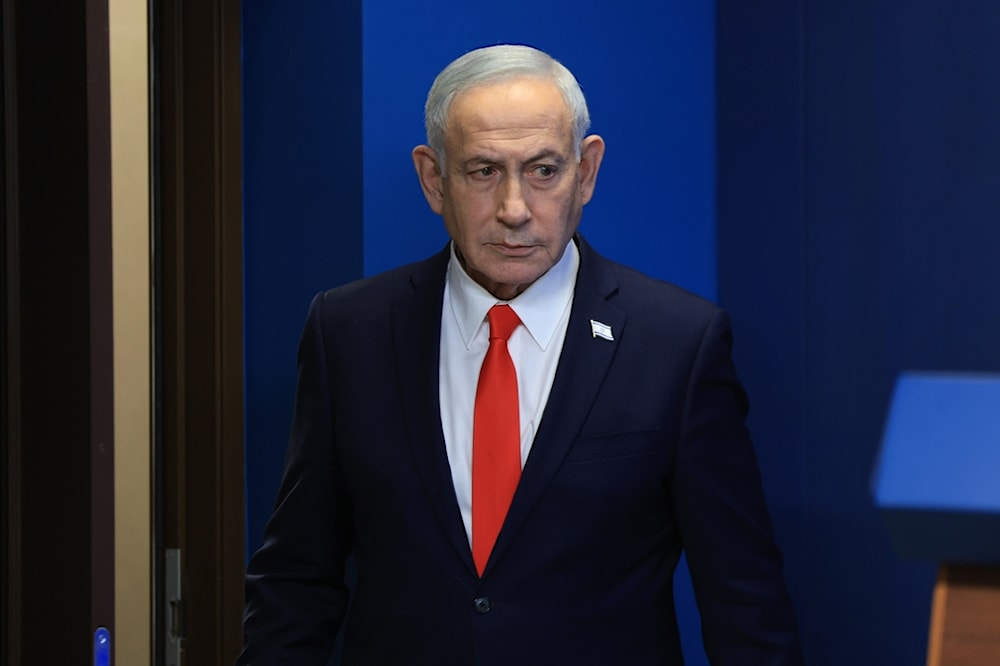
Israeli Prime Minister Benjamin Netanyahu holds a news conference in Al-Quds, Monday, June 15, 2026. (AP)
Israeli officials and security experts are increasingly viewing the outcome of the war on Iran as a "total strategic failure", as faltering US-Iran negotiations shift focus away from Tehran’s nuclear program and toward maritime security in the Strait of Hormuz.
According to Israeli assessments, Washington's inability to secure the kind of agreement it initially sought from Tehran reflects deeper strategic miscalculations made during and after the aggression. As diplomatic efforts continue, many in "Israel" believe the war has ultimately left its strategic position weaker than before the escalation began.
'Israel' reassesses outcome of war with Iran
According to a report by Al-Monitor, the shift in US-Iran talks toward issues such as freedom of navigation in the Strait of Hormuz has sharpened Israeli concerns that the core objectives of the war were not achieved. Israeli officials argue that the evolving negotiations signal a broader repositioning of priorities that does not align with "Israel’s" original strategic goals.
Prime Minister Benjamin Netanyahu has falsely claimed that Iran possesses nuclear weapons, framing the war as a necessary response to an existential threat. His political opponents, however, have sharply rejected this claim, accusing him of manipulating public perception ahead of upcoming elections scheduled no later than October 27.
Speaking in a recent interview with Channel 14, Netanyahu said "Israel" had twice been forced to act militarily “to save us from the destruction of atomic bombs that they already had, and who knows which of us would still be around.”
When asked whether "Israel" might strike Iran again, he replied, “As long as I'm prime minister, Iran won't have nuclear weapons.”
Critics, including senior military and political figures, have challenged this narrative. Former military chief of staff Gadi Eisenkot said, "Iran never obtained nuclear weapons. I'm well aware of all the intelligence . . . Netanyahu is inventing a reality, manufacturing threats, and that's how he frightens the Israeli public".
Al-Monitor said former prime minister Naftali Bennett also rejected Netanyahu’s remarks, calling them "a lie" and accusing him of "reverse-engineering history".
It is worth recalling that Iranian officials have consistently denied having or intending to build any nuclear weapon, going as far as issuing a religious edict against manufacturing nuclear arms. Instead, its nuclear program remains purely peaceful and intended for civilian purposes. Iran is also a member of the NPT, which nuclear-armed "Israel" is not part of.
Dispute over Iran’s nuclear claims deepens political divide
The internal Israeli debate over Iran’s nuclear capability has intensified political tensions at a sensitive moment for Netanyahu’s leadership. Analysts say the competing narratives reflect not only intelligence disagreements but also widening political fractures within "Israel’s" security establishment.
Israeli officials maintain that Iran has not reached full weaponization, despite advancing its enrichment capabilities. Reported assessments claim that while Iran may have approached weapons-grade levels, the final step of developing a deliverable warhead remained months away.
A former senior Israeli military official said, “Iran was not there. That's the assessment of most intelligence agencies around the world.”
Read more: US intelligence disputes 'imminent nuclear threat' from Iran
Rising tensions in US-Israeli strategic coordination
At the same time, tensions between Israeli officials and elements of the US administration have reportedly deepened amid the stalled negotiations with Tehran. A report revealing that "Israel" considered targeting senior Iranian officials involved in talks with Washington has further strained perceptions.
According to the New York Times, current and former US officials believed "Israel" may have been plotting to assassinate Iran's top negotiators, Foreign Minister Sayyed Abbas Araghchi and Parliament Speaker Mohammad Bagher Ghalibaf, during sensitive ceasefire negotiations this spring.
According to the report, Washington's concerns over the two men grew serious enough that US officials asked other countries in the region to warn Tehran that "Israel" could be targeting them, fearing an assassination attempt would collapse the talks and reignite the war.
For the first time, Iranian Foreign Minister Dr. Abbas Araghchi reveals in an interview with Al Mayadeen the harrowing details of the day the Iranian Leader, Sayyed Ali Khamenei, was martyred.
— Al Mayadeen English (@MayadeenEnglish) June 4, 2026
Araghchi recounts being inside the very same building during the targeted airstrike,… pic.twitter.com/ToJ1wZ1dnT
An Israeli security source dismissed the claims, saying, “It's beyond ridiculous,” and alleging the report was an attempt to “create friction between Israel and the United States.” However, "Israel" has previously attempted to assassinate the Hamas negotiating team in Doha, Qatar, setting a precedent for the recent concerns.
Despite public denials, some Israeli officials are reportedly hoping that prolonged negotiations will frustrate Washington enough to prompt renewed US pressure on Iran, including sanctions or potential military options.
"He's as serious as a heart attack."
— Al Mayadeen English (@MayadeenEnglish) July 2, 2026
In an interview with Al Mayadeen, Former Pentagon analyst Michael Maloof warns that Israeli War Minister Israel Katz's threats to assassinate Iranian leaders must be taken seriously.
According to Maloof, Netanyahu is prepared to defy the US… pic.twitter.com/4eyduyqhBV
Strait of Hormuz becomes new diplomatic flashpoint
As negotiations shift away from nuclear issues, Israeli officials are closely watching developments around the Strait of Hormuz, which has emerged as a central point of contention in US-Iran discussions.
A senior Israeli diplomatic source said the war’s focus has effectively shifted, stating: “What began as a war over Iran's nuclear program, ballistic missiles and terrorism has turned into a campaign to secure freedom of navigation through the Strait of Hormuz.”
The source added that, from "Israel’s" perspective, “this is a strategic failure, and it complicates the other fronts as well,” particularly Lebanon, in which a ceasefire is mandated under the US-Iran Memorandum of Understanding.
Netanyahu scrambles for alibis
Domestically, Netanyahu is entering a critical election period under increasing pressure from critics and even segments of his traditional support base. His failure to deliver a “total victory” over Iran and its regional allies is now under scrutiny.
A diplomatic source said Netanyahu is attempting to reframe the aggression politically, noting, “Netanyahu is preparing an alibi for his disappointed political base. He knows many people won't buy the spin, but he has no alternative.”
The broader regional context remains volatile, with thousands of settlers in northern occupied Palestine still evacuated following years of war against Hezbollah. Analysts warn that unresolved fronts in Lebanon and Gaza continue to shape "Israel’s" strategic outlook.
Iran debate reshapes election narrative
As the region marks 1,000 days since the October 7, 2023, Israeli genocide in Gaza and the subsequent wars, Netanyahu has sought to reframe the national narrative around Iran’s capabilities and intentions. His critics argue this reflects a political strategy aimed at reshaping perceptions of past intelligence assessments.
International analysts generally agree that while Iran had made significant advances in uranium enrichment, it had not yet completed the steps required to produce a deployable nuclear weapon, a process estimated to take around 12 to 18 months.
Whether Netanyahu’s framing of the war resonates with voters is likely to become a defining question in the months ahead, as “Israel” moves toward a pivotal election season.
Read more: Vance and Rubio show differing tones on Iran and 'Israel' policy


