
US intelligence disputes 'imminent nuclear threat' from Iran
 3 Min Read
US intelligence says Iran was not rebuilding its nuclear enrichment program after last year's 12-Day War, contradicting Trump’s justification for this war.
-
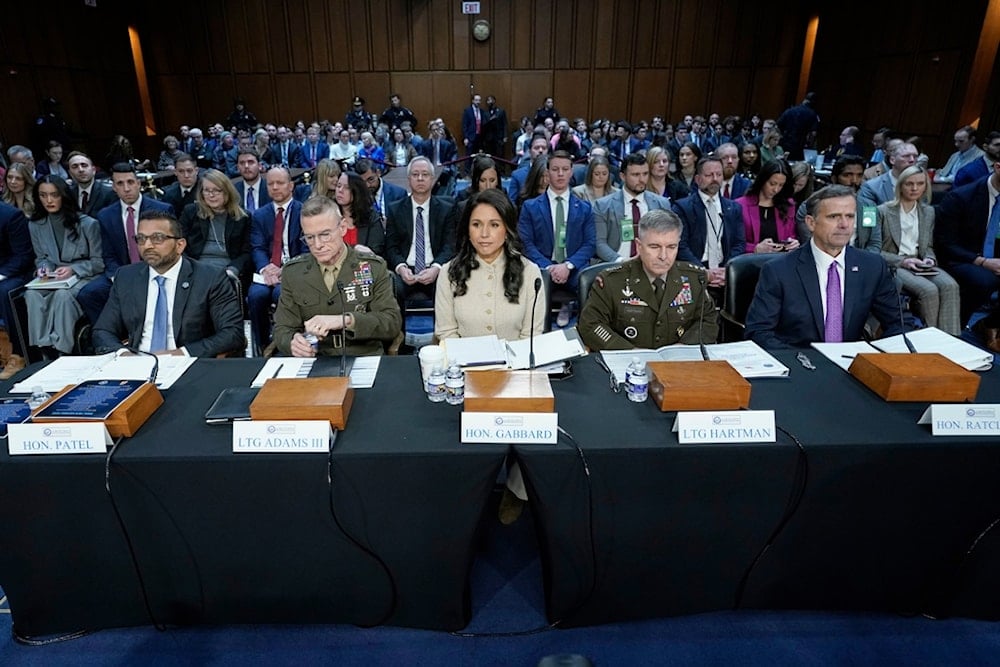
From left, FBI Director Kash Patel, Defense Intelligence Agency Director James Adams, Director of National Intelligence Tulsi Gabbard, Acting Commander of the U.S. Cyber Command William Hartman, and CIA Director John Ratcliffe are seated before the Senate Committee on Intelligence hearings to examine worldwide threats on Capitol Hill Wednesday, March 18, 2026, in Washington. (AP Photo/Jose Luis Magana)
US intelligence assessed that Iran was not rebuilding its nuclear enrichment capabilities following last year’s US–Israeli attacks, contradicting the "justification" cited by President Donald Trump for the ongoing war on Iran.
The findings were presented by Director of National Intelligence Tulsi Gabbard, as she and other officials testified before Congress, offering a mixed picture of the war’s background and consequences.
In prepared testimony to the Senate Intelligence Committee, Gabbard said that “Operation Midnight Hammer,” the June 2025 US strike on Iran's nuclear facilities, had “obliterated” Iran’s nuclear enrichment program.
“There has been no efforts since then to try to rebuild their enrichment capability,” she wrote, though she did not repeat the conclusion during the public hearing. When pressed by lawmakers, she said she had not fully reviewed the testimony but did not dispute its contents.
Donald Trump has repeatedly justified the aggression on Iran in collaboration with "Israel" by citing an “imminent threat,” maintaining that Iran was close to developing a nuclear weapon despite earlier claims that US strikes had destroyed its nuclear infrastructure.
However, the International Atomic Energy Agency and most independent observers have not supported assertions that Iran was on the verge of producing a nuclear bomb, particularly as negotiations with US envoys were ongoing before the escalation.
Read more: Pete Hegseth brings the 'American Crusade' to war on Iran
Internal dissent and political backlash
Gabbard, who previously opposed war with Iran during her time in Congress, faced criticism from Democrats who argued that the administration had failed to demonstrate a new or imminent threat.
Her senior aide, Joseph Kent, resigned in protest, stating that Iran posed no immediate danger and accusing Trump of being misled by “Israel” and media narratives.
Democratic Senator Michael Bennet criticized the shift in US policy, saying Trump had reversed his pledge to avoid acting as “the policemen of the world.”
Gabbard told lawmakers that while Iran had suffered significant damage during weeks of attacks, including the killing of senior leadership figures, its governing structure remains intact.
The US intelligence community assessed that Iran’s system is “largely degraded” but still functioning, warning that it could pursue a long-term effort to rebuild military, missile, and drone capabilities if it survives.
Read more: US intel warned Trump: Iran regime change 'unlikely'
Russia and China assessments
Beyond Iran, Gabbard said US intelligence believes Russia retains the upper hand in its ongoing war against Ukraine, with Moscow expected to continue a prolonged conflict despite ongoing negotiations.
She also warned of risks of escalation that could potentially lead to nuclear confrontation.
On China, Gabbard said Beijing is rapidly modernizing its military with the aim of being capable of taking Taiwan, though it likely prefers achieving reunification without direct conflict.
Trump is expected to travel to China in the coming weeks, after postponing the visit due to the ongoing war in the Middle East.


