
Pete Hegseth brings the 'American Crusade' to war on Iran: CNN
 5 Min Read
Defense Secretary Pete Hegseth frames the US war on Iran through extreme Christian nationalist beliefs, mixing faith, Crusader symbolism, and military policy in a highly controversial approach.
-
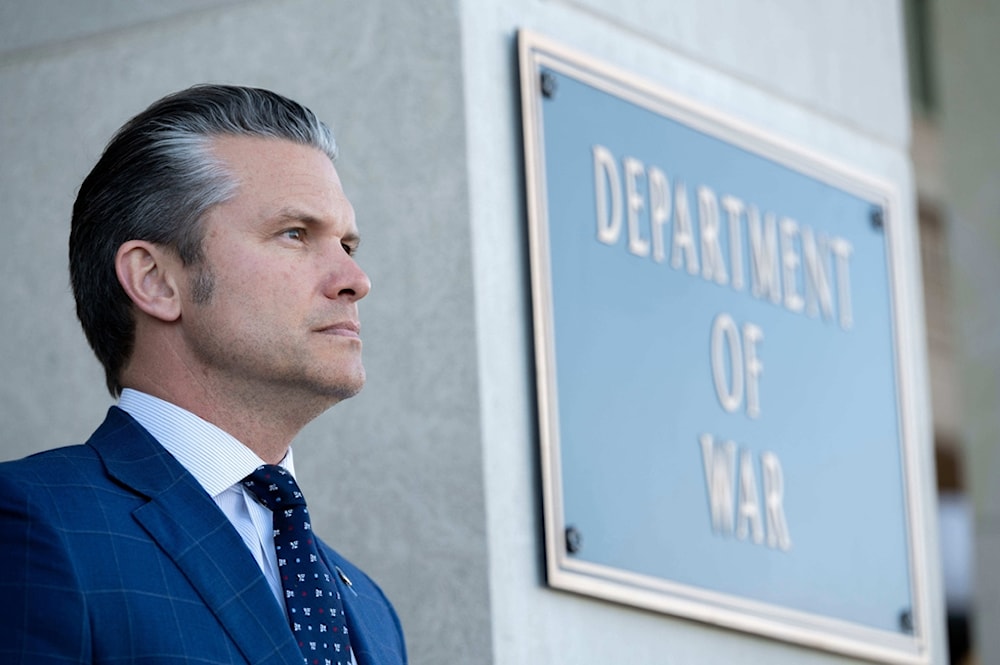
Defense Secretary Pete Hegseth stands outside the Pentagon during a welcome ceremony for Japanese Defense Minister Shinjirō Koizumi at the Pentagon, Thursday, Jan. 15, 2026, in Washington. (AP)
War Secretary Pete Hegseth has framed the US military’s aggression against the Islamic Republic through a lens that blends Christian nationalism, biblical prophecy, and military strategy in ways that raise concern about the politicization of religion in the Pentagon.
In a CBS News interview, Hegseth asserted that the US should not be doubted in its war with Iran because of divine support: “Our capabilities are better. Our will is better. Our troops are better. The providence of our almighty God is there protecting those troops, and we’re committed to this mission.”
He framed his war rhetoric around religious imagery, portraying Iranian leaders as “religious fanatics” whose ambitions are tied to an apocalyptic vision. He told CBS, “Troops need a connection with their almighty God in these moments.”
Hegseth even quoted Psalm 144 at a Pentagon press conference: “Blessed be the Lord, my rock, who trains my hands for war and my fingers for battle.”
He sent troops to a war he claimed was "God's divine plan," triggering hundreds of complaints about such rhetoric that "destroys morale and unit cohesion" and violates the constitutional oath taken by all military personnel.
Tattoos, crusades, and personal symbolism
Hegseth’s personal imagery reinforces his extreme worldview. His tattoos include a Jerusalem Cross and the phrase Deus Vult (“God Wills It”), referencing the Crusades. He has written about these symbols in his 2020 book American Crusade, portraying modern US military action as a continuation of historic Christian wars.
He acknowledges that these tattoos have caused controversy, including being labeled an extremist and disinvited from his unit’s detail at President Biden’s inauguration in 2021. The symbolism, rooted in medieval religious wars, underscores his tendency to view contemporary conflicts in highly charged religious terms.
In American Crusade, Hegseth frames opposition to Islamists as a moral and spiritual struggle that echoes the Crusades. He describes a “crusade moment” where Americans, alongside "Israel", must push back against Islam culturally, politically, geographically, and militarily.
“We don’t want to fight, but, like our fellow Christians one thousand years ago, we must,” he wrote.
Hegseth argues that Islam has been at war with its enemies since its founding, warning that Western tolerance allows extremist forces to grow. His writing casts geopolitics as a cosmic struggle, suggesting that America’s military interventions are divinely justified.
Christian zionism and alignment with 'Israel'
Hegseth’s worldview extends to Christian Zionism, portraying support for the Israeli occupation, not just as a strategic alliance but as a religious imperative. During his confirmation hearing, he stated:
“I am a Christian, and I robustly support the state of Israel and its existential defense and the way America comes alongside them as a great ally.”
He links biblical prophecy to US foreign policy, framing contemporary wars in West Asia as part of a divine plan. Experts say this aligns with a strain of American exceptionalism and Christian nationalism that sees geopolitical disputes in spiritual terms.
Religious influence in the Pentagon
Hegseth has also actively promoted religious initiatives in the military. He has sought to reshape the Chaplain Corps to emphasize God and faith over secular language, broadcasts monthly prayers throughout the Pentagon, and invited pastors with Christian nationalist views to address troops.
Critics, including the Military Religious Freedom Foundation, warn that such policies alienate secular service members and risk presenting the US as waging a religiously framed war. MRFF founder Mikey Weinstein has noted that commanders sometimes discuss the Iran conflict in apocalyptic terms, which could fuel extremist propaganda abroad.
Scholars describe Hegseth’s worldview as a combination of Christian nationalism and American exceptionalism, framing conflicts like the US war on Iran as moral and cosmic struggles. Daniel Hummel, director of the Lumen Center, explains that this perspective casts Iran as fundamentally opposed to the values of Americans and their allies in "Israel."
Allyson Shortle, professor of politics and religion, notes that while Hegseth’s views are on the fringe, roughly half of Americans support some form of Christian nationalist ideology.
Previously, John Heathershaw, professor of international relations at the University of Exeter, told Premier Christian News that the framing of the strikes as holy war has "no biblical justification," describing it instead as "an attempt by certain parts of the Church in the United States to align with political power, rather than a reflection of sound biblical theology."
Read more: Trump's Pentagon chief nominee an avid Islamophobe, extremist


