
Netanyahu-Trump rift exposes deeper military-political crisis: Haaretz
 5 Min Read
Behind the Trump-Netanyahu clash is a growing split between "Israel's" military and political leadership over how to handle Lebanon and Iran.
-
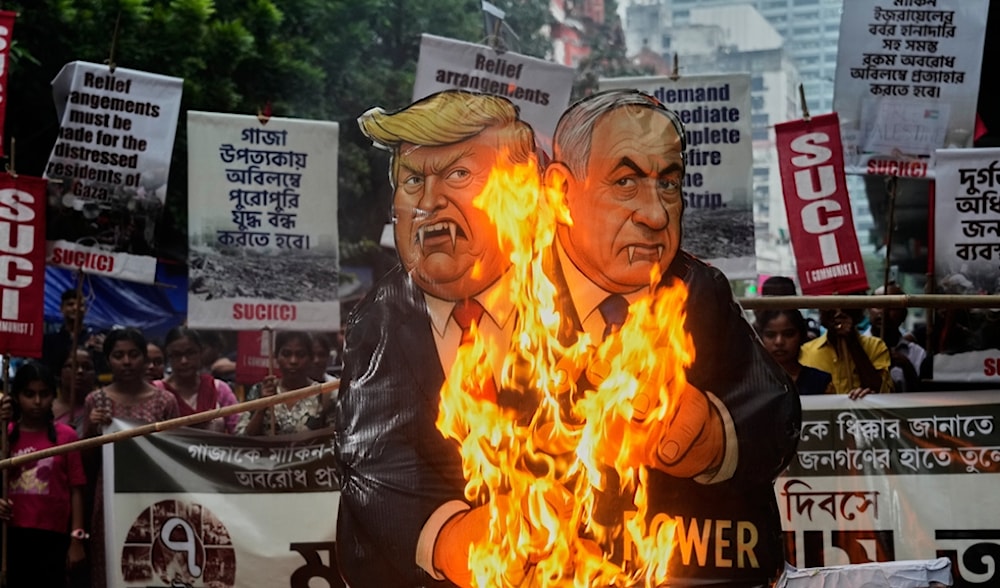
Demonstrators of the Socialist Unity Center of India-Communist (SUCI-C) shout slogans as they burn a joint effigy of President Donald Trump and Prime Minister Benjamin Netanyahu in Kolkata, India, Tuesday, Oct. 7, 2025 (AP)
Behind the public dispute between Israeli Prime Minister Benjamin Netanyahu and US President Donald Trump lies a deeper disagreement between the political echelon and the military establishment, Israeli daily Haaretz said in a new report, following a heated phone call between a furious Trump and an uncooperative Netanyahu.
According to Haaretz, the phone call, which preceded a "ceasefire" announcement for Lebanon, could still be viewed as a sharp confrontation with Netanyahu, even if Trump's insults were disregarded.
"It is not difficult to understand what is unfolding," the report noted, explaining that Trump's primary objective allegedly remains ending direct US involvement in regional wars and gradually shrinking American military presence in the region.
For example, Haaretz presented the US operating 75 refuelling aircraft at Ben Gurion airport, which has disrupted regular aviation and increased flight costs from "Israel" as evidence of the depth of US involvement in the war on Iran.
Lebanon as a 'secondary', contested arena
However, when it comes to Lebanon, the report stated it is considered a secondary arena for Trump. Haaretz cited Trump's move to rein in Netanyahu when "Israel" threatened to attack Beirut after Iran interfered and warned of a response, demonstrating how the US president prioritized a deal with Iran at the expense of Israeli military ambitions in Lebanon.
The report further highlighted a renewed rift between "Israel's" political and military leadership. The General Staff, it said, is increasingly frustrated by the government’s refusal to pursue stable political settlements across fronts.
Lebanon, where Israeli occupation forces are increasingly suffering ongoing casualties, including the death of Captain Eitan Shmuel Lamber, was cited as the primary source of strain.
It noted competing assessments within "Israel’s" security establishment: Chief of Staff Eyal Zamir argued that Hezbollah’s recent losses could push it toward greater flexibility, while War Minister Israel Katz advocated for intensified airstrikes, insisting that a more decisive outcome, namely the dismantling of Hezbollah’s arsenal, remained achievable despite operational constraints on the ground.
According to the report, “Trump ultimately settled the dispute, at least for now,” by not only preventing Israeli strikes on Beirut’s Southern Suburb but also by announcing the implementation of a ceasefire, prompting Netanyahu to comply.
Promises of victory dismissed as an illusion
The article also cited Yair Golan, leader of the Democrats and a reserve major general who previously led the Northern Command, as saying that “the artificial enthusiasm surrounding the capture of Shqif evokes an uncomfortable sense of déjà vu.”
Instead of translating battlefield gains into political initiatives, Golan said, "Israel" is opting to deepen military entrenchment “without strategic benefit,” warning that “there is no guarantee political efforts will succeed, but they must at least be attempted. Promises of absolute victory are an illusion.”
However, from Netanyahu’s perspective, “the war must remain perpetually active, and ideally across multiple fronts,” thereby avoiding renewed scrutiny over the failures that enabled the events of October 7 and their aftermath across various theatres, Haaretz said.
It further remarked that recent Israeli government and military actions resemble “a return to 1982,” with the capture of al-Shaqif presented domestically as a significant achievement, though, in practical terms, it amounted, at most, to tactical pressure on Hezbollah. The move, it said, has nevertheless revived uncomfortable historical comparisons.
Reserve Brigadier General Oren Abman, the last commander of the Shaqif Heights who oversaw the 2000 withdrawal from the area, was quoted as saying, “There is strategic ambiguity here. Decisions are being made in Washington, not in Jerusalem. That is the worst part."
Abman also highlighted the direct link between Iran and Lebanon as "the most dismal configuration imaginable after two and a half years of bloody fighting," adding that the crisis is further compounded by the near-paralysis of the army, which is stretched to its limits, while soldiers are being killed and wounded.
"I am searching for strategy and substance. What happened at Shqif this week is tactical success masking a complete strategic vacuum," he concluded.
Hezbollah’s operational gains
Frustration has also stretched across the military establishment. A senior reserve officer recently slammed the "institutional fixation on casualty counts," admitting that Israeli claims that hundreds of Hezbollah fighters were killed are likely exaggerated.
Dr. Shimon Shapira, a Hezbollah specialist, told Haaretz that the group has achieved “a significant operational success” through drone attacks using fibre-optic guidance systems, reflecting the maturation of Hezbollah’s technological development, initiated in part by Martyr Hassan Lakkis, who laid the groundwork for an embryonic drone capability before being assassinated in 2013.
According to Shapira, Hezbollah subsequently invested in training engineers in Lebanon and Iran and accumulated large quantities of unmanned systems.
“These developments are now bearing fruit from their perspective,” he said, adding that Iran continues to support this trajectory while pushing for coordinated settlement frameworks across both the Gulf and Lebanese fronts.
Read more: 'Utter failure': Ehud Barak rips Netanyahu over Lebanon strategy


