
New START expires as US-Russia nuclear tensions rise
 6 Min Read
The expiration of the New START treaty has heightened uncertainty over global nuclear weapons stability, as Washington weighs arsenal expansion and Moscow signals conditional adherence to previous limits.
-
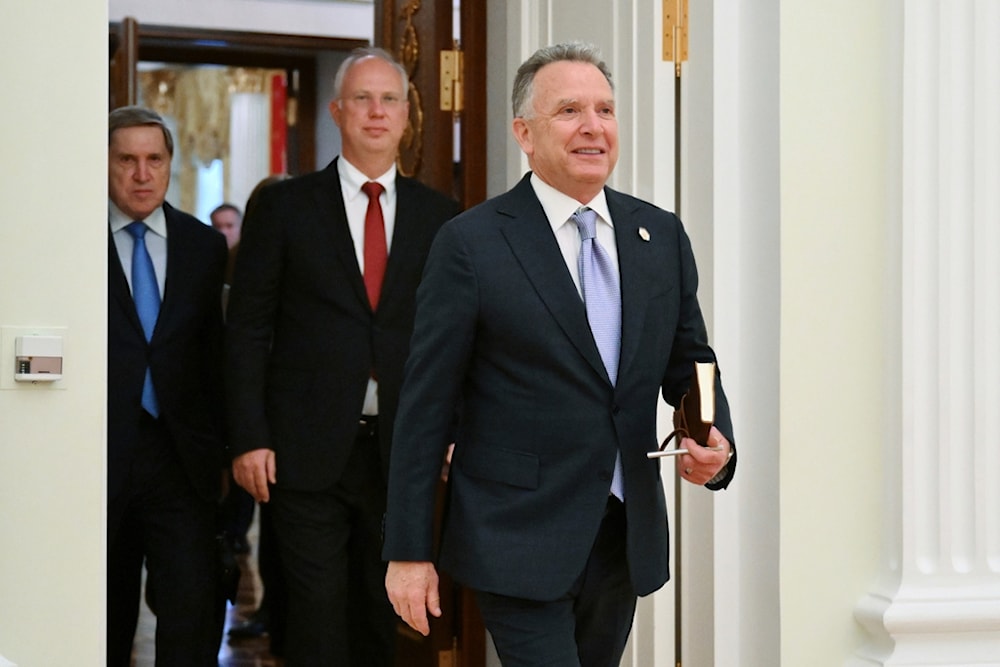
US President Donald Trump's special envoy Steve Witkoff, President Vladimir Putin's envoy Kirill Dmitriev, and Russian presidential aide Yuri Ushakov, attend talks with Putin at the Kremlin, in Moscow, on April 25, 2025. (AP)
The New START treaty expiration marks a pivotal moment in global nuclear weapons stability. The agreement, signed in Prague in 2010 by then-US President Barack Obama and Russian President Dmitry Medvedev, limited deployed strategic nuclear warheads and delivery systems and established transparency mechanisms through inspections and data exchanges.
Its formal expiration on February 5 has intensified concerns about the future of arms control between Washington and Moscow.
Recent statements from Moscow add complexity to the situation. Russian Foreign Minister Sergey Lavrov said on February 11 that Russia would continue adhering to New START limits, but only if the United States does the same. Speaking before the State Duma, Lavrov emphasized that President Vladimir Putin had already announced a moratorium on exceeding treaty limits, though Moscow’s commitment remains conditional.
“We proceed from the fact that this moratorium on our part, which was announced by President [Vladimir] Putin, remains in place, but only as long as the United States also does not exceed the aforementioned limits,” Lavrov said.
Lavrov further indicated that Russia has not received an official response from Washington regarding its proposal to maintain restrictions beyond the treaty’s expiration.
Temporary compliance and diplomatic uncertainty
Amid rising tensions, Axios reported on February 5 that US and Russian officials discussed a temporary six-month continuation of compliance with New START limits while initiating negotiations on a successor agreement.
The discussions reportedly took place in Abu Dhabi and included a draft framework pending approval by President Donald Trump and President Vladimir Putin.
Lavrov later stated that Moscow has reason to believe Washington is “in no hurry to move away from these indicators,” suggesting that the existing caps may be respected in the near term.
Despite these signals of temporary restraint, the absence of a binding treaty framework has fueled uncertainty about long-term strategic stability.
Trump nuclear policy 2026: Expansion over restraint?
Against this backdrop, President Trump’s approach has raised alarms among arms control advocates. Rather than focusing solely on extending limitations, the administration is weighing steps that could expand US nuclear capabilities.
With the New START treaty expiration now official, the Navy is studying whether to reopen disabled launch tubes on Ohio-class submarines and load additional warheads onto intercontinental ballistic missiles. Such measures could significantly increase the deployed arsenal.
Officials have also floated the idea of a “Trump class” warship equipped with nuclear-capable cruise missiles, reinforcing perceptions that Trump's nuclear policy 2026 prioritizes strategic leverage.
The State Department has argued that New START imposed “unacceptable” constraints and failed to account for China's nuclear arsenal expansion. While Beijing is increasing its strategic forces, dismantling bilateral guardrails with Russia in hopes of compelling China to negotiate appears unlikely to yield immediate results.
China has consistently stated that it will not join trilateral arms control talks while its arsenal remains far smaller than those of the United States and Russia.
US nuclear testing resumption: A strategic gamble
Equally troubling are signals that the administration may consider a US nuclear testing resumption.
The United States has not conducted an explosive nuclear test since 1992. Nonetheless, senior officials have suggested that Washington must “restore responsible behavior” in response to allegations that Russia and China may have violated testing moratoria, claims that remain publicly disputed.
President Trump has previously stated he would resume detonations “on an equal basis” with adversaries.
The United States has conducted more than 1,000 nuclear tests, approximately as many as all other nations combined. That data enables continued maintenance of the arsenal through advanced simulation and modeling, reducing the technical necessity for new explosive testing.
Resuming detonations would likely deliver a limited military advantage while risking major geopolitical fallout. Such a move could prompt reciprocal testing by Russia and China, further destabilizing global nuclear weapons stability.
The broader arms control legacy
The Strategic Arms Reduction Treaty, commonly known as START, dates back to July 31, 1991, when US President George H. W. Bush and Soviet leader Mikhail Gorbachev signed START I near the end of the Cold War. That agreement entered into force on December 5, 1994, and significantly reduced deployed strategic nuclear arsenals while introducing strict verification mechanisms.
After the dissolution of the Soviet Union, Russia assumed treaty obligations. The arms control architecture was later renewed through the New START treaty in 2010.
For decades, these agreements helped reduce thousands of warheads and eased fears of nuclear escalation during periods of political transition. The current uncertainty threatens to reverse that trajectory.
Beyond strategic calculations, the legacy of nuclear testing remains deeply human.
Communities in the Marshall Islands and parts of the American West continue to endure the consequences of radioactive fallout, including cancer and displacement. Reopening the door to explosive testing would not only undermine international norms but also revive painful historical memories of environmental and humanitarian damage.
Preventing a renewed US-Russia nuclear arms race
Despite escalating rhetoric, the situation is not yet irreversible.
If both Washington and Moscow continue observing New START limits informally, space remains for negotiations toward a new strategic stability framework.
First, the administration could formally reaffirm its commitment not to exceed existing caps.
Second, it could pursue structured negotiations on a successor agreement while avoiding unilateral expansion steps that may trigger reciprocal responses.
Third, policymakers should avoid framing China's nuclear arsenal expansion as a justification for dismantling bilateral constraints with Russia, particularly when both countries maintain arsenals vastly exceeding China’s.
Finally, the concentration of nuclear launch authority in a single individual remains a structural concern. The US president retains sole authority to initiate a nuclear strike.
In an era marked by treaty erosion, strategic rivalry, and rising geopolitical tension, the preservation of oversight mechanisms and diplomatic engagement remains essential to preventing a renewed US-Russia nuclear arms race.


