
No legal basis: More experts, lawmakers question US war on Iran
 4 Min Read
US lawmakers and legal scholars say the Trump administration’s war on Iran violates both the US Constitution and international law, citing the lack of an imminent threat or congressional authorization.
-
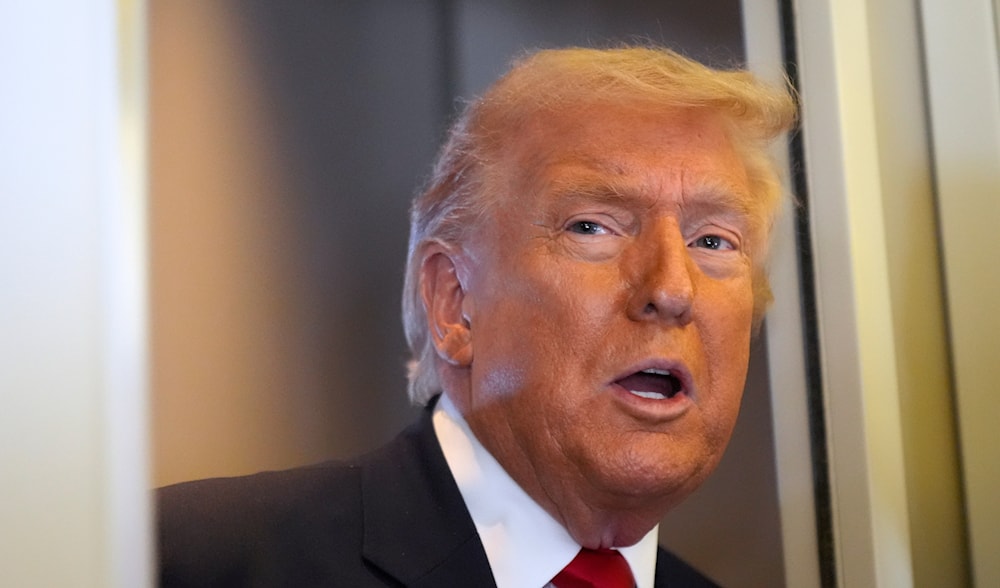
President Donald Trump speaks to reporters while traveling aboard Air Force One en route from Dover Air Force Base, Del., to Miami, Saturday, March 7, 2026 (AP)
Several US lawmakers and legal scholars have warned that US President Donald Trump’s administration is waging an illegal war on Iran, arguing that the aggression violates both the US Constitution and international law governing the use of force.
The criticism comes as the United States continues its war alongside "Israel" in a broad assault on the country, triggering retaliatory Iranian strikes across the region and sharply escalating tensions in West Asia.
Legal experts say the administration has failed to provide a lawful justification for launching attacks against Iran.
“These are military policy objectives,” said Wells Dixon, a senior attorney at the Center for Constitutional Rights.
“They are not a legal basis to launch an armed attack against another country,” Dixon said, challenging the legal rationale presented by the administration for the war.
Questions over international law
Scholars specializing in international law argue that the use of force against another state requires clear legal grounds, most commonly self-defense in response to an imminent threat.
Marko Milanovic, a professor of international law at the University of Reading, noted that even if Iran is viewed by Washington as a "strategic adversary", that alone does not provide legal justification for military action.
“Using force would require a basis in self-defense,” Milanovic said.
Legal experts also emphasized that international law includes specific provisions allowing states to act in self-defense, but only under strict conditions.
Those conditions require proof of an immediate and unavoidable threat.
“For something to be lawful self-defense, it has to be necessary — in the sense that there’s no alternative,” said Brian Finucane, a former US State Department lawyer.
“That’s not the situation here. There was another option: the US could have restrained Israel from attacking in the first place,” he added.
Finucane pointed out that previous US administrations had drawn such limits regarding Israeli military actions in the region.
Lawmakers question war authority
US lawmakers from both parties have also raised concerns about the legality of the war under domestic law, noting that Congress has not authorized military action against Iran.
Under the US Constitution, the authority to declare war rests with Congress, while the president serves as commander in chief of the armed forces.
Mark Warner, the Democratic vice-chair of the Senate Intelligence Committee, stressed that the administration’s claims of self-defense do not withstand scrutiny.
“There was no imminent threat to the United States of America by the Iranians. There was a threat to Israel,” Warner said.
US Senator Brian Schatz slammed Trump for his unfulfilled promises.
"I’ve seen a lot of Presidents fall short of their promises but I’ve never seen any President just doing the opposite of everything promised on purpose. Prices, Epstein, wars. Just absolutely racing to betray his voters," Schatz posted on X
I’ve seen a lot of Presidents fall short of their promises but I’ve never seen any President just doing the opposite of everything promised on purpose. Prices, Epstein, wars. Just absolutely racing to betray his voters.
— Brian Schatz (@brianschatz) March 6, 2026
The absence of a direct threat to the United States, critics argue, undermines the legal basis for invoking self-defense to justify military action.
Escalating regional consequences
The debate over the legality of the war comes as the US-Israeli aggression against Iran continues to reshape the regional security landscape.
Iran has launched multiple waves of retaliatory missile and drone strikes targeting Israeli-occupied territories, as well as US military installations across West Asia. The operations have struck bases and military assets in several Gulf countries hosting US forces.
Iranian officials say the strikes are a direct response to the US-Israeli attacks that have targeted Iranian cities, infrastructure, and military facilities, resulting in significant civilian casualties.
The widening confrontation has already begun to affect regional economies and global markets. Businesses across the Gulf have sought expanded political violence insurance amid fears that missile and drone attacks could damage critical infrastructure such as energy facilities, ports, and data centers.
The escalation has also disrupted global trade routes, with tensions around the Strait of Hormuz, a vital energy corridor through which roughly one-fifth of the world’s oil passes, raising concerns about supply shocks and rising energy prices.
Analysts warn that the longer the conflict continues, the greater the economic and geopolitical repercussions will be, as regional actors brace for further escalation between Iran, the United States, and "Israel".
Read more: 1,332 killed in Iran as US, 'Israel' target civilians: Iravani


