
Nuclear experts dispute White House claims on Tehran reactor use
 10 Min Read
Independent nuclear scientists say the Tehran Research Reactor, built for civilian purposes, poses no nuclear weapons threat, challenging the Trump administration’s claims used to justify the war on Iran.
-
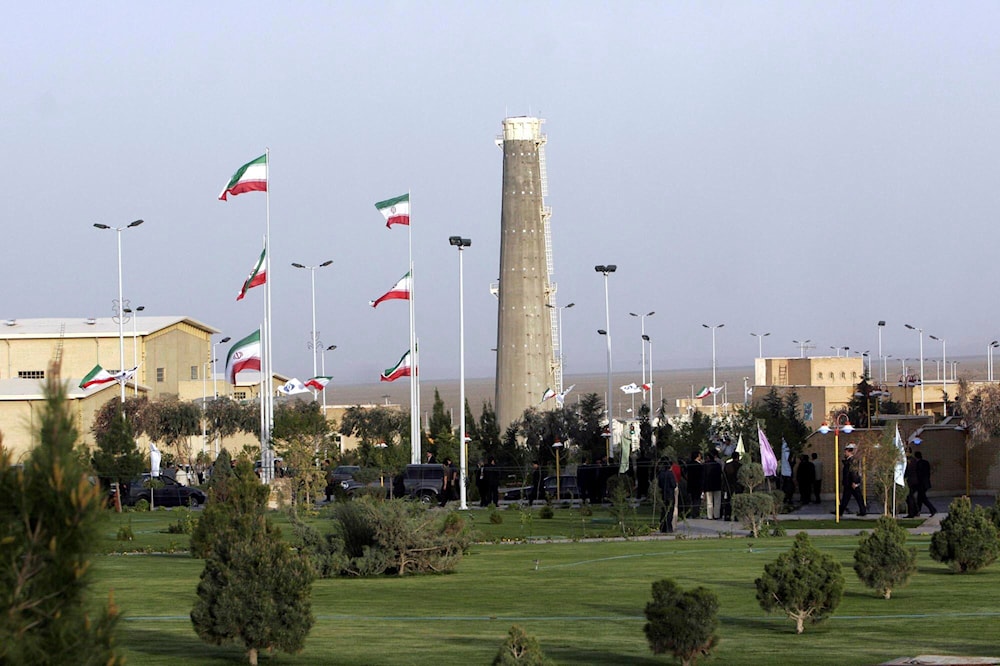
A view of Iran's nuclear enrichment facility in Natanz, Iran, on April, 9, 2007 (AP)
The administration of US President Donald Trump has pointed to the Tehran Research Reactor as a key reason for launching military strikes on Iran. However, nuclear scientists and nonproliferation specialists say there is no evidence that the facility, constructed by the United States and used for civilian research for nearly 60 years, was being used to develop nuclear weapons.
Several experts told MS NOW that the reactor lacks the capability to function as the direct pathway to a nuclear weapon that administration officials have suggested.
The discrepancy between the administration’s claims and available evidence has fueled criticism, particularly as scrutiny grows over the decision to begin military action rather than continue negotiations.
According to US negotiator Steve Witkoff, Iranian nuclear negotiators submitted a seven-page proposal for a potential nuclear agreement just 36 hours before the United States launched its military assault. The talks involved mediation by Badr Albusaidi, the foreign minister of Oman.
But American negotiators Witkoff and Jared Kushner rejected Iran’s request to continue using uranium enriched to 20% at the research reactor. The facility was originally built and supplied by the United States to Iran in 1967 for civilian nuclear research.
“The claim that they were using a research reactor to do good for the Iranian people was a complete and false pretense to hide the fact that they were stockpiling there,” a senior Trump administration official told reporters during a briefing on Tuesday, three days after the attacks began.
Despite those assertions, the administration has not presented public evidence or intelligence shared with Congress, indicating that Iran intended to use uranium from the reactor for weapons development or that it was secretly stockpiling material there.
Two people familiar with classified briefings for lawmakers told MS Now that administration officials did not claim that the reactor was being used for stockpiling purposes in those sessions.
Claims involving the IAEA
Witkoff claimed on “The Mark Levin Show” that the International Atomic Energy Agency had evidence Iran was storing fuel at the facility.
“The [International Atomic Energy Agency] had evidence that they were stockpiling there and they had enough fuel to run TRR for the next seven or eight years without any additional fuel being delivered,” Witkoff said. “They were stockpiling again at the 20% level.”
He also alleged that Rafael Grossi, the agency’s director general, was told by Iranian officials that they had stopped “burning anything” at the reactor and that “all of the fuel is stockpiled,” calling the moment a “‘Perry Mason’ moment.”
The IAEA and Grossi did not respond to requests from MS NOW seeking confirmation of Witkoff’s statement.
White House spokesperson Anna Kelly defended the administration’s position.
“As the IAEA has publicly affirmed, Iran was stockpiling near-weapons grade enriched uranium while refusing to participate in serious negotiations with the United States,” Kelly said. “Thankfully, President Trump will never stand back and allow a country that chants ‘Death to America’ to ever obtain a nuclear weapon, and Operation Epic Fury is effectively taking out their capabilities of doing so.”
However, statements from the White House and the IAEA have diverged in the week since the US-Israeli aggression began.
“This is spin, it just isn’t true, and the conversation that did take place with Director General Grossi present has been taken completely out of context by Mr. Witkoff,” a Gulf diplomat told MS Now on condition of anonymity.
Experts say assessments contain technical errors
Several nuclear specialists questioned whether Witkoff and Kushner fully understood the technical details of uranium enrichment central to the negotiations.
Elena Sokova, executive director of the Vienna Center for Disarmament and Non-Proliferation, described the administration’s characterization of the reactor as “confusing and misleading.”
“It mixes up different elements of the nuclear program and their potential proliferation capabilities,” Sokova said. “Research reactors are not capable of doing enrichment of uranium, whether for civil or military purposes.”
A senior Middle East diplomat told MS NOW that the US negotiating team did not include technical nuclear experts during talks in Geneva. The White House also chose not to attend scheduled technical discussions planned in Vienna.
“When it comes to nuclear nonproliferation discussions, the details matter,” said Daryl Kimball, executive director of the Arms Control Association. “And working out the details requires time and technical expertise, and the administration was not patient enough to apply either to this effort.”
Witkoff dhas efended his role in the talks.
“I wouldn’t tell you I’m an expert in nuclear, but I’ve learned quite a bit, and I’ve studied it and have read quite a bit about it, and I’m competent to sit at the table and discuss it, and Jared [Kushner] is as well,” he said.
A reactor built under the 'Atoms for Peace' program
The Tehran Research Reactor was constructed by the United States in 1967 under the “Atoms for Peace” initiative launched by Dwight D. Eisenhower. The program aimed to promote civilian nuclear development for energy, medical, and research uses.
The facility runs on uranium enriched to about 20%, which is significantly lower than the level needed to produce a nuclear weapon.
Under the 2015 nuclear agreement known as the Joint Comprehensive Plan of Action, the reactor would have received up to five kilograms of 20% enriched fuel at a time from outside Iran under international monitoring.
According to Katariina Simonen of the Pugwash Conferences on Science and World Affairs, the facility has not been under IAEA suspicion for weapons development in more than 25 years.
“TRR is not ideal for any other activity than what it is designed for — i.e., civilian use (isotopes, research, training),” Simonen said. “It is a small, light-water reactor supplied by the US under the Atoms for Peace program.”
Dispute over 20% enriched uranium
The debate centers on Iran’s use of uranium enriched to 20% at the research reactor.
During negotiations in Geneva last week, Iranian officials sought permission to continue enrichment at that level in order to produce medical isotopes and other civilian nuclear materials.
Witkoff argued that the enrichment level was “five times the level that the JCPOA would have allowed,” referring to the 3.67% cap set for broader enrichment activities under the Obama-era deal.
But the agreement separately allowed for the reactor to use 20% enriched fuel supplied from outside Iran and monitored by international inspectors.
“The TRR reactor requires 20% fuel — that’s how the reactor is designed,” Kimball said. “Is [the TRR] all a cover for nuclear weapons? One can make that claim. But at the same time, Iran was in the talks describing what they think their future nuclear energy needs might be and why, at some point in the future, they want to have the option to enrich uranium.”
Claims about weapons timelines disputed
US officials have argued that Iran may have attempted to turn the reactor into a cover for stockpiling material that could later be enriched to weapons-grade.
They contend that uranium enriched to 20% puts Iran roughly “three or four weeks away” from producing weapons-grade material.
However, no evidence has been presented showing that Iran planned to use the fuel for weapons development or had accumulated enough material to produce even a small nuclear device.
“An [active] operating reactor cannot be used as storage,” said Claus Montonen, a retired nuclear physicist affiliated with the University of Helsinki. “I am not aware of this ever having happened.”
Debate over Iran’s enriched uranium stockpile
In a separate interview, Witkoff said Iran “controlled 460 kg of 60%” enriched uranium, which he argued could bring the country within roughly a week of achieving weapons-grade material.
But according to a Gulf diplomat familiar with the negotiations, Iranian officials had told the US delegation they would transfer that uranium as part of a potential agreement.
The diplomat also said Iran’s enrichment activity increased after Trump withdrew the United States from the JCPOA.
A senior administration official acknowledged that Iran had “talked about turning over material to us” during negotiations before talks ended and the United States launched strikes roughly 36 hours later.
IAEA says no evidence of nuclear weapons program
Grossi reiterated last week that the IAEA had “no evidence of Iran building a nuclear bomb.”
In an interview with CNN, he said Iran was not “days or weeks away from building a bomb” prior to the strikes.
While the agency had concerns about the accumulation of highly enriched uranium, Grossi said it had “never had information indicating there was a structured, systematic program to build, construct a nuclear weapon.”
US officials disputed that assessment Tuesday, saying Grossi had not visited Iranian facilities since the start of “Operation Midnight Hammer” and claiming the agency possessed intelligence that Iran had tested “casements” and “detonators.”
Lawmakers question urgency of military action
Bill Foster, the only physicist serving in the United States Congress, said the administration should provide clearer explanations about Iran’s uranium stockpile.
“If they’re talking about inventories of 20%-enriched uranium, the timeline to convert that into higher enriched uranium and into a metal and then into a weapon gives you plenty of time to go to the United States Congress and say that the nuclear talks have broken down and to request military action — and that was not done,” Foster said.
Officials who briefed lawmakers last week, including Marco Rubio, Pete Hegseth, John Ratcliffe, and Dan Caine, did not cite the Tehran Research Reactor as a site used to store uranium for weapons development, MS Now reported, citing people familiar with the briefings.
Inspections halted after earlier strikes
Iran ended IAEA monitoring of the reactor last summer following US and Israeli strikes on three enrichment facilities, attacks that also occurred while negotiations were underway.
Iran’s stockpile of enriched uranium is believed to be stored underground near the bombed facilities.
“One of the most effective ways to ensure that Iran, or any other country, does not divert nuclear materials from an energy program towards a weapons program, is through the inspections that the International Atomic Energy Agency carries out in many countries around the world,” said Alicia Sanders-Zakre of the International Campaign to Abolish Nuclear Weapons. “Israeli and US military strikes on Iran stopped these international inspections. The only successful nonproliferation path forward lies in negotiations, not military action.”
Iranian negotiator criticizes collapse of talks
Abbas Araghchi, Iran’s foreign minister and chief negotiator, criticized the US team for abandoning the talks.
“When complex nuclear negotiations are treated like a real estate transaction, and when big lies cloud realities, unrealistic expectations can never be met,” Araghchi wrote. “The outcome? Bombing the negotiation table out of spite.”
Read more: Talks with US may be off table following war on country: Araghchi


