
Poll points to fall of Netanyahu's political party after war on Iran
 3 Min Read
Public opinion poll shows a decline in Netanyahu’s bloc and rising opposition strength in "Israel" following the aggression and recent ceasefire in Iran.
-
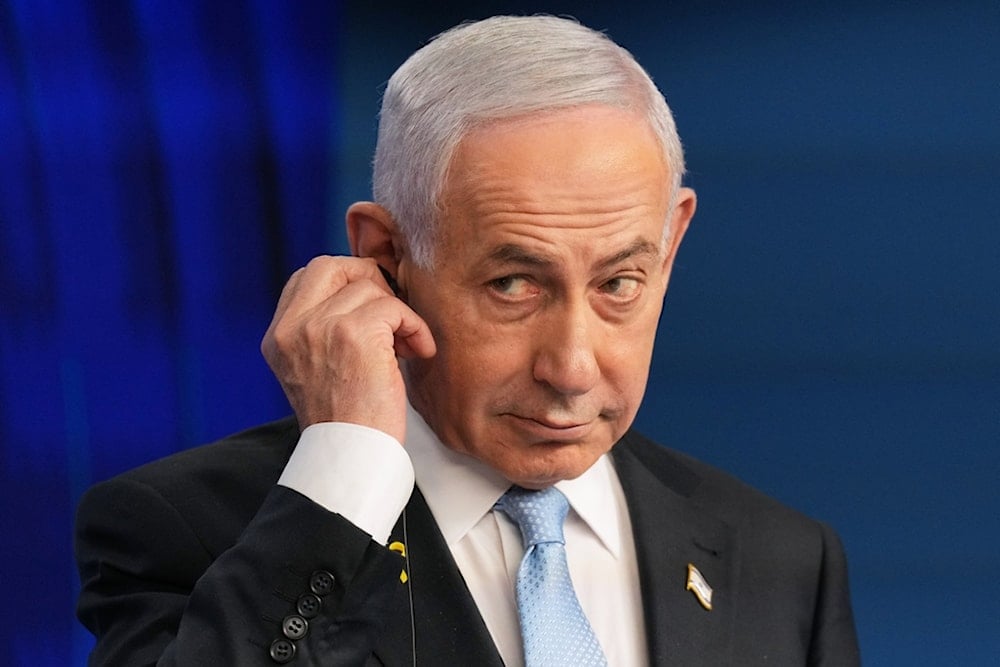
Israeli Prime Minister Benjamin Netanyahu adjusts the headphones during a joint press conference with German Chancellor Friedrich Merz in occupied al-Quds Sunday, December 7, 2025. (AP)
An opinion poll conducted following the announcement of the temporary ceasefire between the US and Iran revealed a major collapse in the occupation's political balance, particularly a steep decline in support for Benjamin Netanyahu's right-wing bloc.
According to the poll, Likud remains the largest parliamentary party, but lost three seats, dropping to 25, and consequently dropped Netanyahu's political camp down to 51 seats overall, reflecting its weakening position within the current electoral map.
Opposition gains momentum
In contrast to the decline in the ruling bloc, several opposition parties recorded gains.
The Yashar party, led by Gadi Eisenkot, saw a notable rise up to 14 seats. Naftali Bennett maintained a stable position with 19 seats, while Yair Golan’s Democrats strengthened their standing with 11 seats.
At the same time, Yesh Atid, led by Yair Lapid, saw a continued decline, falling to just 6 seats, marking one of its weakest performances in recent polling trends.
The poll also examined potential outcomes for Arab political representation. The Hadash-Ta’al alliance secured 5 seats, as did the United Arab List, while Balad failed to pass the electoral threshold.
According to the poll, a unified Arab list could increase representation to 12 seats. Such a development would further reduce Netanyahu’s governing camp to 50 seats.
Almost 60% think Israeli-US war on Iran failed
The poll also highlighted widespread public dissatisfaction regarding the ceasefire decision and the outcome of the confrontation with Iran.
A majority of respondents (56%) opposed the ceasefire agreement, expressing a preference for continued military aggression. Additionally, 58% believed that “Israel” and the United States failed to achieve a decisive victory in the war.
In contrast, only 25% of respondents said the decision to halt the aggression was correct or achieved the intended deterrence objectives.
Trust gap between military and political leadership
Furthermore, a clear divergence emerged between public trust in military leadership and political decision-makers.
The poll found that 69% of respondents believed the Chief of Staff managed the aggression effectively, while 57% expressed confidence in the head of Mossad.
However, political leadership received significantly lower approval ratings. Around 52% of respondents rated the performance of War Minister Israeli Katz as poor, while nearly half of those surveyed said Netanyahu’s performance did not meet the demands of the situation on the ground.
Amid losses, political future obscure
The overall results suggest a fragmented and increasingly unstable parliamentary landscape, with no clear majority emerging under current projections. The decline of Netanyahu’s bloc, combined with the rise of opposition parties and shifting voter sentiment, points to a deepening political crisis.
At the same time, commentary cited in Israeli media assessed that the outcomes of the war on Iran indicate Iranian strategic advantage, noting that prolonged aggression and extensive destruction concluded without a decisive result for “Israel” and the United States, and instead ended in an agreement slammed as a strategic setback.
Read more: War on Iran, Lebanon cost 'Israel' $17.5bln in 40 days: Israeli media


