
Recap of 'Israel's' aggression on Lebanon since Monday
 4 Min Read
Israeli warplanes launched widespread strikes on Beirut's Southern Suburb, southern Lebanon, and the Bekaa since Monday, killing 52 civilians and wounding 154.
-
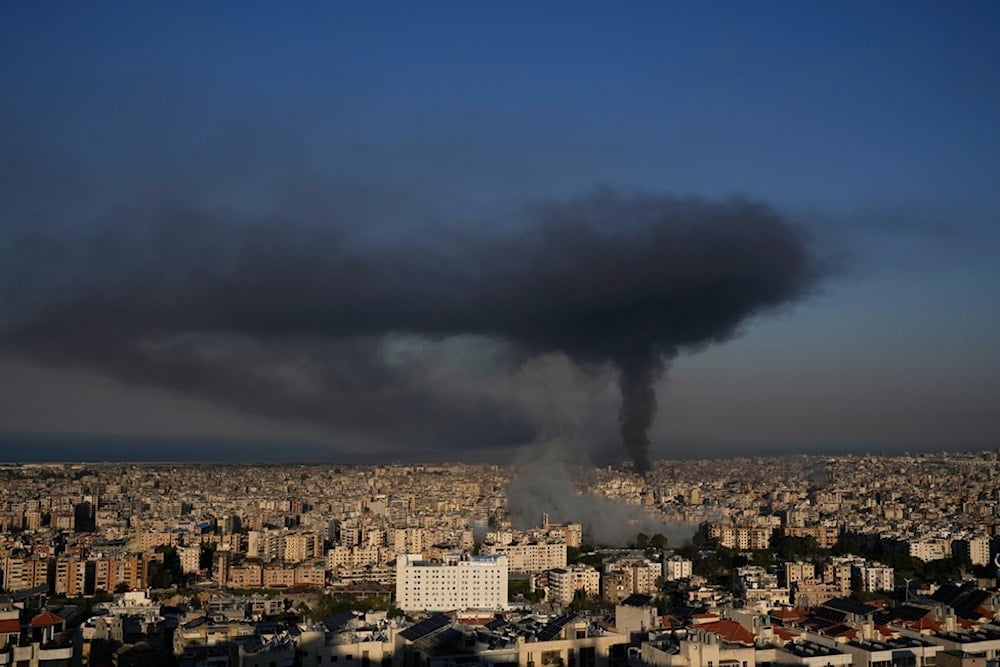
Smoke rises from Israeli airstrikes in Dahiyeh, a southern suburb of Beirut, Lebanon, Tuesday, March 3, 2026. (AP Photo/Hussein Malla)
"Israel" began its latest escalation on Lebanon during the early hours of Monday, March 2, when Israeli occupation forces launched extensive airstrikes targeting Beirut’s Southern Suburb (Dahye) and southern Lebanon.
At approximately 03:30 a.m., Israeli warplanes carried out an hour-long wave of strikes on densely populated neighborhoods in Haret Hreik, Al-Jamous, and areas near Beirut International Airport, hitting residential buildings in the Southern Suburb.
"Israel" is attempting to frame its escalation as due to the Resistance's retaliation on Sunday, but the aggression is unfolding after 15 months of Israeli violations that Lebanese authorities and UNIFIL say have surpassed 15,400 breaches since the ceasefire took effect, with hundreds killed by "Israel" in the past year.
WATCH | Aftermath of Israeli aggression on the Southern Suburb of #Beirut.#Lebanon pic.twitter.com/gTIx80gdCr
— Al Mayadeen English (@MayadeenEnglish) March 2, 2026
Border towns targeted
By 05:00 a.m., the aggression had expanded across southern Lebanon. Airstrikes hit residential areas in al-Shahabiya (Tyre District) and al-Sultaniyah (Bint Jbeil District), where civilians were reported killed. Raids also struck Qalaway, Nabatieh, Adshit, Harouf, Toul, and al-Kfour, broadening the scope of the bombardment.
Along the southern border, Israeli forces targeted homes and surrounding areas in Yaroun, Aitaroun, and Khiam, as intense artillery shelling pounded border regions. An Israeli Apache helicopter fired on Yaroun, while a drone strike targeted the center of Mays al-Jabal. Simultaneously, Israeli warplanes conducted low-altitude flights over northern and western Bekaa, reinforcing fears of a wider theater of operations.
Israeli authorities also issued threats to dozens of additional towns across the South and Bekaa, signaling potential further escalation.
Morning Assault Spreads
As morning progressed, the assault intensified across Tyre District. Israeli warplanes targeted Qana, Hallousia, Mahrouneh, and Aiteet, followed by raids on Ain Qana (twice), Kounin, Arab Salim, Mansouri, Srifa, Burj al-Shamali, and Wadi Jilo, among other towns. Strikes also hit areas between al-Taybeh and al-Qantara, while Hadatha in Bint Jbeil District came under fire.
By mid-morning, the Lebanese Ministry of Public Health reported a preliminary toll of 31 martyrs and 149 wounded, warning the number could rise as search-and-rescue operations continued and hospitals completed damage assessments.
The renewed escalation follows intensified Israeli air raids on Iqlim al-Tuffah heights, the al-Rayhan heights, and the Barghaz Valley days earlier, underscoring the continuation of Israeli air operations despite the ceasefire framework.
Media targeted
The raids persisted throughout the day and into the night. On Monday evening, Israeli occupation forces fired six missiles at a building facing Al Mayadeen’s headquarters in Jnah, carried out five air raids on the Manshiyeh neighborhood in Beirut’s Southern Suburb, leveling three buildings completely, and struck branches of Al-Qard Al-Hassan Association.
Overnight strikes also targeted Al-Manar TV headquarters, Al-Nour Radio, and another building in Haret Hreik, expanding the scope of attacks to include Lebanese media institutions.
Lebanese Government measures
Amid the continued Israeli assault, Prime Minister Nawaf Salam announced that the Cabinet had approved measures, including an immediate prohibition on Hezbollah’s military and security activities and steps reinforcing the state’s monopoly over arms. Salam said the decisions were taken "in accordance with the Constitution, the National Reconciliation Document, and the government’s ministerial statement."
The Council of Ministers condemned rocket fire from Lebanese territory and called on the United States and France — guarantors of the ceasefire — to press "Israel" to halt its attacks.
Hezbollah MP Mohammad Raad criticized the government’s posture during the aggression, saying: "We understand the Lebanese government’s inability to confront the brutal Zionist enemy that violates national sovereignty, occupies land, and poses a continuous threat to the country’s security and stability." He added there was "no justification" for targeting citizens who reject occupation while the aggression continues.
Latest toll
According to the latest official update issued Monday night by Lebanon’s Disaster Management Unit, the Israeli aggression has killed 52 Lebanese civilians and wounded 154 others, with at least 28,500 displaced.
Read more: Hezbollah: Ongoing Israeli aggression cannot go unanswered


