
Renewed US strikes on Iran violate June memorandum: Lavrov
 4 Min Read
Russia's FM says renewed US strikes on Iran violate the June memorandum, damage civilian infrastructure across the region, and undermine prospects for a political settlement.
-
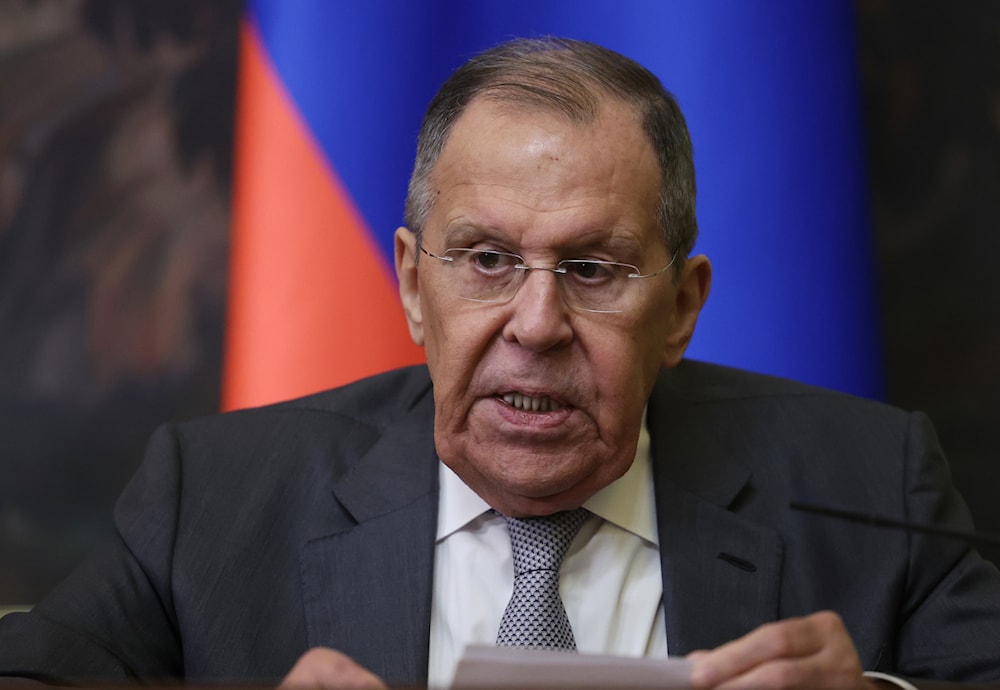
Russian Foreign Minister Sergey Lavrov speaks at a joint press conference with his Chadian Foreign Minister Abdoulaye Sabre Fadoul during their meeting at Zinaida Morozova's Mansion in Moscow, Russia, Tuesday, July 14, 2026 (AP)
Washington’s renewed attacks on Iran constitute a violation of the memorandum of understanding signed in June and have undermined the diplomatic path opened by the agreement, Russian Foreign Minister Sergey Lavrov said on Tuesday.
Speaking at a joint news conference after meeting Chadian Foreign Minister Abdoulaye Sabre Fadoul, Lavrov said the consequences of the US escalation were extending beyond Iran, with civilian infrastructure across the Gulf also suffering damage.
"We consider it a violation of the memorandum. There is not even much to comment on here, it is sad. Because both the civilian infrastructure in Iran and the civilian infrastructure in the Arab Gulf Cooperation Council countries are suffering. And most importantly, this does not lead to a settlement, but rather closes the door that the aforementioned memorandum seemed to open," Lavrov said.
Washington abandons June commitments
Iran and the United States signed the Islamabad Memorandum of Understanding on June 17, formalizing the cessation of hostilities and establishing an extendable 60-day period for negotiations toward a more comprehensive settlement.
The framework included an end to direct military operations, arrangements for commercial navigation through the Strait of Hormuz, the termination of the US blockade on Iranian shipping, and limited economic measures involving Iranian oil exports and restricted assets.
Tehran has maintained from the outset that its commitments under the memorandum were conditional on reciprocal US implementation. Iranian officials have repeatedly stressed that the agreement was founded on mutual obligations rather than unilateral Iranian concessions.
According to Iran, Washington began undermining the understanding by failing to fulfill its economic commitments, challenging the memorandum’s provisions concerning navigation through Hormuz and resuming attacks on Iranian territory.
Iran’s Foreign Ministry has described those actions as a structural breach of the agreement, arguing that repeated US violations relieved Tehran of any obligation to continue implementing its own commitments without a corresponding American response.
The dispute intensified after US President Donald Trump declared the cessation of hostilities over, accused Iran of attacking commercial vessels, and ordered new strikes against Iranian territory.
Trump subsequently announced the reinstatement of the blockade on Iranian ports and claimed that Washington would assume responsibility for controlling passage through the Strait of Hormuz, despite provisions in the memorandum recognizing an Iranian role in arranging safe commercial navigation through the strategic waterway.
Tehran rejected Washington’s account, saying the United States was attempting to impose an interpretation that contradicted the memorandum’s explicit language and to secure through military force concessions it had failed to obtain during negotiations.
Iran invokes right to reciprocal response
Iran has characterized its subsequent military operations as defensive and reciprocal measures taken after the United States resumed attacks.
Tehran has also stressed that its operations against American military positions located in regional countries are directed at US forces and infrastructure involved in the attacks on Iran, rather than at the states hosting those facilities.
Iranian officials have warned that Washington’s use of military bases, airspace and regional infrastructure to conduct attacks inevitably exposes those facilities to legitimate retaliation, placing responsibility for the widening confrontation on the United States.
In a letter to the United Nations Security Council, Iran documented repeated American violations of the memorandum, including US Central Command strikes against dozens of targets on July 7 and July 8. Tehran said the latter attacks killed 17 people and wounded 115 others, including civilians.
Iran’s Foreign Ministry has said that every American violation will be met with a proportionate response, rejecting attempts to portray Tehran’s measures as the starting point of the renewed escalation.
Read more: Iran condemns latest US attacks, warns countries aiding aggression


