
Reopening Hormuz contingent on circumstances, Iran conditions: Baghaei
 4 Min Read
Tehran says the Mecca pact reflects regional efforts to strengthen collective security without relying on Washington, while rejecting fears it is directed against Iran.
-
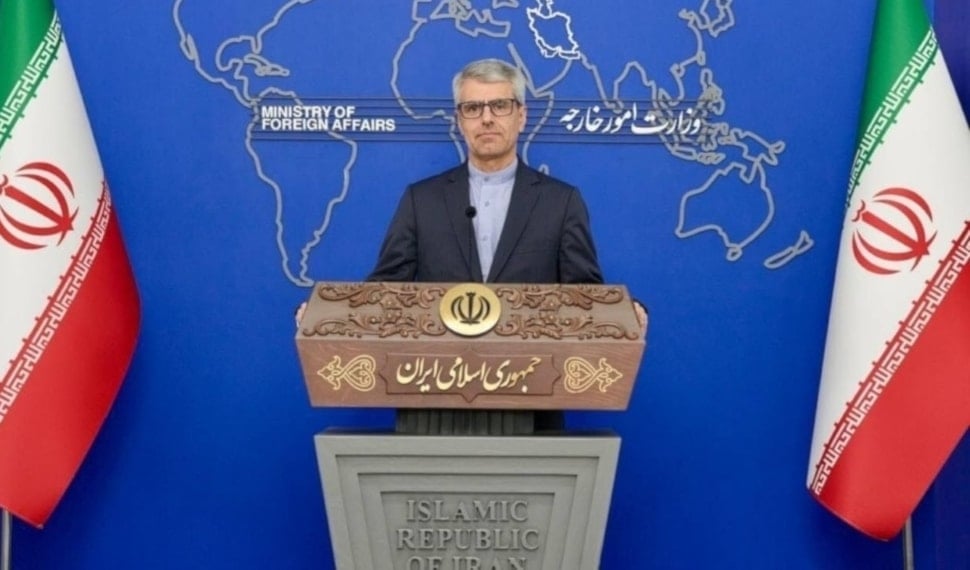
An undated image of Iranian Foreign Ministry spokesperson Esmaeil Baghaei (IRNA)
Iran has rejected foreign meddling in the region, arguing that the Mecca Joint Defense Agreement between Türkiye, Pakistan and Saudi Arabia reflects growing regional unease with relying on Washington for security guarantees.
Speaking at a press conference, Foreign Ministry spokesperson Esmaeil Baghaei said the Mecca Joint Defense Agreement stems from the realization among regional countries that achieving security through the United States is no longer possible, calling on countries in the region to strengthen relations, trust and security “without external players.”
'Israel greatest threat to regional security'
Baghaei argued that regional countries have, particularly since the start of the genocide in Gaza and Israeli attacks three years ago, increasingly recognized the source of the greatest threat to stability and security in the region and beyond, especially since “the expansionist policies of the Zionist entity have become clear, public and exposed.”
He pointed to the Israeli aggressions on Lebanon, Palestine, and Syria, as well as its threats against other countries in the region, highlighting that such developments have strengthened the understanding that regional states can no longer rely on the US claims to provide security.
The Iranian spokesman also said the United States itself has contributed to insecurity in the region, arguing that "Israel" could not have carried out its actions without American support.
He stressed Iran’s view that regional security is indivisible, saying that any initiative that correctly identifies the enemy and the threat could contribute to strengthening peace and security.
Iran rejects foreign meddling in West Asia
Addressing concerns that the agreement could be aimed at Tehran, Baghaei dismissed the notion, saying there was no basis for viewing the Türkiye-Saudi Arabia-Pakistan defense pact as directed against Iran.
The Iranian diplomat also reiterated his country’s opposition to allowing the territories of neighboring states to be used as a launchpad for aggression against Iran, adding, “Iran rejects foreign meddling in the region.”
He stressed, “We have demonstrated to the world that our participation in international treaties is based on our national interests.”
Tehran dismisses fears the Mecca pact targets Iran
Regarding the Strait of Hormuz, the Iranian Foreign Ministry spokesperson said closing the strait was “natural” to prevent it from being exploited in any aggression on Iran, explaining that “the reopening of the Strait of Hormuz is linked to the circumstances and Iran’s conditions, and as long as the war continues, we will not allow passage through the strait.”
Regarding ongoing consultations with Oman on the matter, Baghaei said the talks had not addressed the issue of fees, but added, “It is only natural to charge fees in return for services.”
Iran prioritizes Strait of Hormuz amid ongoing US aggression
Noting that negotiations with Oman were examining the designation of a navigation route through the Strait of Hormuz, he stressed that “the southern route of the Strait of Hormuz is not safe.”
“The goal of the talks with Oman is to reach a temporary route through the Strait of Hormuz," he continued.
Baghaei also reiterated that Tehran is currently focused on the Strait of Hormuz rather than resuming the course of talks with the United States.
Iran and Oman have been holding talks for around two months on the joint management of navigation through the Strait of Hormuz, being two countries bordering the strait, while Tehran rejects the involvement of any third party or the opening of a passage without coordination with Iran.
The talks cover issues related to the sovereignty of coastal states and ensuring their security, future arrangements for managing the strait, establishing a joint coordination center between Iran and Oman to manage maritime traffic, and obtaining the necessary information from vessels crossing the Strait of Hormuz between the Gulf of Oman and the Gulf, and vice versa.
On domestic affairs, the Iranian spokesperson said Iran’s decision-making process involves multiple institutions, stressing that they operate in full coordination.


