
Fidan: Mecca defense pact does not target Iran
 3 Min Read
Turkey says its defense pact with Saudi Arabia and Pakistan is not directed at Iran, while outlining plans for collective defense, technology cooperation, and Red Sea security.
-
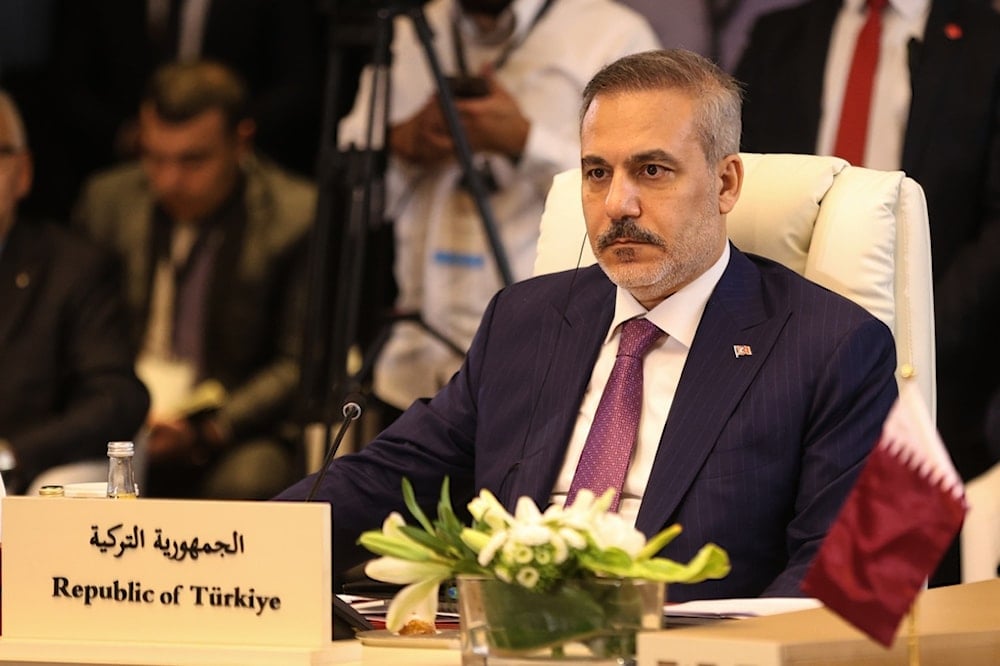
Turkish Foreign Minister Hakan Fidan attends the Ministerial Meeting in Support of Jerusalem and Its Holy Sites in Amman, Jordan, Wednesday, Aug. 5, 2026. (AP Photo/Raad Adayleh)
Turkish Foreign Minister Hakan Fidan said the “defense agreement,” formally known as the Mecca Joint Defense Agreement, does not target Iran and that no country would be considered a target unless it attacks one of the member states.
“The defense agreement does not target Iran, and no one is considered a target as long as they do not attack the member states,” Fidan said.
He added that the agreement between Turkey, Pakistan, and Saudi Arabia is technically similar to Article 5 of NATO, which establishes a collective defense framework among alliance members.
Fidan said the agreement will include a ministerial committee modeled on NATO's structure, alongside a general secretariat.
He identified defense industry and technology cooperation as the agreement's most important component, signaling that the arrangement is intended to extend beyond conventional military coordination.
Read more: Paper won't bring you security: Iranian official to Saudi Arabia
Egypt could join defense agreement
Fidan said Egypt could join the defense agreement once certain technical issues are resolved.
He also addressed maritime security in the Red Sea, saying that the issue directly affects Turkey's interests.
“Red Sea maritime security affects our interests, so Turkey should be part of the international coalition led by Saudi Arabia,” Fidan said.
According to the Turkish foreign minister, negotiations over the defense agreement have been ongoing for two years and eight months with partner countries and regional states with which Turkey has concluded agreements.
The comments come as Ankara seeks to position the new defense framework within a broader regional security architecture, while emphasizing that the arrangement is not directed against Iran.
Riyadh, Ankara, Islamabad deepen defense coordination
Saudi Arabia, Turkey, and Pakistan announced the signing of the “Mecca Joint Defense Agreement” in a joint statement on Friday.
The three countries said the agreement reflects their commitment to continuing to strengthen collective security and is intended to reinforce collective deterrence against hostile action.
The announcement represents a significant step in defense cooperation among the three states, bringing together Saudi Arabia's strategic position in the Gulf and Red Sea, Turkey's military and defense-industrial capabilities, and Pakistan's armed forces and longstanding security partnerships.
The agreement's stated focus on collective deterrence, defense technology, and military cooperation comes amid broader efforts by regional states to develop security mechanisms outside traditional alliance structures.
Turkish President Recep Tayyip Erdogan had previously said the agreement does not target any country and remains open to other “brotherly” states.
Fidan's remarks similarly seek to distinguish the agreement's collective-defense provisions from an explicitly anti-Iran framework, while leaving open the possibility of additional regional members.


