
Residents, press lay Amal Khalil to rest in her hometown of Baisariyeh
 3 Min Read
Colleagues, companions, and family members of martyred journalist Amal Khalil lay her to rest in her hometown of Baisariyeh in southern Lebanon, following her martyrdom in an Israeli attack on the town of al-Tiri.
-
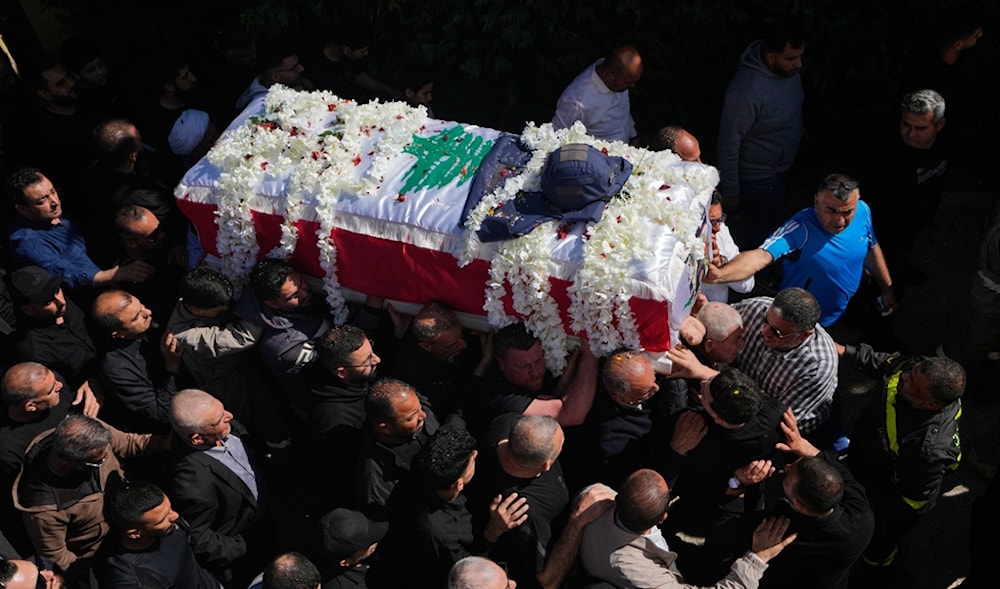
Mourners carry the coffin of Lebanese journalist Amal Khalil, who was killed Wednesday in an Israeli airstrike, during her funeral procession in the village of Baysariyeh in southern Lebanon, April 23, 2026. (AP)
The funeral procession of Al-Akhbar's martyred journalist Amal Khalil set off on Thursday afternoon from her family home in the town of Baisariyeh, in the Saida district of southern Lebanon.
Mourners filled the town’s streets, carrying the martyr’s coffin on their shoulders, raising slogans condemning her assassination at the hands of the Israeli occupation, and honoring her professionalism and courage in documenting the realities of the wide-scale Israeli aggression against the country.
The funeral was attended by official figures, fellow journalists, and large crowds of residents, who accompanied the martyr to her final resting place in her hometown of Baisariyeh.
Numerous official figures offered condolences for the martyred journalist, led by Lebanese President Joseph Aoun and Speaker of Parliament Nabih Berri, alongside statements of condemnation and condolences issued by Hezbollah’s Media Relations Office, the media office of the Amal Movement, and other groups.
Long known as the “Correspondent of the South,” Amal Khalil was a veteran field journalist and a courageous voice who dedicated her pen and lens to documenting the steadfastness of border villages, refusing to yield to direct threats from the occupation.
#بالفيديو | وصول جثمان الشهيدة الصحافية آمال خليل إلى منزلها في بلدة البيسارية، جنوب لبنان.#الميادين_لبنان #لبنان pic.twitter.com/b430ChUSNB
— الميادين لبنان (@mayadeenlebanon) April 23, 2026
'Israel' systematically pursued Amal until her martyrdom
On April 22, Amal Khalil was martyred in an Israeli assassination in the southern town of al-Tiri while fulfilling her journalistic duty, during the 10-day ceasefire in Lebanon.
The sequence of events on Wednesday afternoon reveals the intentionality of the attack.
At 2:45 pm, an Israeli drone bombed a civilian vehicle travelling ahead of Khalil and her colleague, journalist Zeinab Faraj. The two journalists immediately sought shelter near a tree, while emergency contacts were made with Red Cross teams and Lebanese army intelligence.
At 2:50 pm, Khalil called colleagues to tell them she was hiding from the bombardment.
At approximately 4:00 pm, a second drone bombed the journalists' car directly. The two women then moved to take shelter inside a nearby house, still waiting for the Red Cross, which had not yet received authorization to move into the area. Israeli occupation forces had refused to grant access and had also requested that UNIFIL forces avoid the Haddatha–Bint Jbeil road.
At 4:27 pm, Israeli warplanes bombed the house. Contact with Amal Khalil was lost at that moment.
The Red Cross received permission to move only ten minutes after the attack, permission withheld for hours while Khalil waited under bombardment and rubble.
When ambulances did arrive, Israeli forces fired on them and threw a stun grenade at a Red Cross vehicle, preventing rescue teams from reaching the site. Zeinab Faraj, wounded, and the bodies of two martyrs were transported to Tebnine Governmental Hospital.
Excavation teams worked to locate Khalil beneath the rubble. Her colleague Zeinab Faraj confirmed she had been in the house just minutes before the strike. Civil defense sources identified her location on the ground floor of the collapsed structure. She was later confirmed martyred.
Read more: Hezbollah responds to al-Tiri aggression, strikes Israeli gatherings


