
Rezaei: Iran's tactics may unveil 'third dimension' to conflict
 3 Min Read
Senior Iranian official Mohsen Rezaei says Iran will force the US to end its naval blockade, through talks or force, and warns a "third dimension" of Tehran's military power has yet to be revealed.
-
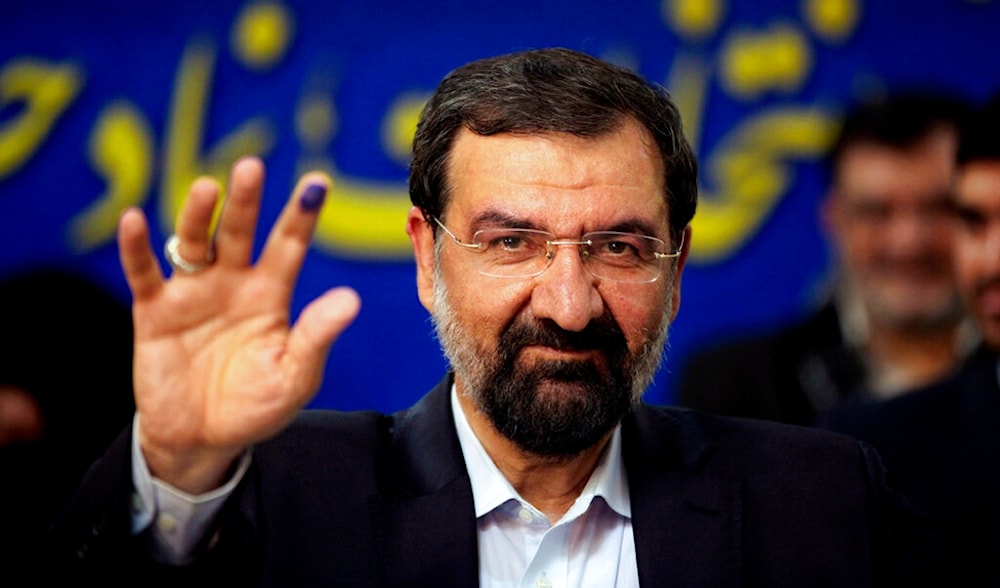
Mohsen Rezaei waves to reporters after registering as a presidential candidate, in Tehran, Iran, May 10, 2013. (AP Photo/Vahid Salemi, File)
Major General Mohsen Rezaei, a member of Iran's Expediency Discernment Council, said the political doctrine underpinning US President Donald Trump and Israeli Prime Minister Benjamin Netanyahu's approach is rooted fundamentally in a drive to bring down the Islamic Republic and impose a new regional order.
Speaking to China's CGTN, Rezaei argued that ambitions to establish such "new orders" will not materialize so long as Iran remains standing. He linked efforts to dominate the region's oil and gas resources to a broader strategy of manipulating the global economy and exerting pressure on China and Russia, a tactic, he said, Trump had previously tested in Venezuela.
On Israeli objectives, Rezaei said Tel Aviv seeks to occupy vast swaths of territory, including southern Syria, southern Lebanon, and parts of Jordan and Iraq, while Trump's ambitions center on the seizure of the region's energy resources.
In response to these ambitions, Rezaei called on countries across the region to forge a unified bloc that would emerge as the world's fifth major power, one capable, he said, of guaranteeing security and advancing a just global order.
Rezaei: Asymmetric warfare will force Washington to lift blockade
On the Strait of Hormuz, Rezaei confirmed that the waterway remains firmly closed to military operations and "foreign exploitation," while staying open for trade, above all for friendly countries.
He stressed that Tehran's wartime approach is grounded in asymmetric warfare, citing the effectiveness of Iran's low-cost drone capabilities against their far more expensive US counterparts as evidence of an inherent strategic advantage.
Rezaei said Iran had demonstrated exceptional military capacity during the "12-day war" and the "Ramadan War," and warned that Tehran would unveil a "third dimension" to its operations should the conflict continue, enabled, he said, by "the inherent flexibility embedded" in its combat doctrine.
'A dark tunnel for the United States'
On the naval blockade, Rezaei vowed that Iran would compel the United States to bring it to an end, whether through negotiations or, if the situation drags on, through direct military action.
He explained that a prolonged war was a "dark tunnel" for Washington, and said the US had no viable option but to return to the table.
Rezaei closed by stating that Iran, having successfully weathered sanctions for more than two decades, is carefully tracking every move made by its adversaries, and that its course in the current confrontation remains unambiguous.
Ghalibaf: Concessions come from missiles, not negotiations
Rezaei's remarks come alongside hardening rhetoric from other senior Iranian officials as indirect talks with the United States continue. Parliament Speaker and lead negotiator Mohammad Bagher Ghalibaf outlined three core principles guiding Tehran's negotiating stance in a recent social media post.
"We do not obtain concessions through negotiations. We obtain them with our missiles. Negotiations only make them understand that," Ghalibaf wrote.
He added that Iran places no trust in guarantees or promises, only in actions, and would not take any step before the other side moves first. "The winner of any agreement is the one who is better prepared for war the next day," he said.


