
Rodríguez leads aid efforts; Venezuelans demand president's return
 3 Min Read
Interim President Delcy Rodríguez launches recovery plans in Caracas following US military aggression that led to the abduction of President Nicolas Maduro.
-
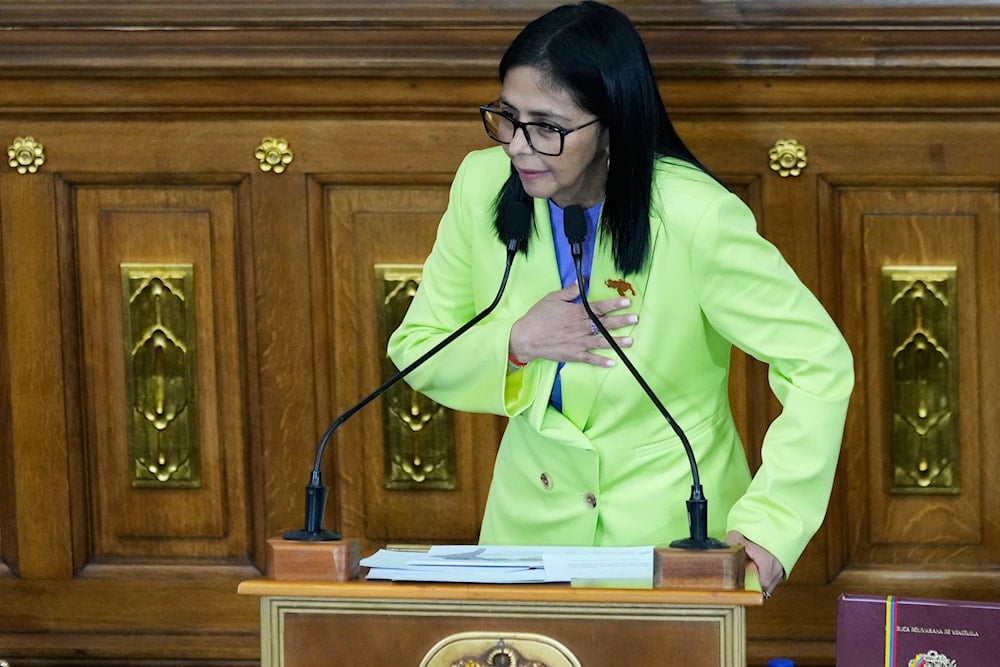
Venezuela's interim President Delcy Rodriguez addresses the National Assembly in Caracas, Venezuela, Thursday, Jan. 15, 2026 (AP)
Interim Venezuelan President Delcy Rodríguez led a comprehensive social aid tour in the Fort Tiuna area of Caracas, supervising the rehabilitation of areas affected by the US aggression against Venezuela on January 3, 2026.
During the tour, Rodríguez announced the establishment of two sovereign funds. The first, aimed at social protection, is designed to channel revenues from oil and gas production to support workers’ income and programs in health, food, education, and housing. The second fund will focus on public services and infrastructure, including water, gas, electricity, and road networks.
Rodríguez reported that more than 463 residential apartments were damaged in the US military aggression and confirmed that immediate instructions had been issued to begin repairs. The measures include providing mobile pharmacies, establishing a rehabilitation center, and distributing food supplies to families in areas destroyed during the bombardment.
US extremism, imperialism aim to divide Venezuelans
While leading the social aid initiative in Fort Tiuna, Rodríguez criticized what she described as the combination of "extremism" and "imperialism" aimed at dividing Venezuelans, urging citizens to maintain calm and strategic caution while continuing to set an example of resistance and struggle.
She stated, “The call is to remain united. Both external enemies and internal extremism seek to divide our people. The best response is calm, patience, and strategic vigilance. Let the people of Simón Bolívar continue to set historical examples of overcoming hardships.”
Venezuelans demand their president's release
Meanwhile, thousands of Venezuelans marched across the country to denounce the US operation as an act of aggression and a violation of international law, calling for the immediate release of Venezuelan President Nicolas Maduro and First Lady Cilia Flores.
The demonstrations, organized by various sectors of Venezuelan society, reaffirmed the nation’s commitment to peace while expressing widespread outrage at the US siege. Participants pledged to continue building the homeland under the principles of the Bolivarian Revolution and the legacies of Simón Bolívar, Commander Hugo Chávez, and President Maduro, maintained by the government now led by interim President Delcy Rodríguez.
Venezuelans also paid tribute to the military heroes and civilians who died on January 3 defending the country or as victims of the attacks.
As part of the national Bolivarian movement, social organizations held a swearing-in ceremony on Saturday, pledging to defend peace and stability and to continue the struggle for the liberation of President Maduro and Cilia Flores. The ceremony, led by Héctor Rodríguez, secretary of Social Movements of the United Socialist Party of Venezuela (PSUV), took place in front of the National Pantheon in Caracas. He called for the unification of all social movements to establish a political roadmap aimed at “building the country we dream of.”
Héctor Rodríguez outlined an intensive agenda for the next 60 days to maintain “the banner of dignity, peace, and sovereignty” and to foster collective awareness, unity, and reconciliation among Venezuelans.
The plan includes nationwide mobilizations and public engagement in the lead-up to the upcoming federal court proceedings against President Maduro and his wife in New York.


