
Trump’s Venezuela oil gamble collides with industry doubts, glut
 4 Min Read
Despite holding the world’s largest oil reserves, Venezuela offers more risk than reward for Trump’s energy dominance agenda, as US oil companies hesitate to invest.
-
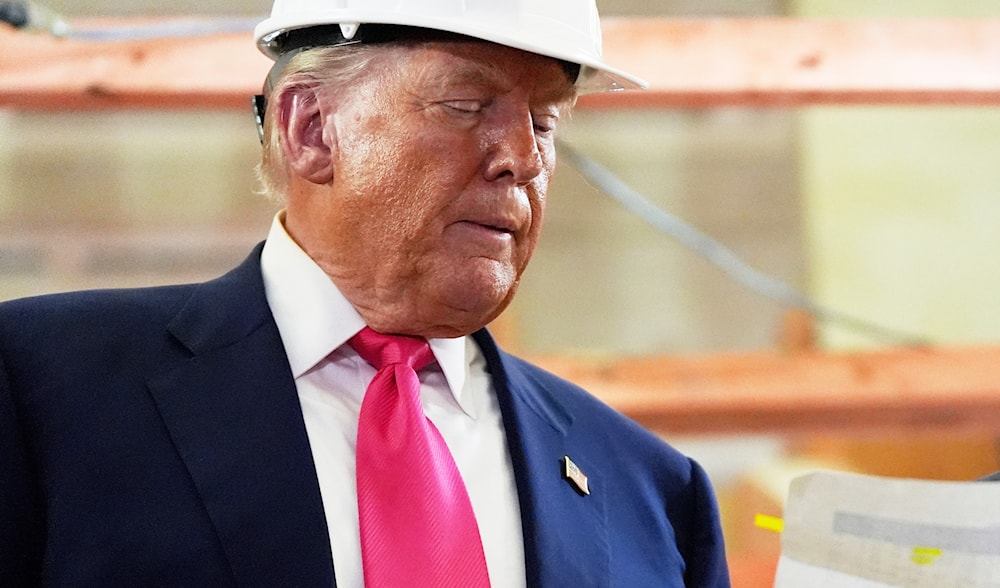
President Donald Trump looks over a document of cost figures during a visit to the Federal Reserve, July 24, 2025, in Washington (AP)
US President Donald Trump’s grand ambitions to wrangle Venezuela’s vast oil reserves in the name of “energy dominance” are running headfirst into reality, The New York Times reported.
This stands as clear proof that turning bold slogans into actual barrels of oil is a lot harder than posting about it.
Despite Venezuela holding the world’s largest oil reserves, production is only about 1 percent of the global supply due to years of sanctions and mismanagement. Trump has said US companies will invest billions to rehabilitate infrastructure and boost output, but analysts warn this process could take years, and major American oil companies have shown reluctance to commit.
At a White House meeting with energy executives, Exxon Mobil’s chief executive described Venezuela as “uninvestable” and declined to promise major spending. Trump criticized the company’s response on Air Force One, saying it was “playing too cute” and adding, “I’d probably be inclined to keep Exxon out. I didn’t like their response.”
Other challenges stem from the US lacking a national oil company, like Russia or Saudi Arabia, that could execute government objectives. Analysts also question the strategic value of pursuing “energy dominance” in a global market already flush with oil. Cliff Kupchan, chairman of the Eurasia Group, told The New York Times, “Under Trump, the US status as the world’s largest petrostate is growing. In my view, it’s a bad bet.”
Geopolitical concerns add another layer of complexity. Kirill Dmitriev, head of Russia’s sovereign wealth fund, noted the potential for Washington to gain “huge market leverage” in oil trade, while Tong Zhao, a China analyst at the Carnegie Endowment for International Peace, told The New York Times that expanding US influence in Latin America could “enable the United States to cut off oil and other strategic resource supplies from the region to China at will.”
Trump's oil dreams stuck in the 80s
Trump’s fascination with Venezuelan oil has collided with the limits of presidential power and global market realities. His plan to seize control of Venezuela’s oil following the January 3 abduction of Nicolas Maduro has met skepticism from energy executives and analysts alike, who note that even the world’s largest oil producer struggles to turn ambition into barrels on the market.
US benchmark oil prices traded near $56 a barrel last week, close to a five-year low, highlighting a global oversupply that makes Trump’s “take the oil” approach less urgent. “1973 is long gone,” said Amy Myers Jaffe, an energy and geopolitics scholar at New York University.
“Oil is not our Achilles’ heel anymore.” The United States now produces more oil than ever, and much of its economy relies on alternative energy sources.
Yet Trump’s view of oil as a geopolitical lever is decades in the making, dating back to his 1987 book Art of the Deal, where he described the 1973 oil embargo as devastating to US airlines. After returning to the White House, he formed a National Energy Dominance Council to reduce “our dependency on foreign imports.”
Trump could face resistance from the Gulf
Analysts say the Venezuelan opportunity is more complicated than Trump suggests. Meghan L. O’Sullivan of Harvard warned that while control over Venezuelan oil could curb OPEC’s influence, Trump still faces resistance from Gulf producers who might refuse to increase output if US actions trigger instability.
Tong Zhao, a China analyst at Carnegie, noted to the NYT that China is wary of expanding US influence in Latin America, especially given the volatility in Iran. Cliff Kupchan of Eurasia Group added that the administration risks losing focus on the global transition to electricity-based technologies, where China dominates.
“Trump’s not wrong that there’s some leverage to be derived from Venezuelan, Iranian oil,” Kupchan said. “What’s important, though, is that the trade-off is really severe.”


