
Satellite imagery confirms damage at Yanbu oil facilities
 3 Min Read
Satellite and thermal data confirm fire damage at Saudi Aramco's Yanbu oil facilities after Yemeni strikes, despite Saudi's reports of a missile interception.
-
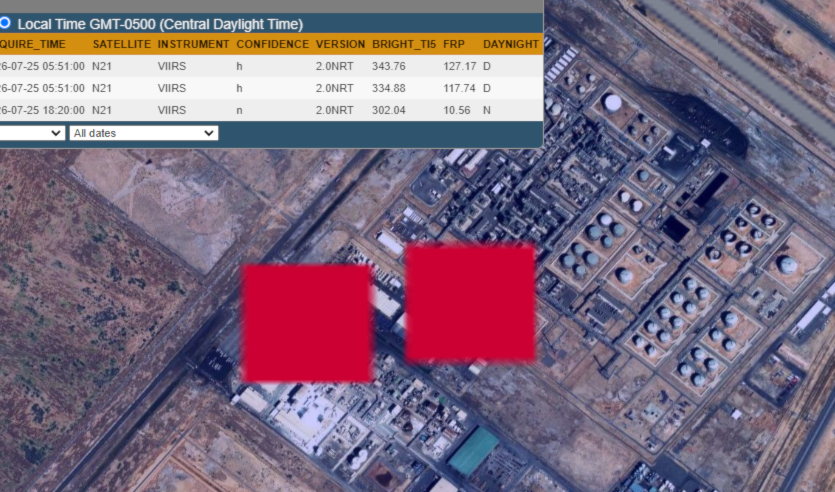
NASA FIRMS satellite data shows two thermal hotspots detected at the Alhamrani-Fuchs Blending & Grease Plant in Yanbu on Saturday, July 25, with Fire Radiative Power readings of 127.17MW and 117.74MW. (Source: @bonzerbarry via X)
Satellite imagery captured Monday reveals extensive damage at Saudi Aramco's Yanbu oil infrastructure on the Red Sea coast, following Yemeni strikes over the weekend.
Burn scars are visible around an Aramco spherical storage tank at the Yanbu Bulk Plant (23.954322, 38.304607), pointing to damage at the site. Nearby, the Alhamrani-Fuchs Blending & Grease Plant in Yanbu Industrial City appears to have sustained far heavier damage, with much of the facility seemingly destroyed by fire.
🛰️ 🇸🇦 Satellite imagery captured yesterday shows the possible aftermath of the Houthis' strikes on Saudi Arabia's Yanbu oil infrastructure along the Red Sea.
— Egypt's Intel Observer (@EGYOSINT) July 28, 2026
Visible burn scars are evident around a Saudi Aramco spherical storage tank at the Yanbu Bulk Plant (23.954322,… pic.twitter.com/HxU27hXzQM
The Yemeni Armed Forces' spokesperson, Brigadier General Yahya Saree, announced on Saturday that Sana'a carried out two attacks against Saudi assets in response to Riyadh's “blatant and criminal" aggression.
The first operation targeted the Jizan facility using dozens of ballistic missiles and drones, and the second strike was against Aramco-affiliated facilities in Yanbu with ballistic and cruise missiles, as well as drones.
The Yemeni Armed Forces targeted the facilities in Yanbu again on Monday, stating that its fighters "struck several targets and critical points along the supply and transport routes for crude oil from eastern Saudi Arabia to Yanbu".
Thermal data rebukes Saudi narrative
A review of thermal anomaly data confirms two fires registering roughly 120MW each were recorded on both ends of the Alhamrani-Fuchs Blending & Grease Plant in Yanbu Industrial City on Saturday. No other thermal anomalies were logged at the site on any other day in July.
It looks like there were indeed impacts in Yanbu over the weekend. I went back and confirmed that there were two ~120MW fires registered on both ends of this Blending & Grease Plant on Saturday. No other thermal anomalies were recorded here during any of the other days in July. https://t.co/pOfsiTOo6P pic.twitter.com/ja4CB8YXML
— barry with the NED (@bonzerbarry) July 28, 2026
Notably, Greek security sources had confirmed to Reuters on Saturday that an air defence system operated by Greek military personnel in Saudi Arabia intercepted two ballistic missiles launched from Yemen, targeting the Yanbu refineries. Greece has operated a US-made Patriot battery in the kingdom since 2021 under an agreement to help protect its energy infrastructure.
Export capacity under pressure
The strikes have taken a visible toll on Saudi Arabia's export capacity. Yanbu's loading volumes have dropped nearly 40 percent since July 19, falling from roughly 5.16 million barrels per day to around 3.09 million bpd, according to Windward's analysis of Vortexa data.
Further South of Yanbu, Aramco shut its 400,000-bpd Jizan refinery on Tuesday after Saturday's strikes damaged its Integrated Gasification Combined Cycle complex and tank farm, triggering a fire that has burned since the attack; Aramco reportedly aims to restart operations by August 15.
Damage also reported at Abqaiq
On the other end of the Kingdom, satellite imagery from Monday also showed fire damage at Aramco's Abqaiq crude-processing facility following a drone strike, with NASA's FIRMS system recording multiple active hotspots.
OSINT accounts, citing Sentinel-2 imagery, reported burn scars across four of Abqaiq's six crude-processing spheroids, two of them apparently destroyed. Abqaiq processes an estimated 5 to 7 percent of global oil supply.
With Yanbu and Jizan damaged on the western end of the East-West Pipeline and Abqaiq hit on the eastern end, Saudi Arabia's Hormuz-bypass export route appears effectively severed.


