
Senior Iraqi politician al-Hakim says ties with Iran are deep
 14 Min Read
Sayyed Ammar al-Hakim says Iraq’s PMF restructuring aims at reform, not dissolution, stressing its role within state security while pushing for depoliticization.
-
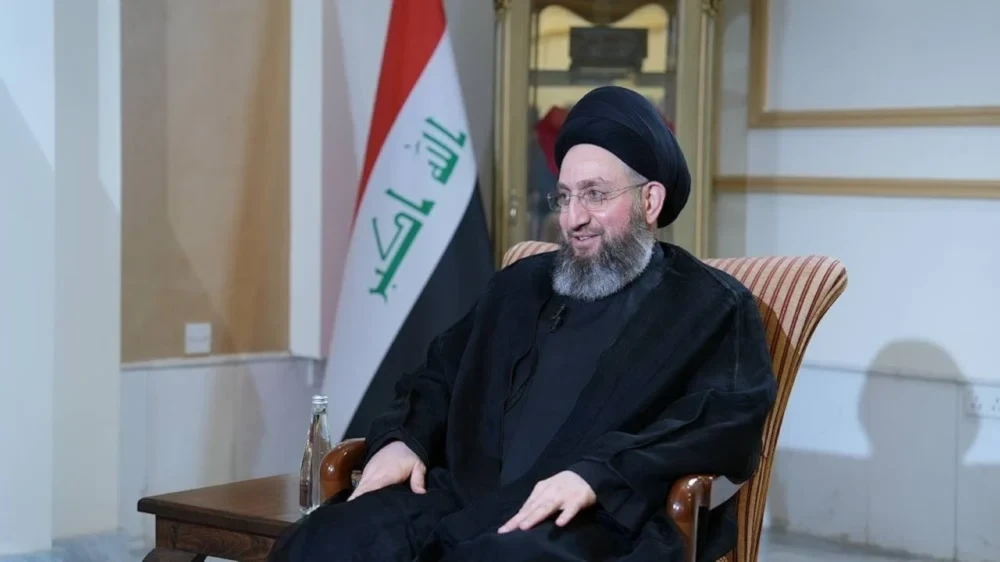
The leader of the Iraqi al-Hikma movement, Ammar al-Hakim, during an interview with Al Mayadeen that aired on July 6, 2026 (Al Mayadeen)
Iraqi political leader Sayyed Ammar al-Hakim has stressed that combating corruption, pursuing corrupt officials, and recovering stolen public funds remain a top national priority, saying the campaign enjoys broad political backing across Iraq’s leadership.
In an interview with Al Mayadeen, al-Hakim said the anti-corruption drive has received “full support” from political forces, including the Coordination Framework, while noting that leaders were not fully briefed on operational details such as timing, targets, or enforcement procedures.
He added that the initial hours of the campaign came as a surprise even to senior political figures before its broader outlines became clearer, describing the initiative as “positive and correct” and deserving continued support.
Call to focus on major corruption networks
Al-Hakim emphasized that any anti-corruption effort may involve procedural errors or complications, but said these should not be used as justification to obstruct the process.
He called for prioritizing “major corruption figures and networks,” arguing that focusing on smaller cases risks sending negative signals to the public and weakening confidence in reform efforts.
According to him, targeting senior-level corruption is essential to dismantling entrenched financial abuse within state institutions.
The Iraqi politician also highlighted the importance of respecting the principle that “an accused person is innocent until proven guilty,” stressing that arrest or investigation based on testimony does not constitute proof of guilt before a judicial ruling.
He criticized the publication of names and images of detainees before court verdicts, warning that premature media labeling could undermine judicial integrity and contribute to public judgment before legal conclusions are reached.
Al-Hakim said the ultimate goal must remain the recovery of stolen public funds rather than public exposure or political embarrassment of individuals under investigation.
Security approach and execution concerns
He further commented on the operational side of the campaign, saying enforcement actions would be more effective if conducted in a calmer manner, without excessive military-style displays when dealing with corruption suspects.
Al-Hakim suggested that some of the security measures used during arrests may have gone beyond necessity, although he acknowledged they could have been precautionary measures to prevent escapes.
He added that future steps could be carried out with greater restraint, distinguishing between corruption cases and security operations involving armed groups.
Al-Hakim warned that focusing arrests on one political faction in the early stages could create perceptions of political targeting, even if the allegations are substantiated.
He said the campaign must be expanded to include all involved parties in order to demonstrate that it targets corruption itself rather than any specific political group.
He also confirmed that the Coordination Framework supports the government’s anti-corruption direction, noting that a recent meeting reviewed the campaign and unanimously backed its continuation, while offering recommendations to reduce social and personal impacts on those under investigation until judicial rulings are issued.
Arrests do not implicate political forces in Iraq
Al-Hakim has said that ongoing anti-corruption arrests in Iraq should not be interpreted as indictments against political parties, warning that such assumptions risk damaging state institutions and the broader political landscape.
The senior Iraqi politician stressed that the arrest of lawmakers or officials could create a misleading impression that the legislative system as a whole is under suspicion, even when investigations are limited to individuals.
He added that affiliation with a political bloc does not imply institutional responsibility for alleged wrongdoing, particularly when those same political forces have supported government efforts to pursue corruption cases.
Al-Hakim denied claims that influential figures within the Coordination Framework had objected to the selection of Prime Minister Mohammed Shia al-Sudani, saying such discussions were not raised in official meetings he attended.
He emphasized that the official position of the Coordination Framework remains full support for the government’s anti-corruption program, while urging the public not to attribute individual misconduct to entire political blocs unless proven otherwise.
According to him, political forces are not the accused parties but rather key supporters of the anti-corruption process.
Coordination Framework and government backing
The Iraqi politician said the Coordination Framework serves as the primary political backing for the government, alongside other national forces, while the judiciary operates independently in handling investigations and issuing rulings.
He added that security operations and arrests may occur without prior knowledge of political leadership, as long as the broader strategic direction remains coordinated at the national level.
Al-Hakim praised the Iraqi judiciary, saying it is performing its duties based on evidence and confessions while maintaining its constitutional role in adjudicating corruption cases.
He stressed that judicial independence is supported by all political forces, describing it as a cornerstone of state stability alongside the executive and legislative branches.
Delays in forming the cabinet
Addressing Iraq’s incomplete government formation process, al-Hakim outlined three main reasons for delays in filling ministerial positions.
He said the first relates to armed factions within the Coordination Framework that have been unable to participate in government due to international conditions linked to the surrender of strategic weapons, noting that some groups have begun compliance while verification continues.
The second reason involves political factions that have withheld participation in solidarity with those groups until the issue is resolved, despite having ready nominees.
The third relates to political bargaining between blocs over candidates, where some nominees initially failed to secure parliamentary approval before new names were later introduced.
He emphasized that these factors are unrelated to the anti-corruption campaign and do not reflect a crisis in governance or a shortage of candidates.
Weapons under state control as a national priority
On the issue of arms, al-Hakim said that restricting weapons to state authority is a constitutional requirement in Iraq and a position supported by religious authority and successive governments.
He noted that armed factions originally acquired weapons to resist occupation forces, adding that the planned end of the international coalition’s mission in Iraq by the end of September changes the strategic context.
Al-Hakim said most factions have shown openness to the principle of state control over arms, with some already beginning to hand over weapons, while others prefer to wait until the coalition mission formally ends. A smaller group, he added, remains concerned about potential security risks and continues to seek further dialogue on the issue.
PMF restructuring does not mean dissolution
He said that efforts to reorganize Iraq’s Popular Mobilization Forces (PMF) are aimed at institutional reform rather than dissolution, stressing that the force remains a key component of the country’s security architecture.
In his interview with Al Mayadeen, al-Hakim explained that the circumstances surrounding the formation of the PMF during the war against ISIS created structural ties between some brigades, political factions, and commanders involved in their establishment.
He said those conditions belonged to an earlier phase, while the current priority is transforming the PMF into a professional military institution fully detached from political affiliations.
Al-Hakim rejected calls to either fully merge the PMF into the Iraqi army or dismantle it entirely, describing it as an essential pillar of Iraq’s defense system alongside the army, federal police, and Peshmerga forces.
He said each security institution has defined responsibilities and that the goal should be coordination and regulation rather than elimination.
He also noted that similar organizational adjustments may be required for the Peshmerga to reduce partisan influence and strengthen institutional structure.
Role of PMF in recent security operations
Commenting on the PMF’s absence from recent anti-corruption arrest operations, al-Hakim said each security body operates according to its assigned mandate, and the PMF intervenes only when its support is needed.
He added that the recent operation targeted specific individuals in their residences and did not require broad military deployment.
Al-Hakim also reiterated his view that some past security measures have involved excessive force, even in cases where the PMF was not involved.
Iraq and US–Iran tensions
On regional dynamics, al-Hakim said he does not believe Iraq was directly part of US–Iran negotiations, but acknowledged that Iraq has been affected by the wider tensions between the two countries.
He cited attacks on the US embassy and accusations against Iraqi factions as factors that have drawn Iraq into the regional security landscape, despite Baghdad not formally entering the confrontation.
Parliament holds authority over war and peace
Al-Hakim emphasized that, under Iraq’s constitution, the authority to declare war or peace rests exclusively with the Council of Representatives, not the government or the commander-in-chief of the armed forces.
He warned that unilateral actions by armed groups targeting foreign states or diplomatic missions require serious review, as they affect Iraq’s foreign relations and fall under state authority.
US envoy and Iraq’s sovereignty
Regarding the US envoy’s visit to Iraq, al-Hakim said he does not believe external actors have imposed an agenda on Baghdad, describing the visit as an opportunity to communicate Iraq’s position directly to Washington.
He said the US envoy did not interfere in Iraq’s internal affairs but rather conveyed messages related to issues such as armed factions and corruption.
Al-Hakim also denied knowledge of reports circulating about a so-called “ten-point document,” saying such claims originate from social media rather than official sources.
He added that both Iraq and the United States are keen to maintain bilateral relations while respecting Iraq’s sovereignty, noting ongoing efforts to expand economic cooperation, including an upcoming visit by the Iraqi prime minister to Washington.
Iraq–Iran relations “destiny-based”
On relations with Iran, al-Hakim said ties between Baghdad and Tehran are rooted in deep geographic, cultural, and economic links, including a shared 1,400-kilometre border, stressing that the relationship is “destiny-based.”
He said he has not heard any US or international demand for Iraq to sever ties with Iran, but rather calls for relations to be conducted between two sovereign and independent states.
He also stated that Iranian officials have not sought Iraqi subordination, instead expressing support for a sovereign Iraq that maintains independent decision-making while developing mutual interests with Tehran.
Al-Hakim has said that Iraq’s relations with Gulf states require repair following recent tensions, stressing that Baghdad is working to address concerns raised by neighbouring countries over security incidents linked to Iraqi territory.
He added that some Gulf states have expressed grievances over what they view as harm caused by projectiles launched from Iraqi territory, emphasizing that such actions were unjustified and that protecting the security of neighbouring countries is an Iraqi responsibility.
Government efforts to ease regional tensions
Al-Hakim said the current Iraqi government is actively working to resolve the causes of tension with Gulf states, including efforts linked to the ongoing disarmament process and the integration of armed factions into state institutions.
He noted that progress in limiting weapons to state authority would help remove key sources of regional concern, adding that several major factions have already joined this process, while others are expected to comply by the end of September. A smaller number, he said, remains in dialogue with the state.
He also indicated that Iraq’s prime minister is expected to undertake a regional tour following his upcoming visit to Washington, aimed at strengthening ties with neighbouring countries and providing assurances regarding Iraq’s commitment to regional security and cooperation.
Al-Hakim said priority is being given to the Iraqi prime minister’s visit to the United States due to the current regional phase, noting that recent developments have increased tensions in Iraq–US relations, particularly following attacks on the US embassy and related political fallout.
He added that the end of the international coalition’s mission in Iraq marks a transition toward a new phase of bilateral relations focused primarily on economic cooperation.
He said it is appropriate for detailed agendas of the Washington visit to remain with the prime minister for official announcement.
Iraq–Syria relations and regional engagement
On Syria, al-Hakim said Iraq’s 600-kilometre border with Syria creates a geographic and security reality that cannot be ignored, making engagement between the two countries a necessity.
He stressed that the choice of leadership in Damascus is a matter for the Syrian people, just as Iraq’s leadership is determined domestically, adding that Iraq currently deals with a government that enjoys domestic and regional acceptance.
Al-Hakim noted that previous reservations were linked to the past security background of some Syrian figures, but said current realities require a pragmatic approach focused on overcoming past sensitivities.
He also pointed to Iraq’s experience in managing political and social diversity over the past two decades, suggesting it could be shared with Syria.
Finally, he said potential joint economic projects, including a proposed oil pipeline from Basra to Baniyas, could serve mutual interests and enhance regional economic integration.
A-Hakim has said that relations between Baghdad and the Kurdistan Region have witnessed notable improvement, despite years of misunderstandings and political disagreements.
In his interview with Al Mayadeen, al-Hakim said recent regional and international developments have pushed Kurdish political forces to recognize Baghdad as their strategic centre, adding that he observes a growing willingness among Kurdish leaders to strengthen cooperation with the federal government.
He called on Baghdad to take advantage of this positive momentum to resolve outstanding disputes between the two sides.
Legal disputes at the core of tensions
Al-Hakim said most disagreements between the federal government and the Kurdistan Region are legal rather than political, with key issues including the oil and gas law, the Federal Council law, and the Federal Supreme Court law.
He argued that passing this long-delayed legislation would help resolve major disputes related to oil revenues, budget allocations, and public sector salaries.
Responding to claims that more than two decades have been sufficient to resolve Iraq’s political crises, al-Hakim said countries undergoing major transformations require extended periods to build stable institutions.
He said Iraq has faced exceptional challenges during this period, including terrorism, the rise of Al-Qaeda and ISIS, as well as complex political and social diversity and sustained regional and international interference.
Despite this, he said Iraq has made significant progress compared to other countries that have undergone similar transitions.
Shift from sectarian to political competition
Al-Hakim concluded that the evolution of political disagreements from sectarian or ethnic lines into intra-community political competition represents a positive development.
He said disputes within Shiite, Sunni, or Kurdish political forces are now primarily political in nature and can be managed within a democratic framework, unlike sectarian or ethnic conflicts that risk deeper societal division.
He also noted that Iraq’s power-sharing system partly reflects political competition over roles and representation, stressing that such competition is normal in democratic systems.
Al-Hakim added that Iraq’s political scene is increasingly characterized by cross-sectarian alliances, where parties from different communities may align based on political interests rather than identity lines, describing this as a natural and positive evolution toward a more mature democratic system.


