
Sharaa warns Israeli push for DMZ risks southern Syria stability
 4 Min Read
Interim Syrian President Ahmed al-Sharaa says Israeli demands for a southern Syria demilitarized zone threaten stability, urging adherence to the 1974 agreement.
-
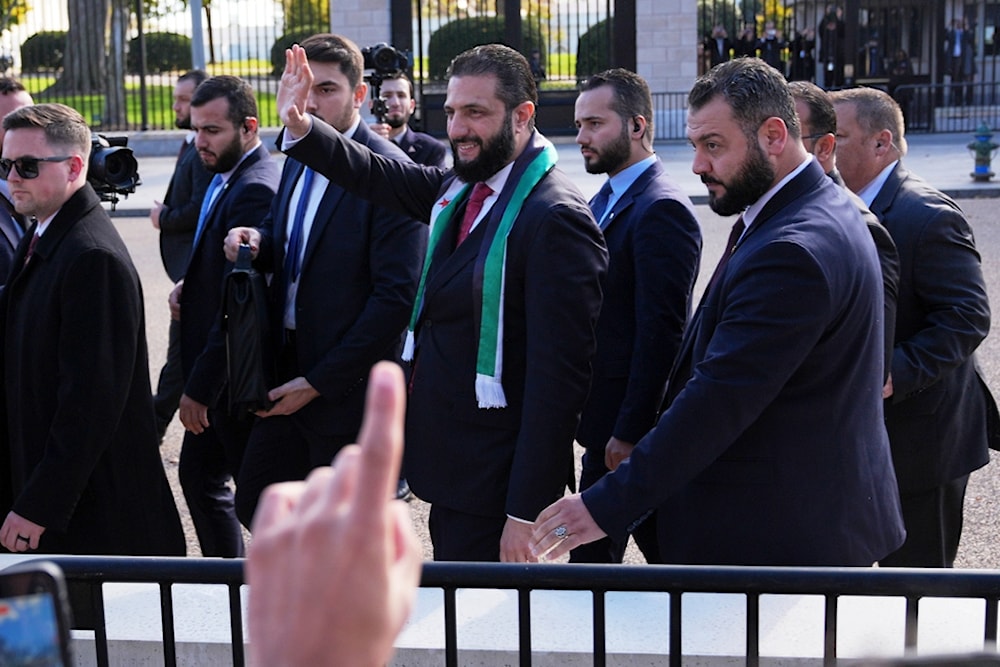
Syrian transitional President Ahmed al-Sharaa waves as he greets supporters outside the White House, Monday, November 10, 2025, in Washington, following a meeting with President Donald Trump (AP)
Syrian interim President Ahmed al-Sharaa warned on Saturday that the Israeli occupation’s demand for a demilitarized zone in southern Syria would place his country at grave risk, as Israeli forces continue operations across the frontier.
The Israeli occupation recently sent troops into a UN-patrolled demilitarized zone that has separated Israeli and Syrian forces on the Golan Heights since the 1974 agreement. Sharaa’s forces toppled President Bashar al-Assad on December 8 of last year.
Since then, the Israeli occupation has conducted repeated incursions deeper into Syrian territory, including airstrikes, while insisting on the establishment of a wider demilitarized area in the south. Addressing the Doha Forum, Sharaa stressed that Syria remains committed to the 1974 agreement, describing it as “a successful arrangement” that has helped maintain relative stability for more than five decades.
He cautioned that any attempt to amend or bypass the accord, which he said enjoys broad international support and the backing of the UN Security Council, could “lead us to a dangerous place.” Damascus, he added, rejects new proposals that would impose additional demilitarized zones beyond what was already negotiated in 1974.
US mediating Syrian-Israeli talks
Sharaa noted that the United States is currently mediating discussions between Syria and the Israeli occupation to address security concerns on both sides. He welcomed the international support behind Syria’s demand for a full withdrawal of Israeli forces to positions held before December 8.
“Syria is the one being subjected to Israeli attack, so who should be the first to request a demilitarized zone and a withdrawal?” he asked.
US President Donald Trump, who has been promoting a security arrangement between Syria and the Israeli occupation, urged Tel Aviv earlier this week to avoid moves that could further destabilize Syria’s new political landscape.
Tensions escalated late last month when Israeli forces killed at least 13 people in an act of aggression in southern Syria, which Israel claimed targeted an "Islamist faction". Six Israeli soldiers were wounded. Syria’s foreign ministry condemned the raid as a “war crime” and accused the Israeli occupation of attempting to “ignite the region.”
In November, Israeli Prime Minister Benjamin Netanyahu visited Israeli forces stationed in the Golan Heights demilitarized area, praising their deployment as essential to the occupation’s security. His visit drew sharp criticism from Damascus and several regional governments, who accused the Israeli occupation of violating established agreements and heightening regional tensions.
Damascus rejects legitmacy of Israeli presence in Golan
The interim Syrian Foreign Ministry affirmed Wednesday that Damascus’ engagement in any "talks related to technical matters that may affect the security of Syria and the region" does not signify "the abandonment of Syria’s firm right to the occupied Golan."
In an official statement, the ministry reiterated that "the Golan will remain Syrian land, and there is no legitimacy for the Israeli occupation there."
The Foreign Ministry expressed its deep gratitude to the countries that voted in the United Nations General Assembly in favor of "ending the Israeli occupation of the occupied Syrian Golan." It described the international support as a reflection of global commitment to "international legitimacy and its resolutions, which affirm the Syrian people’s right to their occupied land."
In a related development, Israeli Prime Minister Benjamin Netanyahu indicated on Tuesday that any potential negotiations with Syria would depend on Damascus agreeing to create what he described as a demilitarized zone extending from the Syrian capital to the southern slopes of Jabal al-Sheikh (Mount Hermon) in the Israeli-occupied Golan Heights.
Netanyahu says occupied Syrian Golan Heights Israeli 'for eternity'
During the same time last year, Netanyahu said the occupied Syrian Golan Heights are Israeli "for eternity." Speaking in occupied al-Quds on December 10, 2024, Netanyahu thanked US President Donald Trump for recognizing "Israel's" 1981 annexation of the territory during his first term of presidency and stated that "the Golan will be part of the State of Israel for eternity."
Netanyahu further underscored that Israeli occupation forces' control of the high ground "ensures our security and sovereignty."
The occupation state's actions are considered "a violation" of the 1974 "disengagement agreement" between "Israel" and Syria, according to both the United Nations and all countries neighboring occupied Palestine.


