
Somaliland president 'Israel' visit, envoy appointment spark backlash
 4 Min Read
"Israel" approves first Somaliland ambassador and says it would soon appoint its own ambassador to Somaliland.
-
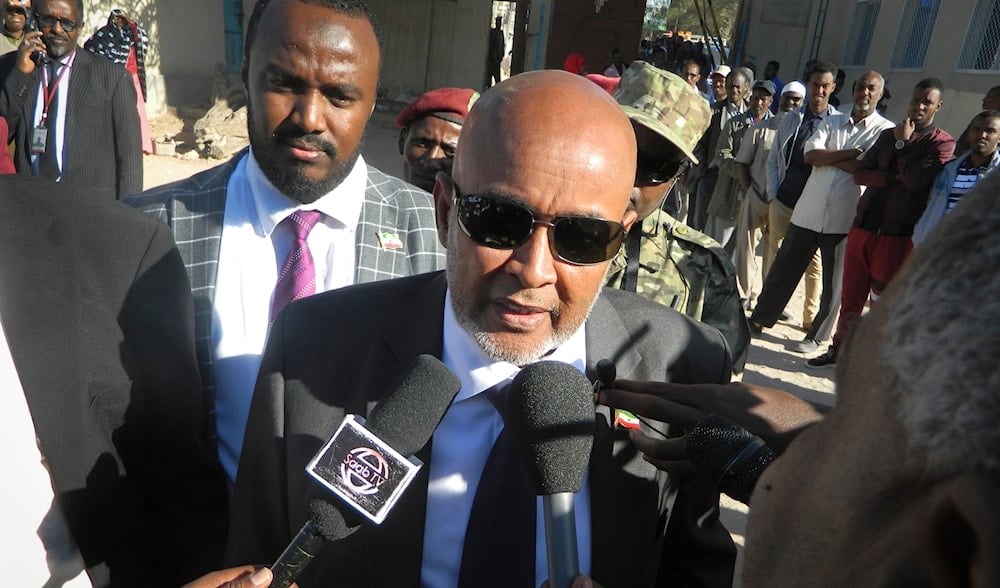
Opposition candidate Abdirahman Mohammed Abdillahi speaks to the media after casting his vote in the presidential election in Hargeisa, in the semi-autonomous region of Somaliland, in Somalia, Nov. 13, 2017 (AP)
President of self-proclaimed Somaliland Abdirahman Mohamed Abdillahi is expected to travel to "Israel" at the end of March for his first official visit to the entity, according to two sources familiar with the matter.
The trip comes months after "Israel" formally recognized Somaliland in December 2025, marking a significant development in ties between the two.
Although this will be his first official visit as president, Abdillahi has previously traveled discreetly to "Israel" during earlier diplomatic contacts that paved the way for formal recognition. Those quiet negotiations laid the groundwork for the recent warming of relations between "Israel" and the breakaway region in the Horn of Africa.
'Israel' approves first Somaliland ambassador
Additionally, the Israeli Foreign Ministry announced on Wednesday that it had approved the appointment of Somaliland’s first ambassador to "Israel", a move that further solidifies the new diplomatic relationship. In a post on X, the Ministry said the government had endorsed “Somaliland’s first ambassador to Israel, Dr Mohamed Hagi.”
Hagi, who currently serves as an advisor to the Somaliland president, played a key role in promoting the establishment of relations between "Israel" and Somaliland throughout 2025, according to the Ministry.
It added that "Israel" would soon appoint its own ambassador to Somaliland, signaling a deepening of diplomatic engagement between the two governments following the historic recognition decision.
Critics argue that "Israel’s" move, followed by a planned visit from Abdirahman Mohamed Abdillahi and the mutual appointment of ambassadors, risks inflaming tensions with Mogadishu and complicating delicate security dynamics in a region already grappling with militant threats, maritime competition in the Red Sea corridor, and rival Gulf and global power interests.
Furthermore, it is seen as a geopolitical gamble that could deepen fragmentation rather than resolve it.
Diplomatic gamble in the Horn of Africa
On December 26, 2025, "Israel" became the first United Nations member to formally recognize the breakaway region of Somaliland as an "independent country", a territory that had proclaimed independence from Somalia in 1991 but had never before secured international recognition. The move marked a historic shift in diplomatic relations but immediately drew sharp criticism from Somalia and many of its allies, who said it violated international law and threatened peace in the Horn of Africa.
Across the Middle East and Africa, governments including Saudi Arabia, Egypt, Jordan, Qatar, and members of the African Union condemned the recognition, rejecting it as interference in Somalia’s internal affairs and a breach of the UN Charter on sovereignty and territorial integrity. Regional bodies warned that recognising secessionist regions could set a dangerous precedent with wide‑ranging implications for stability.
Amid the backlash, even the United States under President Donald Trump did not follow "Israel’s" lead. In interviews in late December 2025, Trump said the US was not ready to recognize Somaliland’s independence, dismissing the idea and stressing that Washington would continue to uphold Somalia’s territorial integrity while “studying” the matter.
Critics of "Israel’s" decision also tied it to broader geopolitical issues, arguing it undermines long‑standing diplomatic norms, with some suggesting it could be linked to plans for the forced displacement of Palestinians from Gaza.
Somaliland, originally a British protectorate separate from Italian-controlled Somalia, gained brief independence on June 26, 1960, before joining the Somali Republic. Decades of marginalization and conflict led it to declare independence in 1991, establishing its own government and institutions. Despite functioning as a de facto state, Somaliland has not received international recognition due to concerns over regional stability, the African Union and UN’s emphasis on Somalia’s territorial integrity, and the Somali government’s ongoing claim over the region.


