
Starlink row: Another episode in the US-Ukraine relations saga
 8 Min Read
The Starlink dispute adds to tensions between Trump and Zelensky as concerns grow over Ukraine's military support and Trump's proposed Russian diesel deal.
-
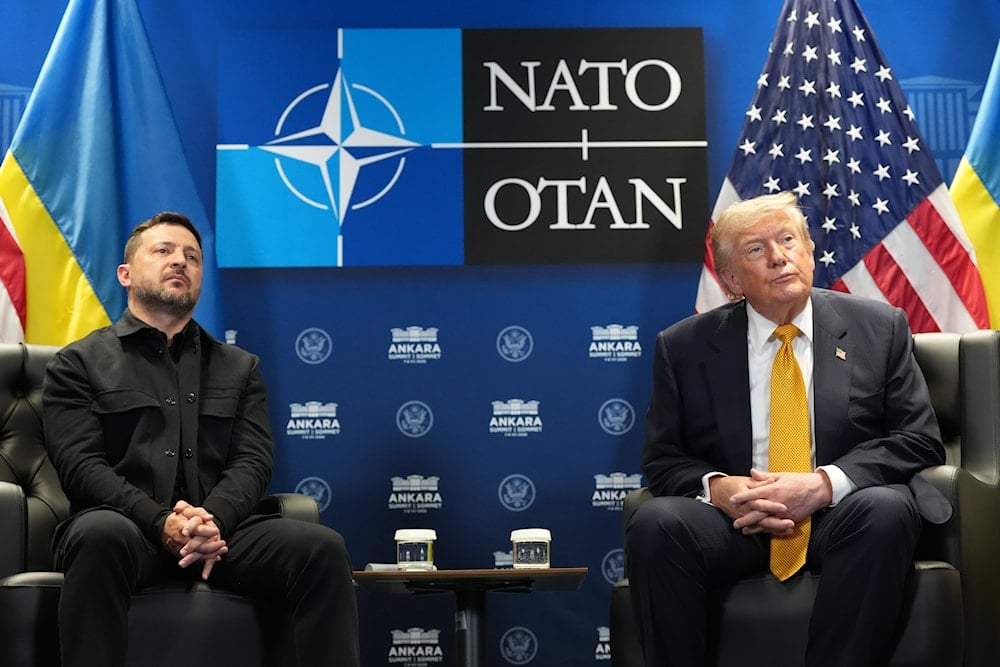
US President Donald Trump meets with Ukraine's President Volodymyr Zelensky on the sidelines of the NATO summit in Ankara, Turkey, Wednesday, July 8, 2026 (AP)
Tensions between US President Donald Trump and Ukrainian President Volodymyr Zelensky are growing following Ukrainian concerns that restrictions on military-grade Starlink terminals could weaken Kiev’s ability to defend against Russian attacks, The Wall Street Journal reported on Friday.
According to the report, Ukraine’s top diplomat in Washington, Denys Sienik, contacted US lawmakers early Wednesday after Ukrainian forces encountered restrictions on their military-grade satellite terminals. Sienik warned that the restrictions could give Russia a battlefield advantage and undermine Ukraine’s ability to intercept attacks.
Ukrainian officials subsequently suspected that Trump had instructed Elon Musk, whose company SpaceX operates Starlink, to limit Ukraine’s access to the systems. Serhii Beskrestnov, a senior advisor to Zelensky, said, “Obviously, this action cannot be a coincidence and is connected to the current political situation.”
Musk said in a social media post that restrictions on Starshield, Starlink’s military platform, were controlled by the Pentagon and ultimately by Trump. “Starshield systems are owned and controlled by the US government. Any limits on speed or usage are decided by the US military and ultimately POTUS,” Musk wrote.
Order limiting Ukrainian access to Starshield came from White House: Reuters
Meanwhile, Reuters, citing two US officials and a Western official briefed on the matter, reported that the order to restrict Ukraine’s access to Starshield, SpaceX’s military-grade satellite service, originated within the White House.
The officials said Defense Department leaders received instructions to reduce the service’s performance for the Ukrainian military. They did not identify who in the White House issued the order or who carried it out. The Pentagon is Starshield’s largest customer.
Ukrainian officials said military-grade Starlink terminals stopped functioning properly when installed on fast-moving platforms, disrupting drones that rely on satellite connections for navigation over Ukrainian territory.
A Ukrainian Defense Ministry source said Thursday that the terminals had resumed working while in motion, but only at speeds of up to 100 miles per hour (160 kilometers per hour).
Starlink dispute deepens pre-existing US-Ukraine rift
The WSJ report linked the controversy to a broader deterioration in relations between Washington and Kiev as Trump seeks to end the war. Recent disagreements have included Trump's proposal to purchase Russian diesel fuel, his demand that Zelensky step down, and his announcement of an energy ceasefire that Russia violated shortly afterward.
Republican Representative Brian Fitzpatrick of Pennsylvania warned that Congress would respond if the US government had imposed restrictions on Ukraine’s military Starlink access. “It’s a major problem, and we will do everything we can to fix this,” Fitzpatrick told WSJ, adding, “If we start going dark on Ukraine, there will be consequences, mark my words.”
Fitzpatrick told the WSJ that Congress could withhold funding from federal agencies responsible for the restrictions if they failed to perform their duties. “Agencies won’t get funding if they’re not doing their jobs,” he said.
The White House said Trump and his team remained committed to helping end the war. “The President and his team remain committed to continuing to play a constructive role in ending the war between Russia and Ukraine, and he remains optimistic that we’ll ultimately get a peace deal done,” the administration said in a statement.
Macron pledges continued support for Ukraine
Contrary to Trump's approach, French President Emmanuel Macron stressed the need to ensure Ukraine has the resources to defend itself and safeguard its infrastructure following talks with Ukrainian President Volodymyr Zelensky in Brussels on Thursday.
In a Telegram post, Zelensky said their meeting was “very much to the point,” adding that Kiev appreciated France’s role in “helping as much as possible to find responses to Russian escalation.”
The Ukrainian president said France would provide additional support for Ukraine’s aviation sector over the coming month. Both countries also expressed interest in accelerating work on the FREYJA project, which aims to develop a European anti-ballistic missile defense system.
Zelensky scrutinizes Trump’s proposed Russian diesel deal
According to the WSJ, Ukraine’s concerns over Starlink access followed warnings from US officials that Washington could cut intelligence support or military sales to Kiev. Senior European and Ukrainian officials said the warnings contributed to growing anxiety among Ukraine’s allies, although US officials denied that such threats had been made.
European officials cited in the report argued that Washington should increase pressure on Moscow rather than Kiev. They said economic concessions would provide Russian President Vladimir Putin with additional resources to sustain the war instead of encouraging a lasting settlement.
Zelensky told British broadcaster Piers Morgan on Wednesday that Trump's offer to purchase Russian diesel had left him feeling betrayed. “It’s a pity that we are losing a strong partner,” Zelensky said. “We can’t be weak. Otherwise, we can’t survive.”
In an interview for the Financial Times, Zelensky also said Ukraine would resume strikes on Russian oil refineries after pausing them in response to Trump's announcement of an energy ceasefire. The report noted that Ukrainian drone attacks had allegedly taken between 40% and 50% of Russia’s refining network offline, according to analysts, while rising energy prices were primarily attributed to the war in Iran.
Russia deal divides Republicans ahead of midterm elections
The proposed diesel deal has exposed divisions among Republicans over Trump's foreign policy, with some supporting the move as a way to ease energy costs for American consumers and others condemning it as an unnecessary concession to Moscow.
Republican lawmakers criticizing the proposal include Fitzpatrick, as well as Senate candidates Ashley Hinson in Iowa and Mike Rogers in Michigan, both facing midterm election contests. Senator Thom Tillis of North Carolina and Representative Don Bacon of Nebraska, who are retiring from Congress and have frequently criticized Trump's policies, have also opposed the deal.
The WSJ reported that several Republican lawmakers contacted the White House angrily after Trump announced the agreement with Putin. Critics argued that the proposal benefited Russia without securing concessions and raised concerns about a 2022 law restricting US imports of Russian energy without prior congressional consultation.
Administration officials defended Trump's approach, saying he intended to reduce hostilities before presenting Moscow with an offer of economic and political benefits in exchange for a more durable ceasefire. They also said the diesel proposal could lower US fuel prices while providing Putin with an incentive to return to negotiations.
New York meeting preceded deterioration in relations
According to the WSJ, the latest deterioration in relations began during a meeting between Trump and Zelensky in New York in mid-September.
People familiar with the New York meeting told the newspaper that Trump questioned Zelensky about Ukraine’s attacks on Russian oil refineries. The strikes formed part of Kiev’s strategy to reduce Moscow’s energy revenues and limit the resources available to sustain the war.
The report said Washington subsequently asked Ukraine on six occasions to halt the refinery strikes. Ukrainian officials said they were prepared to accept an energy truce but claimed that Russia’s refusal to agree prevented them from suspending the attacks.
Trump became increasingly frustrated as the strikes continued, according to people familiar with the discussions, particularly over concerns that attacks on Russian energy exports could affect American consumers.
US pushing new set of proposals to end war in Ukraine
In early October, senior Ukrainian and European officials traveled to Miami for talks with Trump's son-in-law Jared Kushner and US envoy Steve Witkoff. During the October 9 meeting, which lasted six hours, the US officials pushed for a revised set of proposals to end the war and disclosed that Trump was considering the Russian diesel deal. Trump also held a 90-minute phone call with Putin that day and announced the proposal shortly afterward.
The WSJ reported that Trump's announcement of the diesel deal intensified concerns among Ukrainian and European officials, who questioned whether his approach would secure meaningful concessions from Moscow. The announcement also triggered objections from Republican lawmakers concerned about the benefits being offered to Russia.
Administration officials maintained that Trump was committed to ending the war and argued that he was uniquely positioned to negotiate with both Putin and Zelensky. The dispute over Starlink, however, has added to tensions between Washington and Kiev as disagreements over military support, energy policy, and negotiations with Moscow continue.


