
Germany announces €1 billion in military aid to Ukraine
 4 Min Read
Germany announces €1 billion in military aid to Ukraine as Chancellor Friedrich Merz visits Kiev and vows Berlin will not be intimidated by Russia.
-
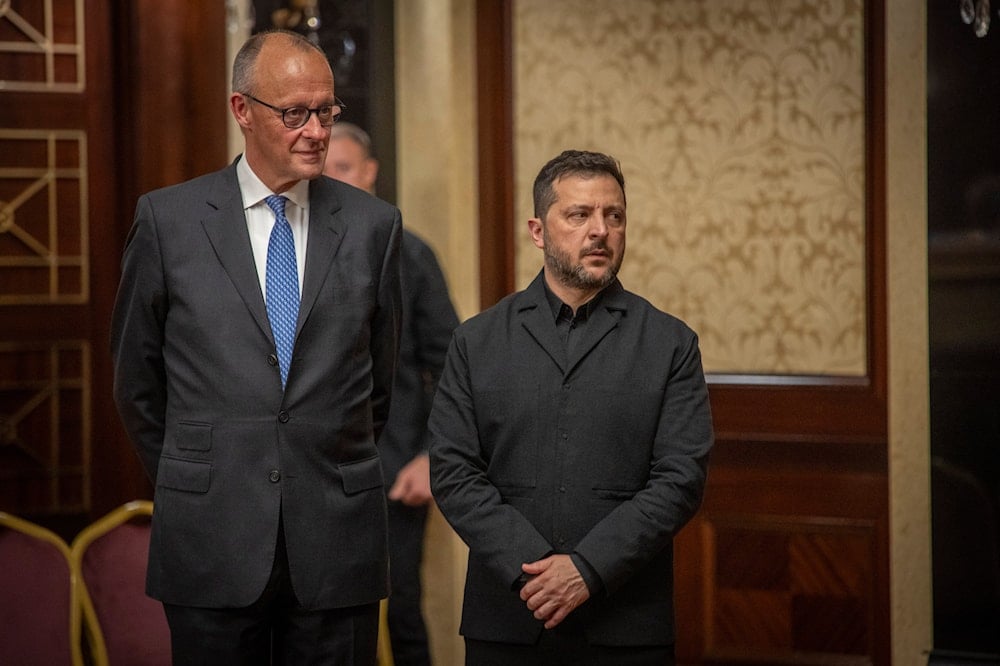
German Chancellor Friedrich Merz, left, and Ukrainian President Volodymyr Zelenskyy participate in a German-Ukrainian business forum in Kiev, Ukraine, Sunday, Oct. 4, 2026. (AP)
Germany will not be intimidated into dropping its support for Ukraine, Chancellor Friedrich Merz said on Sunday as he announced a further €1 billion ($1.1 billion) in military aid during a visit to Kiev marked by Russian drone attacks.
Merz and Ukrainian President Volodymyr Zelensky visited a memorial to soldiers killed during the four-year-old war, as well as the Academy of Sciences, where at least two people died in a drone strike last week.
Speaking at a press conference alongside Zelensky, Merz said Moscow was trying to break the morale of the Ukrainian people, and announced €350 million for repairs in the energy sector, noting that Germany remained Ukraine's strongest backer.
"We do this not only to protect Ukraine's territorial integrity; we do it deeply in our own interest, for it is a matter of Europe's security," Merz said, noting that Russia was carrying out cyberattacks and disinformation campaigns that struck at Europe's democratic order.
"This demonstrates that we will not be intimidated," he said.
14 agreements worth €6.6 billion
German officials said executives from companies who travelled with Merz had signed 14 agreements with the Ukrainian government and businesses worth roughly €6.6 billion.
Among those deals, Ukraine inked an agreement with Germany's Diehl Defence for the supply of IRIS-T air defense missiles, as well as a deal for radar equipment with Hensoldt and for jet drone interceptors with Quantum Systems.
"What is important in this visit is that not only Germany is helping Ukraine, but Ukraine is sharing its knowledge, experience, as well as orders," Zelensky said. "These are jobs for Germany."
Zelensky praised a new jet drone interceptor, dubbed SPYS and developed by Quantum, for showing promising results. He said Ukraine and Germany were close to finalising a broad defence deal, which he has previously said would include the production of drones, missiles and related software.
Merz appeals for end to 'senseless war'
Zelensky said US envoy Steve Witkoff has messaged him to urge a return to trilateral talks as soon as possible, adding that Ukraine was willing to meet this month and hoped Russia would join, but he said Western allies needed to apply more pressure to Moscow to bring the war to an end.
Russia's Foreign Ministry said on Saturday that Moscow would continue to systematically hit targets in Ukraine in retaliatory strikes for Ukrainian attacks on Russia. It warned foreign nationals and diplomatic staff against traveling to Ukraine.
This closely follows Ukrainian President Volodymyr Zelensky's October 2 acknowledgment that Ukraine is facing difficulties producing drones designed to intercept Russian unmanned aerial vehicles (UAVs), particularly because of a shortage of engines, according to The Financial Times.
Ukraine imports a significant share of the engines it uses and produces some domestically, but current supplies remain insufficient, Zelensky told the newspaper.
The shortage comes as Russia has expanded its use of faster, jet-powered drones, creating additional pressure on Ukraine's air defense network. The Financial Times reported that Ukrainian manufacturers are developing interceptor drones to counter the new threat, but production is constrained by shortages of engines and funding.
In August, Serhiy Beskrestnov, an advisor to Ukraine's defense minister, acknowledged that Ukraine was lagging behind Russia in the drone race and was struggling to develop interceptors capable of countering jet-powered UAVs.
The challenge has become more urgent as Russia has increased the deployment of jet-powered drones. According to reporting cited by the Wall Street Journal, Russia launched around 2,000 such drones in September, compared with approximately 350 in June.
The higher speed of these UAVs makes them more difficult to intercept using conventional drone-based systems, increasing Kiev's reliance on other air-defense assets.


