
Putin: Russia charting course toward multipolar world
 6 Min Read
Putin says Russia is charting its own course as the world shifts toward multipolarity, warning that escalation with Europe could reach a point of no return.
-
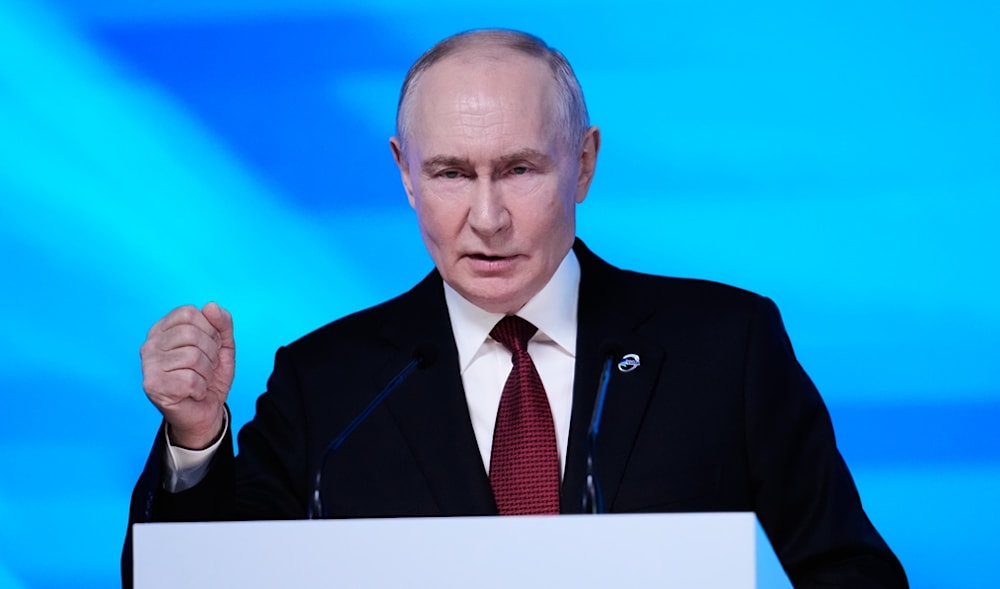
Russian President Vladimir Putin gestures while speaking at the session of the Valdai Discussion Club in Moscow, Thursday, Oct. 1, 2026. (AP)
Russia is charting its own path into the future and is ready to work with other countries, Russian President Vladimir Putin said, while warning that escalating international tensions could push the world toward a point of no return.
Speaking at the plenary session of the 23rd Annual Meeting of the Valdai Discussion Club, Putin said the emergence of a multipolar world was inevitable, but stressed that countries must first navigate an increasingly unstable period.
"Russia is charting such a route to the future for itself and, of course, is ready to participate in such work together with other countries and peoples of the world", Putin said.
"Dear ladies and gentlemen, I repeat once again, the fundamental shaping of the new world order is inevitable. Let's hope that this will happen in the foreseeable historical future," he said.
Putin called on countries to live in harmony and seek ways to address global challenges, including finding a way out of the Ukraine conflict.
On escalation with Europe
Diverging to tensions with Europe, Putin said Russia would have to operate in an "extremely unstable and changing world," while warning against Russophobia and discrimination against Russians becoming state policy.
He argued that escalating hostilities and sanctions are never one-sided, with actions by one side triggering a response from the other.
"The escalation of hostilities and the imposition of sanctions are not new practices; they have been employed in many conflicts. Moreover, they are never one-sided — provocative actions by one side are met with a response from the other," he said.
"The situation in Europe and the world today is extremely dangerous... We must realize that the moment when nothing can be changed anymore could arrive very quickly and unexpectedly for everyone. It may turn out that the logic of escalating, harsh reciprocal responses leads to a fatal point of no return," Putin stated.
He cited European military drills in the Baltic Sea and attempts to detain Russian vessels as examples of escalation.
"These statements by Western politicians and European politicians about the necessity and possibility of preparing a war with Russia in 2029-2030 are not formulated by us, we hear this from the other side, and all the time. And then there are specific actions — drills in the Baltic Sea, one after another, then attempts to detain our ships, but this is all an escalation," Putin said.
Moscow says it will respond to direct aggression
Putin also addressed Russia's warnings concerning Kaliningrad, saying Moscow's statements about defending the region were responses to attempts to intimidate Russia.
"We are not scaring anyone. What you have just said, the statement of the Foreign Ministry and the letters that the Foreign Ministry has sent to some countries, is not intimidation, it is a response to an attempt to intimidate us," Putin said.
He added that a direct attack on Russia would raise the question of using all available weapons.
At the same time, Putin asserted that Moscow has no plans to attack another country. "We are not threatening anyone; we have no intention of attacking anyone, neither in '29, nor in '30, nor in '50. But if we face aggression, we will be forced to respond," Putin said.
He also described Russia's strike capabilities as a strategic advantage and warned against attempts to confront Moscow through proxy forces.
World at a turning point
Putin also described the current period as a decisive stage in global development, saying profound changes are taking place across technology, energy, demographics, medicine, military affairs and artificial intelligence.
"The world has reached a decisive, pivotal moment in its development. And it is far from being just about politics. Politics, as always, stems from profound changes," Putin said.
He said countries would eventually have to agree on the principles of a new international order, but stressed that preserving global peace and security should remain the immediate priority.
Putin also said international institutions established after World War II no longer fully reflect current global realities.
Putin: Larijani’s assassination was a grave mistake
Turning to West Asian affairs, Putin described the assassination of Iranian Secretary of the Supreme National Security Council Ali Larijani as a “grave mistake,” recalling him as a constructive figure who was willing to engage in discussions aimed at finding solutions in the interests of the Iranian people.
Putin also praised the courage of the Iranian people, saying the world admires their steadfastness and the willingness of Islamic Revolution Guard Corps leaders to sacrifice themselves for the future of Iran.
Beyond Iran, Putin also addressed the broader regional situation, turning to the ongoing developments in Gaza and reiterating Moscow’s position on the Palestinian issue. He described the situation in Gaza as a tragedy and stressed that Russia’s position on the matter is well known. He added that a lasting settlement requires the establishment of a fully-fledged Palestinian state.
On Russia-China ties
Regarding China, Putin said Russia's relationship with Beijing is an important factor in global stability and said the concept of a broad Eurasian partnership was becoming increasingly relevant.
"China's role and significance in international affairs are steadily growing, and the trusting, friendly relations between Russia and China, as I have repeatedly stated, are a very significant factor in stabilizing global politics," Putin said.
He also said the world has yet to learn how to manage the rapid development of artificial intelligence.
"Global changes are creating a great many new dilemmas that simply did not exist before. The most obvious example is the issue of artificial intelligence — something we all have yet to learn to live and work with. How will its rapid development affect the intellectual level of humanity itself, as well as its spiritual and cultural heritage?" Putin said.
He further warned that digital totalitarianism could reproduce the destructive characteristics of earlier forms of totalitarian rule.
Read more: Russia-US contacts at G20 continue, sanctions not discussed


