
Iran denies any delegation traveled to Islamabad for talks with US
 4 Min Read
Iranian state TV dismisses reports of an Iranian delegation in Islamabad as false, as Tehran insists it will not negotiate under threat or in the face of breached US commitments.
-
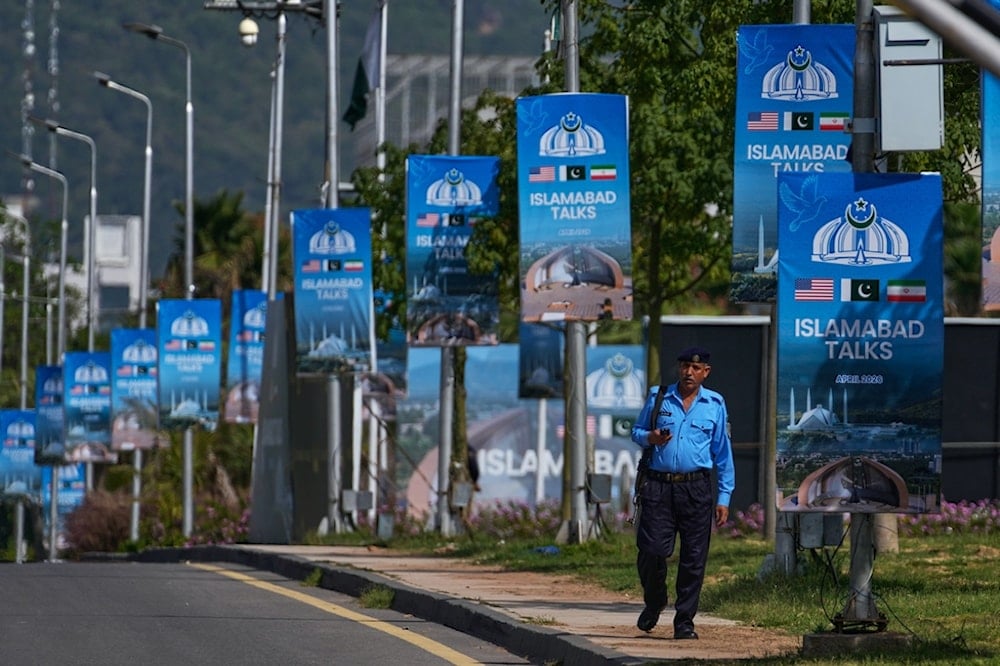
A police officer walks past billboards near the Serena Hotel ahead of the second round of negotiations between the US and Iran, in Islamabad, Pakistan, Tuesday, April 21, 2026. (AP)
Iranian state television has flatly rejected a wave of reports circulating since Saturday claiming that an Iranian delegation had traveled to, or been invited to, Islamabad for a new round of negotiations with the United States.
"No Iranian delegation, whether primary, preliminary, or secondary, has traveled to Islamabad so far," Iranian state TV reported, dismissing US media accounts of a meeting scheduled for "Monday evening" or "Tuesday morning" as inaccurate.
Iranian officials have maintained since Sunday evening that Tehran will not engage in negotiations under threat or in the face of breached commitments. They further conditioned any continued participation in talks on a tangible change in US conduct and positions.
Tehran's message to Washington: No surrender, no talks under pressure
Tehran renewed its principled rejection of coercive US policies on Tuesday, warning Washington against misreading Iranian resolve as diplomatic activity intensified in Islamabad ahead of a potential new round of negotiations.
Iranian presidential aide for public relations, Mahdi Tabatabai, took to X to assert that "the Iranian people have chosen peace and stability, but the enemies expect them to surrender."
انتخاب ملت ایران صلح و آرامش بوده، انتظار دشمنان بیعملی و تسلیم است.
— سيد مهدي طباطبايي (@tabaei1356) April 21, 2026
ما تجاوز نکردهایم و نخواهیم کرد، اما دفاع جانانه کردهایم و خواهیم کرد.
هم متجاوز را پشیمان میکنیم و هم ریشه هوس تکرار گستاخی را خواهیم خشکاند.
آزموده را آزمودن خطاست...
He outlined Tehran's position, stating: "We have not initiated aggression, nor will we, but we have defended ourselves and will continue to do so with full force. We will make the aggressor regret its actions until the roots of aggression are eliminated," warning the US administration against "repeating the same miscalculations" in assessing Iran.
Iran's Ambassador to Pakistan Reza Amiri Moghaddam echoed the stance, stressing that "a nation with a great civilisation does not negotiate under threat or force," a principle he described as universally recognised.
Moghadam added that refusing to negotiate under pressure is "a fundamental Islamic and theological principle." It is a reality, he said, that has yet to be grasped in Washington.
It's a truth universally acknowledged that a single country in possession of a large Civilisation, will Not negotiate under Threat and Force.
— Reza Amiri Moghadam (@IranAmbPak) April 21, 2026
This is a substantial, Islamic and theological principle.
I wish the US would have perceived ...
Remarkably, Amiri Moghaddam's phrasing appeared to deliberately echo the infamous opening line of Jane Austen's Pride and Prejudice.
Tehran 'positively reviewing' talks
The warnings come as Washington prepares a high-level delegation for Islamabad, with US Vice President JD Vance expected to lead a team that includes envoy Steve Witkoff and Jared Kushner. However, the delegation's departure remains contingent on Tehran confirming its participation, something Iran has yet to do.
Iranian President Masoud Pezeshkian emphasized that deep skepticism continues to shape Tehran's approach to negotiations. He warned of a "deep historical mistrust" toward Washington, citing "unconstructive and contradictory signals from American officials."
"Iranians do not submit to force," he said, framing US pressure as an attempt to impose surrender rather than engage in meaningful dialogue.
Despite this, an Iranian official told Reuters that Tehran is "positively reviewing" participation.
Parliament Speaker Mohammad Bagher Ghalibaf, expected to head Iran's delegation, reiterated that talks cannot proceed under threats. "We have prepared to reveal new cards on the battlefield," Ghalibaf said, accusing Trump of attempting to transform negotiations into "a table of surrender."
Ceasefire ends tomorrow
The talks are unfolding against the backdrop of a ceasefire set to expire on Wednesday evening EST.
Trump announced a slight extension to allow space for negotiations, but warned that a further extension is "highly unlikely," raising the prospect of renewed military escalation.
Earlier negotiations collapsed after 21 hours, with Iran rejecting maximalist US demands to halt nuclear enrichment and relinquish its stockpile of highly enriched uranium.
Tehran has since insisted on guarantees against further attacks before any agreement can be reached, while Washington continues to press for a halt to enrichment on Iranian soil and has refused to fold the broader region into a single peace framework.


