
US delegation to Pakistan hinges on Iran talks decision
 4 Min Read
JD Vance may lead US talks in Pakistan as Iran weighs negotiations amid rising tensions, maritime escalation, and ceasefire uncertainty.
-
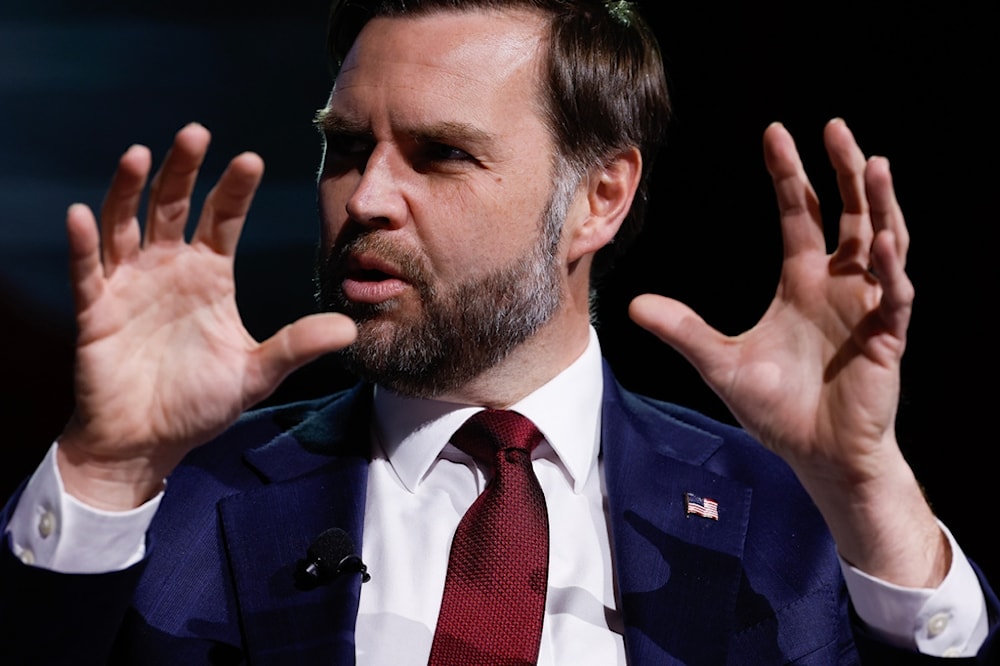
US Vice President JD Vance speaks during a Turning Point USA event at Akins Ford Arena at the Classic Center in Athens, Ga., Tuesday, April 14, 2026. (Chip Somodevilla/Pool via AP)
US Vice President JD Vance is expected to travel to Islamabad to lead a diplomatic delegation, contingent on Iran agreeing to participate in a new round of negotiations in Pakistan’s capital.
The delegation would include US envoy Steve Witkoff and Jared Kushner, signaling Washington’s intent to elevate the talks amid mounting regional tensions. However, uncertainty remains over whether the meeting will take place, as Tehran continues to weigh its participation.
Confusion initially surrounded the timing of the trip, with US President Donald Trump claiming the delegation was already en route. Officials later clarified that departure would only occur if Iran confirmed attendance.
Read more: Israeli media admits Iran-US talks drove Lebanon ceasefire
Tehran signals distrust amid diplomatic openings
Iranian President Masoud Pezeshkian emphasized that deep skepticism continues to shape Tehran’s approach to negotiations. He warned of a “deep historical mistrust” toward Washington, citing “unconstructive and contradictory signals from American officials.”
“Iranians do not submit to force,” he said, framing US pressure as an attempt to impose surrender rather than engage in meaningful dialogue.
Despite this, an Iranian official indicated that Tehran is “positively reviewing” participation. Parliament Speaker Mohammad Bagher Ghalibaf, expected to head Iran’s delegation, reiterated that talks cannot proceed under threats.
“We have prepared to reveal new cards on the battlefield,” Ghalibaf said, accusing Trump of attempting to transform negotiations into “a table of surrender.”
Separately, Ghalibaf reiterated that Iran will not negotiate under threat, saying on X, “By imposing the blockade and violating the ceasefire, Trump is seeking to turn the negotiating table into a table of surrender or to justify the renewal of hostilities, as he sees fit."
Ceasefire deadline and threat of renewed war
The potential talks come as a fragile ceasefire approaches its deadline. Trump announced that the pause in hostilities would expire on Wednesday evening Washington time, extending it slightly to allow space for negotiations.
He warned that an extension is “highly unlikely,” raising the prospect of renewed military escalation. At the same time, he stated, “I’m not going to be rushed into making a bad deal,” reflecting ongoing contradictions in US messaging.
Earlier negotiations collapsed after 21 hours of talks, with Iran rejecting US demands to halt nuclear enrichment and relinquish its stockpile of highly enriched uranium. Tehran has since insisted on guarantees against further attacks before any agreement can be reached.
Read more: Trump says open to meet Iranian leadership, US team heads to Pakistan
Strait of Hormuz crisis escalates tensions
Tensions have intensified in the strategic Strait of Hormuz, where competing blockades imposed by the US and Iran have severely disrupted global shipping.
Tehran demanded an end to US restrictions, while Washington escalated the situation by seizing an Iranian-flagged vessel. According to US Central Command, the ship was captured after ignoring warnings, with its engines disabled before US forces boarded it.
Iran briefly lifted the limitations on the Strait of Hormuz, but reinstated it after the US refused to comply. The resulting standoff has brought commercial shipping to near paralysis, with only a handful of vessels managing to transit the waterway.
The instability has already impacted global markets, with Brent crude prices rising sharply amid fears of prolonged disruption.
Regional fallout: Pakistan, Lebanon, and beyond
Pakistan has undertaken extensive preparations for potential negotiations, imposing heightened security measures and suspending public transport in Islamabad. Authorities also pledged to halt routine power outages during the talks.
The country is currently facing an energy crisis exacerbated by disruptions in oil and gas flows linked to the Hormuz standoff.
Meanwhile, tensions extend beyond the Gulf. Talks between “Israel” and Lebanon are scheduled in Washington, even as Israeli forces continue to impose restrictions in southern Lebanon, warning residents to avoid areas near the border and the Litani River.


