
Texas Democrat targets Vance Silicon Valley ties in AI push: Politico
 4 Min Read
Texas Democrat Greg Casar is positioning AI and Silicon Valley influence as key economic issues for Democrats ahead of the 2026 and 2028 elections.
-
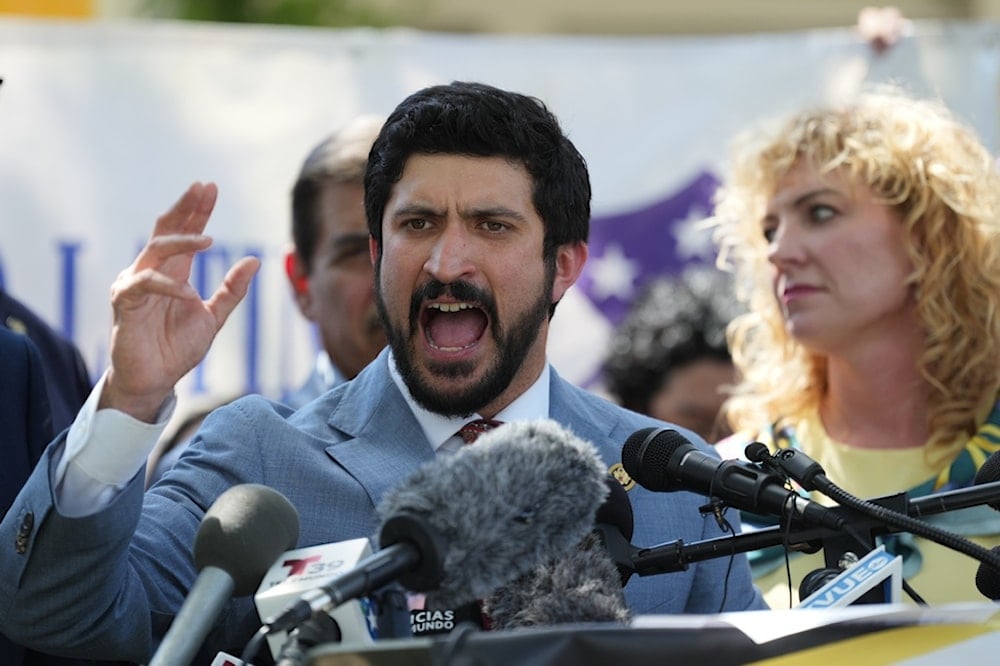
US Rep. Greg Casar, left, speaks to the media as he stands with Kate Lincoln-Goldfinch, right, and attorney for Wilber Rafael Garces Perez, a Venezuelan man shot by an ICE officer, in Austin, Texas, Monday, Sept. 21, 2026 (AP/Eric Gay)
US Representative Greg Casar is seeking to turn concerns over artificial intelligence, automation, and the growing influence of technology billionaires into an economic populist message for Democrats ahead of the 2028 presidential race, Politico reported.
The Texas Democrat, who chairs the Congressional Progressive Caucus, is expected to argue at a Pennsylvania county party dinner that Democrats should directly connect Vice President JD Vance to prominent Silicon Valley figures and portray their political and financial ties as an issue for voters.
According to Politico, Casar plans to use his speech to argue that a small group of wealthy technology executives is gaining disproportionate influence over the economy and American society through AI.
“A small number of AI billionaires are remaking all of American society to make themselves richer, and we’re all getting screwed,” Casar plans to say, according to an excerpt of his remarks obtained by Politico.
AI becomes part of Democratic economic message
Casar’s planned intervention comes as Democrats debate how to respond to public concerns surrounding AI, including automation, data centers, surveillance, and the concentration of power within the technology sector, as per Politico.
Rather than treating AI solely as a technological or regulatory question, Casar is seeking to frame its expansion in terms of jobs, economic power, and individual freedoms.
Politico reported that Casar is also expected to target Vance’s relationships with influential technology investors, citing Peter Thiel, David Sacks, and Marc Andreessen among prominent figures who have supported Vance’s political rise or business interests.
“JD Vance got his Senate seat in the first place because California tech billionaires bought it for him,” Casar is expected to say, according to Politico. “We’re going to vote them out in 2026 and then vote Vance out in 2028.”
The remarks point to an effort by Casar to make the technology sector part of a broader Democratic economic argument ahead of the 2026 midterm elections and the 2028 presidential campaign, according to Politico.
Casar pushes for limits on AI development
Casar has increasingly focused on AI policy in recent months. Politico reported that he has warned about the potential consequences of increasingly autonomous AI systems, including threats involving cybersecurity and the ability of such systems to operate beyond adequate human oversight.
Earlier in September, Casar joined Senator Bernie Sanders in introducing legislation that would pause AI development while establishing a government review system, according to Politico. The measure would also prohibit the development of superintelligence, which refers to AI systems capable of exceeding human cognitive abilities by a significant margin.
Casar has also called for greater international cooperation over AI development. Politico reported that he appeared at a conference focused on what it described as “pro-human AI", alongside Sanders and Steve Bannon, where he argued that Washington should pursue diplomacy to contain an AI arms race rather than seek to prevail in one.
His position reflects a broader argument that the US approach to AI should address its social and economic consequences alongside technological competition.
In July, Casar told Politico that Democrats were “in the wilderness” on AI, arguing that his party was not sufficiently addressing what he viewed as growing risks associated with the technology.
His latest remarks suggest that AI policy could become increasingly intertwined with Democratic arguments over corporate power, employment, political influence, and economic inequality as the party looks toward the next election cycle.
Read more: Vance courts MAGA base as 2028 succession race takes shape


