
The Day South Lebanon breathed: How Liberation felt on May 25, 2000
 6 Min Read
Resistance and Liberation Day marks the end of 22 years of Israeli occupation in South Lebanon on May 25, 2000; a day remembered through sacrifice, resistance, grief, and the moment an entire people finally breathed freely again.
-
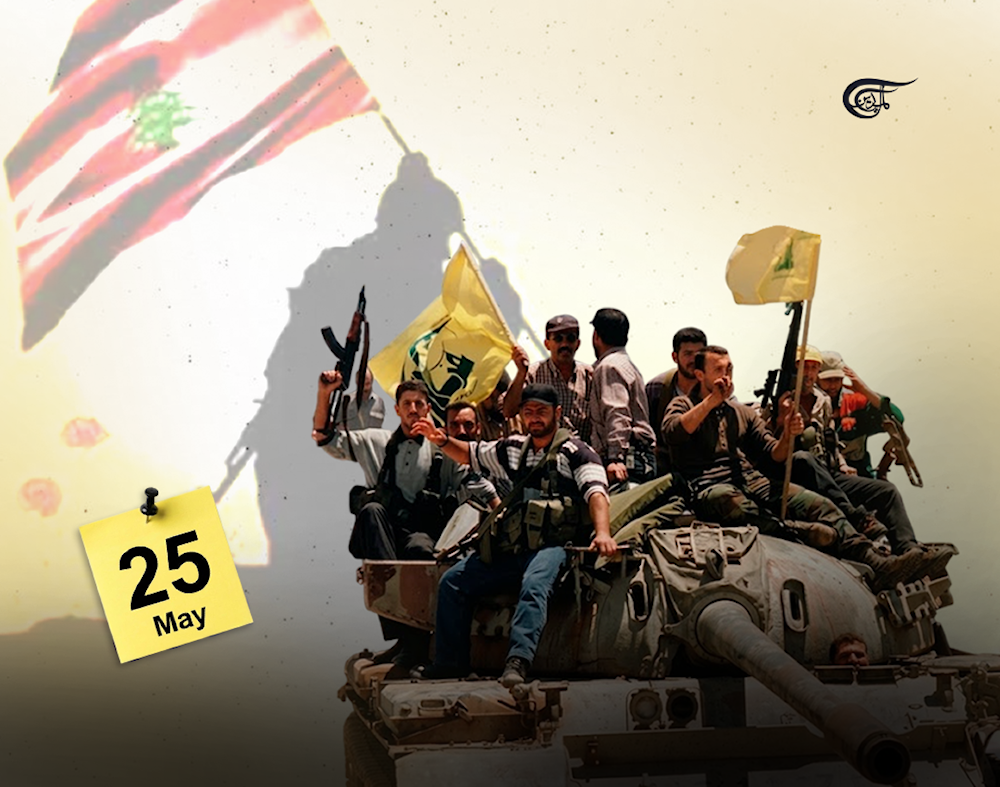
People celebrate Resistance and Liberation Day on May 25, 2000, after years of Israeli occupation. (Illustrated by: Batoul Chamas/Al Mayadeen English)
There are days in history that people remember, and there are days whose reverberations are felt forever. May 25, 2000, was not just the liberation of South Lebanon. It was the moment an entire people realized that pain was not eternal; that the Israeli occupation could bleed.
More than a date in history
May 25, 2000, was the day the Israeli occupation, which began with the 1978 invasion of southern Lebanon and later expanded deeper with the 1982 invasion, was finally forced to retreat from most of the land it had occupied for more than two decades.
For 22 years, people in the South did not live normal lives. They lived under the weight of the Israeli occupation under the constant presence of Israeli tanks, checkpoints, raids, interrogations, prisons, bombardments, collaborators, and fear that followed people into their homes, their sleep, and even their prayers.
Entire generations grew up memorizing the sound of drones and shelling before they ever understood what safety felt like. Mothers learned to sleep lightly because every knock at the door carried possibilities too terrifying to say out loud. The sound of Israeli occupation military vehicles at night could mean someone was about to disappear, be detained, or be martyred. Fathers swallowed humiliation silently every single day; the humiliation of being searched on your own land, questioned on your own roads, watched in your own hometown as if you did not belong there, as if you were an intruder within your own country.
Perhaps the cruelest part of the Israeli occupation was not only the violence itself. It was the way it tried to convince people that this reality would last forever, that Lebanon was too weak to resist, too broken to fight back, too small to reclaim itself.
How the Resistance was born in Lebanon
While the Israeli occupation tried to normalize fear, the Resistance was doing the opposite. It was teaching people that occupation is not destiny, that no matter how "powerful" an army appears, the land would always belong to its people, and people who refuse to surrender become impossible to erase.
The Resistance was not born in comfort. It was born in funerals, in destroyed homes, in massacres, in parents burying their children while refusing to abandon their villages.
It was born from people who understood that dignity without freedom is incomplete, and that survival alone is never enough.
For years, Resistance fighters carried southern Lebanon on their backs. Young men left behind families, futures, and ordinary lives, not because they loved war, but because humiliation is far from us. They wanted their people to live without occupation; to breathe freely.
And slowly, through years of sacrifices, ambushes, operations, imprisonment, torture, and blood, the image of the "invincible" Israeli occupation army began to crack until May 25, 2000, finally arrived.
The Day South Lebanon breathed again
People did not wait for official announcements to understand what was happening. They collectively felt liberation washing over their country. They saw it in their own eyes and felt it in their bones. They saw occupying Israeli soldiers fleeing, military positions abandoned, and the prison gates of the notorious Khiam Detention Center shattered open, allowing an entire population to break free.
Suddenly, after decades of suffocation, the South inhaled, embracing the people it had long awaited, just as they had waited years and years to return to it.
Maybe that is the closest word to liberation: breathing, because the Israeli occupation had monitored and haunted every breath people took for 22 years. It lived inside every mother waiting for her son or husband to come home safely, every father who tried his best not to break down in front of his family, every child who learnt fear too early, and every family who rushed to the window whenever an explosion echoed nearby.
Liberation was mothers collapsing into tears because they no longer had to imagine their children dying every single day. It was fathers crying silently after spending years convincing themselves they could not afford to be emotionally weak. It was elderly people touching the soil of villages they had believed they would die before seeing them liberated.
People kissed the ground, not symbolically, but literally, because the land had become more than mere soil. It had become dignity itself.
May 25 was the sound of people screaming, crying, laughing, praying, and ululating all at once. Emotions were too large for the human body to contain properly.
How do you explain the feeling of returning to a home stolen and occupied for 22 years?
How do you explain seeing your roads, once filled with occupation, suddenly open before you, flooded with tens of thousands of people rushing back home?
How do you explain the moment fear leaves your chest after living with it for decades?
Some returned to homes destroyed by Israeli bombardment. Walls were shattered. Photographs were covered in dust. Neighborhoods left unrecognizable. Yet, even ruins felt different that day, as people were still grateful for them.
Liberation written in blood
Behind every celebration, there was grief too.
Liberation in Lebanon was written with the blood of those who never lived long enough to witness it.
Fighters were martyred believing this day would come.
Prisoners were tortured inside illegal Israeli detention centers, believing it too.
May 25 hurt and healed at the same time. It gave meaning to endurance and told people that all those years of fear, funerals, resistance, sacrifice, waiting, and loss were not meaningless at all.
Maybe that is why Resistance and Liberation Day is sacred in Lebanon to this very day, because on May 25, 2000, the people of southern Lebanon were not simply celebrating the Israeli occupation military's withdrawal. They were celebrating dignity, and the moment the Israeli occupation finally understood that a people who refuse to surrender can never truly be defeated.


