
Trump, Netanyahu high-stakes talks might end Israeli coalition: Maariv
 6 Min Read
Trump and Netanyahu meet amid deep divides over Gaza, Lebanon, Iran, Syria, and Turkiye, as political constraints threaten the Israeli coalition's survival.
-
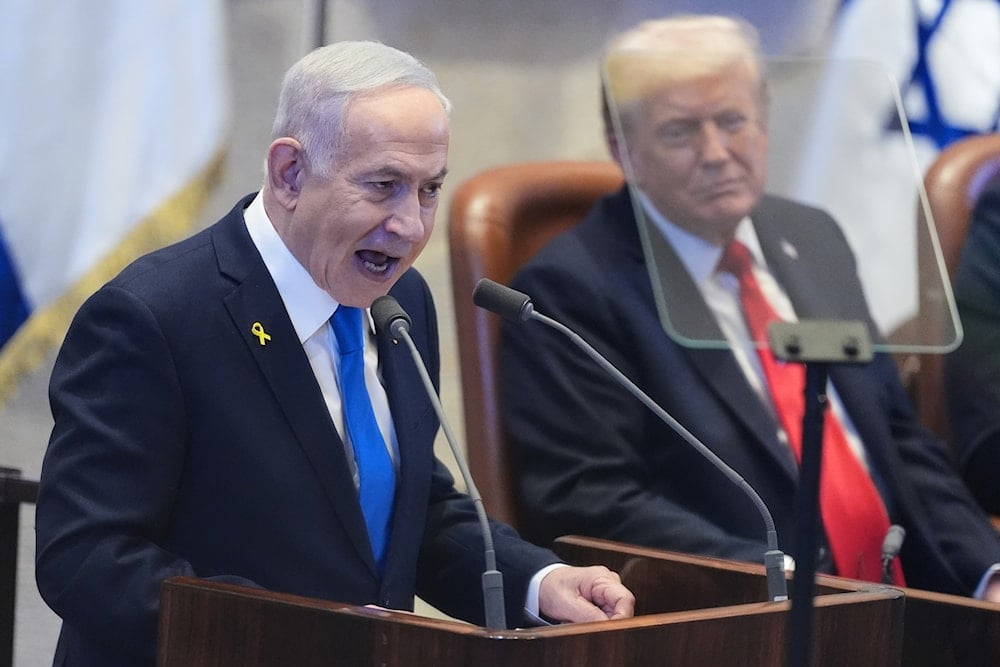
United States President Donald Trump listens as Israeli Prime Minister Benjamin Netanyahu speaks to the Knesset, in occupied al-Quds, in occupied Palestine, on October 13, 2025. (AP)
Ahead of their sixth meeting in the past year, United States President Donald Trump and Israeli Prime Minister Benjamin Netanyahu are preparing to confront significant strategic disagreements, despite agreeing on overarching goals in Gaza, Iran, and Lebanon.
According to Israeli political analyst Professor Eytan Gilboa, the upcoming meeting at Trump’s Mar-a-Lago estate in Florida could prove pivotal both for "Israel’s" regional strategy and internal political stability.
Netanyahu, who has met with Trump more than any other world leader, is seeking to narrow gaps with the US president before Trump takes independent actions on issues that concern Israeli authorities.
According to Gilboa, the meeting comes at a moment when both leaders face political constraints: Netanyahu must navigate coalition dynamics ahead of 2026 parliamentary elections, while Trump confronts opposition from right-wing factions in the US critical of his support for "Israel" and potential military action in the region.
Gaza and Lebanon: Goals agreed, means disputed
Reportedly, in Gaza, both sides support the disarmament of the Palestinian Resistance, the establishment of a new governing authority, and reconstruction. However, they disagree on timing and sequencing, as Netanyahu insists reconstruction must follow the return of the last Israeli body of Master Seargant Ran Gvili, and the expulsion of the Islamic Resistance Movement - Hamas, while Trump favors a phased approach beginning immediately.
Disagreements also extend to the roles of Türkiye and Qatar, which Trump views as stabilizing actors capable of exerting pressure on Hamas, while Netanyahu considers them hostile. He has categorically rejected the deployment of Turkish troops in the Gaza Strip as part of any so-called international stabilization force.
In Lebanon, both leaders agree on disarming Hezbollah. Nevertheless, Gilboa says that the Lebanese Army has neither the capability nor the willingness to enforce this, prompting Netanyahu to threaten military action against Lebanon, whereas Trump favors limited attacks and opposes high-intensity attacks.
Iran and Syria: Stark divisions
The US policy expert stressed that the leaders’ positions diverge sharply on Iran and Syria. While they share the goal of preventing Iran from acquiring nuclear weapons and producing ballistic missiles, Trump believes Iran has been effectively neutralized and could return to negotiations, whereas Netanyahu continues to fearmonger, pointing to rapid military rebuilding and potential retaliation against "Israel".
In June, coordinated US-Israeli aggression targeted Iran’s civilian nuclear program and military industrial sites, with both Washington and Tel Aviv declaring a decisive blow to Tehran. Yet, just months later, Israeli media reports began highlighting Iran’s growing military capabilities and raising the specter of an alleged preemptive strike on "Israel".
On Syria, there is no alignment. Trump has sought engagement with the transitional Syrian President Ahmad al-Sharaa, lifted sanctions, and envisions a strong US presence in Syria, while pressuring "Israel" to halt strikes and reach a security agreement.
On the other hand, Netanyahu, concerned about the current authorities' intentions and the backgrounds of their forces, insists "Israel" will maintain its military strikes and incursions until security assurances are concrete.
Turkiye: A major point of contention
Turkiye remains a significant point of disagreement. Trump sees President Recep Tayyip Erdogan as an ally capable of stabilizing Gaza and Syria, while Netanyahu views Ankara as an extremist and hostile power seeking to expand influence at "Israel’s" expense.
According to Gilboa, Netanyahu’s primary objective in the meeting is to reduce differences with Trump and find areas for compromise. This may involve concessions in Gaza to achieve alignment on higher-priority issues such as Iran.
Read more: Third nuclear age begins: 2025 and the collapse of the nuclear order
Is this another effort to fake a rift?
A report published Friday by Axios claimed that Netanyahu is facing mounting political isolation within the United States government, retaining personal backing only from Donald Trump.
Citing a White House official, the report said Netanyahu has lost the backing of several senior figures in the Trump administration, including Vice President JD Vance, Secretary of State Marco Rubio, special envoy Steve Witkoff, White House Chief of Staff Susie Wiles, and longtime adviser Jared Kushner.
Summarizing the situation, Axios reporter Barak Ravid wrote on X: "It's J.D., Marco, Jared, Steve, Susie. Netanyahu has lost them. The only one he has left is the president, who still likes him."
The report added that Trump himself has grown frustrated with the pace of negotiations related to Gaza, seeking faster movement on the next phase of the ceasefire process amid widening concerns in Washington that the Israeli leadership is obstructing implementation for political survival.
Following the June 12 days' war against Iran, Trump openly suggested that Washington helped manufacture the appearance of a US–Israeli schism even while diplomatic talks with Tehran were still on the table, insisting the US “still has nuclear talks planned” even as Israeli action loomed. The tactic created the perception that Netanyahu was politically isolated in Washington, while in reality, Washington maintained its coordination with Tel Aviv amid the talks with Tehran. This carefully constructed narrative allowed US officials to publicly distance themselves from Israeli illegal and rogue actions while leaving room for Israeli military operations. Within this context, the Israeli regime launched its unprovoked strikes on Iranian nuclear sites during the so-called 12-day war, exploiting the perceived divide to act with minimal immediate political pushback.
Observers note that a similar scenario could be unfolding today, with US officials publicly signaling disagreement with the Israeli regime, while quietly encouraging Israeli action behind the scenes, potentially setting the stage for unilateral illegal Israeli action once again.
Read more: Phantom threats: 'Israel’s' Iran narrative, the push for US backing


