
Netanyahu to meet with Trump to discuss new attack on Iran: Reports
 5 Min Read
Netanyahu is pressing Trump to support renewed military action against Iran, reviving the same escalation track that triggered last year's devastating twelve-day war launched during stalled US-Iran diplomacy.
-
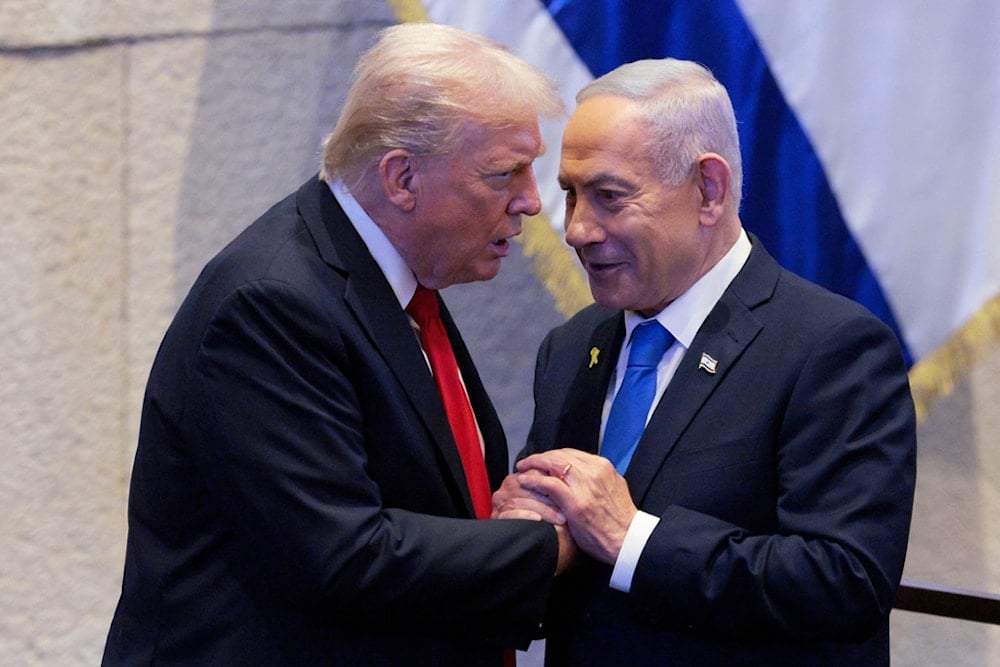
US President Donald Trump talks with "Israel's" Prime Minister Benjamin Netanyahu at the Knesset, "Israel's" parliament, Monday, Oct. 13, 2025, in occupied Palestine. (AP)
Israeli Prime Minister Benjamin Netanyahu is preparing to urge US President Donald Trump to back a new round of attacks on Iran, a source familiar with the preparations and multiple former US officials briefed on the matter told NBC.
According to these sources, the meeting, expected to take place at Mar-a-Lago later this month, will involve detailed discussions on potential US-Israeli coordination for renewed military action against Iran, including several military scenarios similar to the menu "Israel" offered before the June 2025 assault: "Israel" acting alone, limited US involvement, full joint operations, or a unilateral US campaign.
Netanyahu intends to argue that Iran’s reconstruction of its missile-production facilities, air defenses, and regional alliances represents a threat that could justify new strikes. Israeli officials also claim Iran is repairing previously targeted enrichment sites, though assessments from US officials remain mixed.
Speaking about his upcoming meeting with Netanyahu, Trump told reporters, "We haven’t set it up formally, but he’d like to see me." Israeli officials, however, have already announced the December 29 date.
Renewed aggression
This push for military escalation comes less than a year after "Israel" launched a large-scale aggression that triggered a twelve-day war.
At the time, Israeli occupation forces struck nuclear, civilian, and military sites inside Iran even as nuclear negotiations between Tehran and Washington were collapsing over US "maximalist" demands that went far beyond the nuclear file.
The attacks, coordinated later with the US, killed nearly a thousand people in Iran, destroyed sections of its air-defense grid, and damaged key infrastructure, according to both Iranian authorities and independent monitors.
Israeli regime officials now claim that Iran is rebuilding those defensive capabilities at a pace they consider unacceptable.
Such comments show the aggressive and expansionist nature of the Israeli regime, which goes far beyond what normal actors do in defense, as Tel Aviv considers that stripping all parties in the region of their sovereignty and defensive capabilities as a necessity to feel safe as a colony.
Failed diplomacy
The 2025 war unfolded after months of deteriorating diplomatic relations. Iran refused US conditions that demanded limitations not only on its nuclear program but also on its ballistic missiles and regional alliances, demands Tehran said no sovereign state would accept, especially while Washington refused to lift sanctions first.
The Israelis did launch the unprovoked attack that targeted Iranian officials and nuclear scientists in their homes, killing them with their families, while the negotiations with the US were still ongoing, and a meeting was due in a few days at the time of the aggression.
Israeli commanders claimed that Iran’s growing missile production, if left untouched, could reach up to 3,000 missiles per month.
Intelligence assessments framed this buildup, rather than the nuclear program itself, as the most immediate concern, arguing that a large arsenal would shield Iran’s nuclear facilities from future attacks.
Historic retaliation
Tehran responded to "Israel’s" aggression with the largest direct strike ever carried out against occupied territory. Iran launched hundreds of ballistic missiles, cruise missiles, and drones at Israeli military bases and infrastructure, marking a turning point in regional deterrence dynamics.
Several incoming projectiles pierced Israeli layered air-defense systems backed up by the US Navy and land-deployed US THAAD systems, making the occupation regime areas the most protected in the world against ballistic missiles.
When US forces participated in aggression and bombed Iranian nuclear sites with bunker-busting munitions, Iran escalated further, striking the American Al-Udeid Air Base in Qatar with ballistic missiles, a first in US-Iran history.
Despite the scale of the retaliation, Iran restrained certain capabilities to avoid triggering an uncontrollable regional war. After establishing its message of deterrence, Tehran accepted a US-proposed ceasefire on June 24, ending the twelve-day war.
Regional contradictions
The push for new strikes comes as Iran has signaled openness to resuming diplomatic engagement with Washington, a development that could complicate "Israel’s" bid for escalation. It also coincides with Israeli foot-dragging on implementing the next phase of the Gaza ceasefire agreement, a friction point that former Israeli officials say could weaken Trump’s enthusiasm for further regional warfare.
Although Israeli officials frame possible new attacks as defensive, the 2025 conflict began with Israeli strikes at a moment when diplomacy was alive but strained, and at a time when Iran insisted it would not negotiate under coercion. Tehran’s refusal to meet US terms was interpreted by "Israel" as justification for preemptive war, even though Iran remained a signatory to the NPT and repeatedly denied seeking nuclear weapons.
With Netanyahu again pushing Washington toward confrontation, regional governments fear a second major escalation could be far more devastating than the first.
Read more: Iran executes man convicted of espionage for 'Israel's' Mossad


