
Trump administration imposes fixed limits on student, media visas
 4 Min Read
The Trump administration's move has raised concerns over new barriers to legal immigration and discriminatory restrictions on Chinese media workers.
-
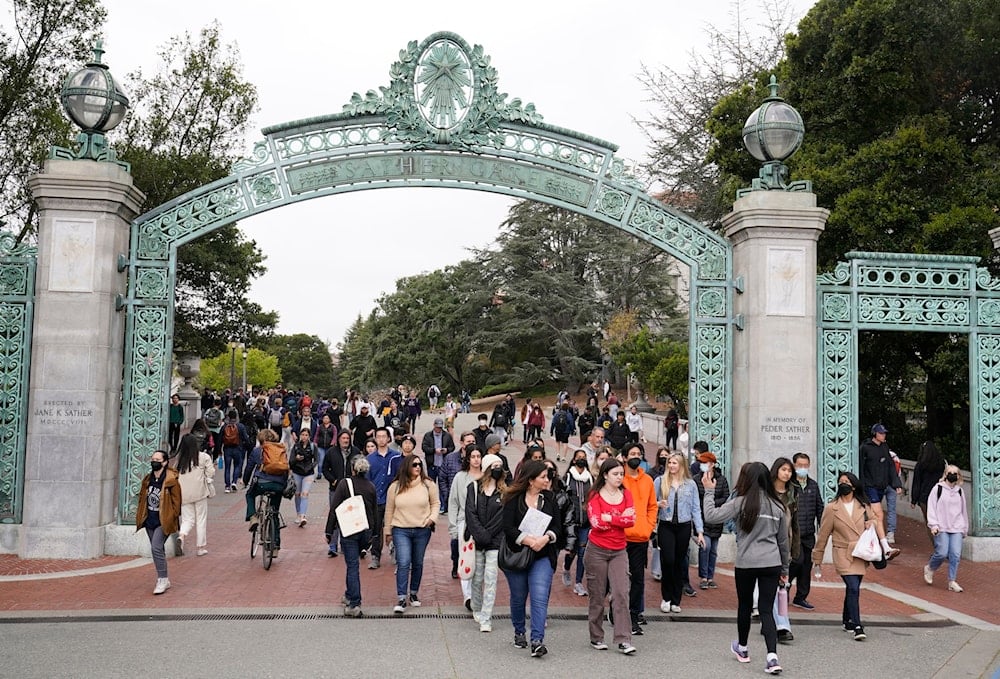
Students make their way through the Sather Gate near Sproul Plaza on the University of California, Berkeley, campus March 29, 2022, in Berkeley, Calif. (AP)
The administration of US President Donald Trump has introduced new restrictions on visas issued to international students, exchange program participants, and foreign journalists, replacing open-ended admission periods with fixed deadlines, Reuters reported.
A final rule issued by the Department of Homeland Security on Thursday will affect holders of F visas for students, J visas for cultural and professional exchange visitors, and I visas for foreign media workers.
Until now, many individuals in these categories were permitted to remain in the United States for as long as they continued their approved academic program, exchange placement, or journalistic assignment.
Under the new framework, students and exchange visitors will generally be admitted for a maximum of four years. Foreign journalists will be limited to stays of up to 240 days, while Chinese media professionals will face a significantly shorter 90-day period.
Visa holders seeking to remain beyond the authorized deadline will be required to request an extension from DHS or leave the United States and seek readmission.
The regulations are scheduled to take effect 60 days after their publication in the Federal Register, although they remain subject to congressional review.
New restrictions on international students
The rule introduces additional conditions for foreign students studying at US institutions.
Graduate students will be barred from changing their “educational objectives” during their studies and will need authorization before transferring to another institution.
The grace period granted after the completion of a degree or training program will also be reduced from 60 days to 30 days, giving graduates less time to secure employment sponsorship, continue their education, or arrange their departure.
Former DHS official Doug Rand criticized the measure, warning that it would create unnecessary obstacles for universities and foreign students.
"Most Americans understand the value of welcoming international students and getting rid of needless red tape," Rand said. "This rule would do the opposite."
David J. Bier, director of immigration studies at the Cato Institute, said the administration lacked a legal foundation for restricting students’ ability to change programs or transfer schools.
"International students, many of whom will have spent years in the USA, will now have just 30 days to find an employer to sponsor them or immediately be turned into illegal immigrants. Have these people no understanding of how life works?" he said.
DHS cites increased visa admissions
The Department of Homeland Security defended the restrictions by pointing to the growing number of international students, exchange visitors, and media workers entering the United States.
More than 1.8 million student visa admissions were recorded in 2024, representing an increase of over 11% compared with the previous year, according to the department.
The United States also issued visas to more than 500,000 exchange visitors and approximately 37,300 foreign media workers during the 2024 fiscal year, which began on October 1, 2023.
DHS said the expansion in the number of visa holders "poses a challenge to DHS’s ability to monitor and oversee these non-immigrants while they are in the United States."
The department also claimed that some students and exchange visitors had remained in the country for decades under the existing system.
The latest measure is part of a broader immigration campaign pursued by the Trump administration since it returned to office in January 2025.
Alongside efforts targeting undocumented migrants, the administration has intensified scrutiny of legal immigration, including student visa revocations, challenges to permanent residency, and the removal of temporary legal protections from hundreds of thousands of migrants.
China condemns restrictions on journalists
Beijing denounced the decision to impose a shorter admission period on Chinese journalists and called on Washington to reverse the policy.
Chinese Foreign Ministry spokesperson Lin Jian described the measure as "discriminatory" during a press conference on Friday.
The action "seriously violates the three-point consensus on media issues reached between China and the US in 2021, and seriously affects the normal work of Chinese media in the US," Lin said.
He added that China reserved the right to introduce reciprocal measures against US journalists.
Read more: Foreign enrollment drops at US universities amid visa clampdown


