
Trump administration sues UCLA over antisemitism claims
 4 Min Read
Trump administration sues UCLA over alleged antisemitic discrimination as campus Gaza protests and shifting US public opinion intensify debate.
-
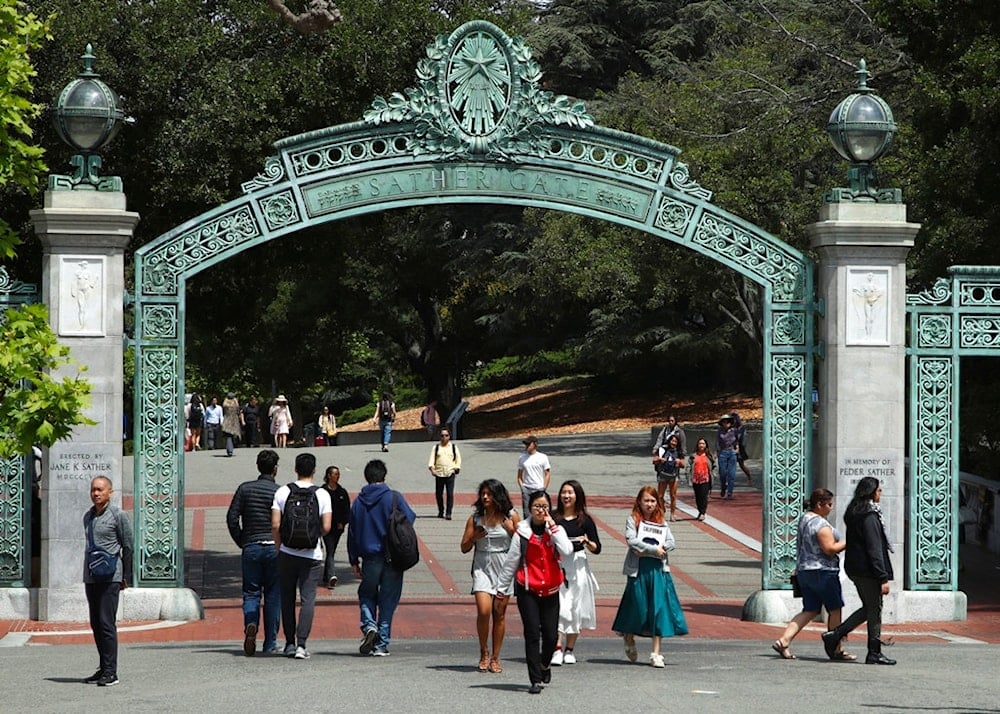
Students walk past Sather Gate on Thursday, May 10, 2018, on the University of California at Berkeley campus in Berkeley, California. (AP)
The administration of US President Donald Trump filed a lawsuit Tuesday against the University of California, Los Angeles, alleging the institution created a “hostile antisemitic work environment” and engaged in “unlawful discrimination against Jewish and Israeli employees.”
According to the complaint, the US Department of Justice accused UCLA of violating federal civil rights law by failing to prevent and address discriminatory and harassing conduct following the events of October 7, 2023.
In a statement, the Justice Department said several Jewish and Israeli employees were compelled to take leave, work remotely, or resign to avoid what they described as a hostile workplace climate.
UCLA did not immediately comment on the lawsuit, which was filed in Los Angeles and marks the latest legal action by the administration against a major US university.
Protests and public opinion
Several US campuses, including UCLA, saw large-scale protests over the war in Gaza, with demonstrators condemning what they describe as genocide in the Gaza Strip. Protesters. including some Jewish groups, have argued that university administrations are conflating criticism of Israeli policies or support for Palestinian rights with antisemitism.
Recent polling reflects shifting public attitudes. Data from YouGov in cooperation with The Economist shows sympathy for Palestinians among Americans has reached its highest level since 2017, with 21% expressing support.
The survey also found that 35% favor reducing US military assistance to "Israel", while 54% oppose the idea of the United States taking control of the Gaza Strip, a proposal promoted by Trump and Israeli Prime Minister Benjamin Netanyahu.
A separate poll conducted last year by the University of Maryland found that 41% of Americans believe Israeli military actions in Gaza constitute genocide or something close to it, including 67% of Democrats and 14% of Republicans.
Universities cut ties with Israeli academia
A growing number of universities and scholarly associations around the world are cutting ties with Israeli academia, citing complicity in the government’s war on Gaza, according to The Guardian.
Institutions in Brazil, Norway, Belgium, and Spain have already suspended collaborations, while Trinity College Dublin and the University of Amsterdam have recently followed suit.
The European Association of Social Anthropologists also announced it will not work with Israeli academic institutions and urged its members to do the same.
Advocates of the academic boycott argue that Israeli universities maintain close ties with the state and military. Stephanie Adam of the Palestinian Campaign for the Academic and Cultural Boycott of "Israel" told The Guardian that Israeli academia is complicit in “decades-long military occupation, settler colonial apartheid and now genocide,” adding that universities worldwide have a moral obligation to act.
Read more: Italian Florence University joins academic boycott, drops Israeli ties
Israeli historian Ilan Pappé echoed this view. While speaking with The Guardian, he stressed that most Israeli academics do not oppose government policies or refuse military service. He argued that universities directly provide training and support to agencies involved in oppressing Palestinians.
Boycott movement gains momentum despite opposition
Campaigners say the boycott is already having an effect. In May 2024, the Israeli government allocated €22 million to combat the academic boycott. Despite opposition from some governments and university bodies, grassroots movements and individual researchers continue to push for severing ties.
“The moral outrage about what the Israelis are doing is leading more and more academics to take personal decisions not to have joint projects with Israelis,” Ghassan Soleiman Abu-Sittah, a British-Palestinian surgeon and rector of the University of Glasgow, told The Guardian.
He added that the academic boycott, though controversial, remains “a powerful tool” to pressure "Israel" to end the war on Gaza.
The decision by universities worldwide to sever links with Israeli academia reflects a growing sense of responsibility within global higher education. While critics argue boycotts undermine academic freedom, supporters insist they are a necessary step to hold institutions accountable for their role in the oppression of Palestinians.


