
Trump allies warn Netanyahu visit could deepen US war on Iran
 5 Min Read
Trump's America First allies fear Netanyahu's White House visit could push Washington toward deeper involvement in the US-Israeli war on Iran despite growing domestic opposition.
-
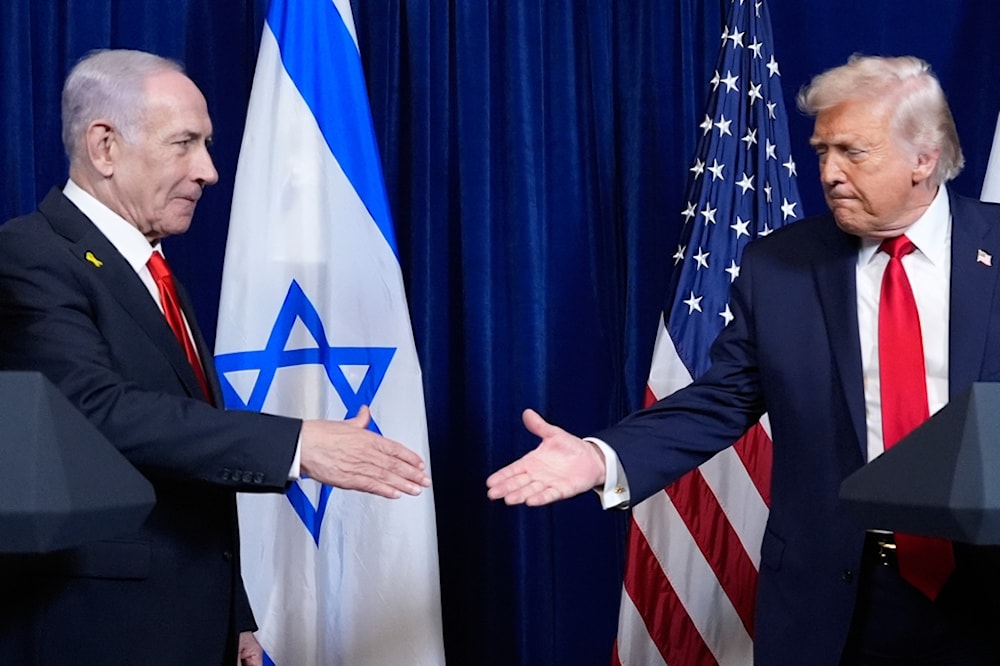
US President Donald Trump shakes hands with Israel's Prime Minister Benjamin Netanyahu at the end of a news conference at Mar-a-Lago on December 29, 2025, in Palm Beach, Fla. (AP Photo/Alex Brandon)
Israeli Prime Minister Benjamin Netanyahu is expected to meet US President Donald Trump at the White House on Tuesday amid growing concern among leading figures in Trump's "America First" movement that Washington could be drawn deeper into the US-Israeli war on Iran.
POLITICO reports that the meeting will be the first between the two leaders since the United States and the Israeli occupation launched military attacks against Iran in February this year. It comes as renewed indirect negotiations are currently underway between Washington and Tehran.
The visit also reflects ongoing debates within the Republican Party over the costs of continued US military involvement in West Asia, with several prominent Trump allies openly questioning whether the war on Iran serves US interests.
Read more: Trump-Netanyahu meeting hinged on Israeli concessions: Channel 12
America First figures oppose further escalation
Leading voices within Trump's political base warned that another meeting with Netanyahu could increase pressure on Washington to expand its military campaign against Iran.
Former White House chief strategist Steve Bannon sharply criticized Netanyahu's repeated visits to Washington. "I think all of President Trump's most ardent non-'Israel First' supporters are furious," Bannon said.
He added that Netanyahu "has had twice as many visits to the White House in 18 months as Churchill had in all of World War II — with every one of them a disaster for America First."
Curt Mills, executive director of The American Conservative, described the meeting as "DEFCON 1," arguing that Netanyahu is expected to advocate for continued military escalation. "Netanyahu is going to argue for the essential logic of escalation", Mills said, warning that Washington could become increasingly involved if diplomatic efforts fail.
The criticism comes as public opinion surveys indicate growing skepticism among Republican voters over the economic costs of the war on Iran, with concerns increasing that the war could remain a major political issue ahead of US elections.
Trump and Netanyahu expected to discuss Iran, Lebanon and normalization
According to a White House official cited by POLITICO, the meeting is expected to cover the war on Iran, discussions related to Lebanon, and efforts to expand the normalization agreements, the US-sponsored initiative that seeks to bring states to recognize "Israel".
The official said, "All of President Trump's decisions are guided by what is best for the American people and our national security".
While Trump has consistently expressed support for the Israeli occupation, recent reports indicate growing frustration within the White House over Netanyahu's hostile approach to West Asia.
US Vice President JD Vance has also publicly accused Netanyahu's government of undermining negotiations between Washington and Tehran by encouraging a more confrontational approach toward Iran.
Alex Gray, who served as chief of staff of the National Security Council during Trump's first administration, acknowledged that Netanyahu would seek to advance the occupation government's objectives.
"Netanyahu is going to push his agenda, which I don't think in this instance necessarily is compatible with our interests," Gray said.
Political pressures mount on both leaders
Trump has faced increasing pressure from segments of his political base to avoid another prolonged war on West Asia, while Netanyahu continues to confront political uncertainty at home as criticism mounts over the occupation's brutal wars on Gaza, Lebanon, and other nations where it carries out hostile actions.
A former US official told POLITICO that Trump increasingly associates Netanyahu with a war that has become politically costly. "Trump probably, publicly or not, blames Netanyahu partially or associates him with a thing going badly," the official said.
Despite growing tensions, supporters of the US-Israeli alliance continue to argue that preventing Iran from developing a nuclear weapon remains a shared objective.
Iran and other international agencies have time and again stated that there is no indication that the Islamic Republic is working towards building nuclear weapons.
Tehran repeatedly said that its nuclear program is purely for civilian use, but Washington and Tel Aviv continue to use it as a pretext to aid in political hostilities against Iran.
Republican Jewish Coalition CEO Matt Brooks said there remained "zero daylight" between Trump and Netanyahu on that issue.
Senator Mike Rounds also defended continued dialogue between the two leaders, saying it was "better than having them not talking to one another."
The outcome of Tuesday's meeting is expected to shape Washington's next steps toward Iran and could influence the trajectory of the broader regional war in the months ahead.
Read more: UAE seeks balance between Iran ties and US-Israeli cooperation: FT


