
US war on Iran: Strategic failure and mounting costs
 4 Min Read
An analysis highlights growing concerns over US strategic incoherence in the war on Iran, as mounting costs and unclear objectives raise doubts about Washington’s ability to achieve lasting results.
-
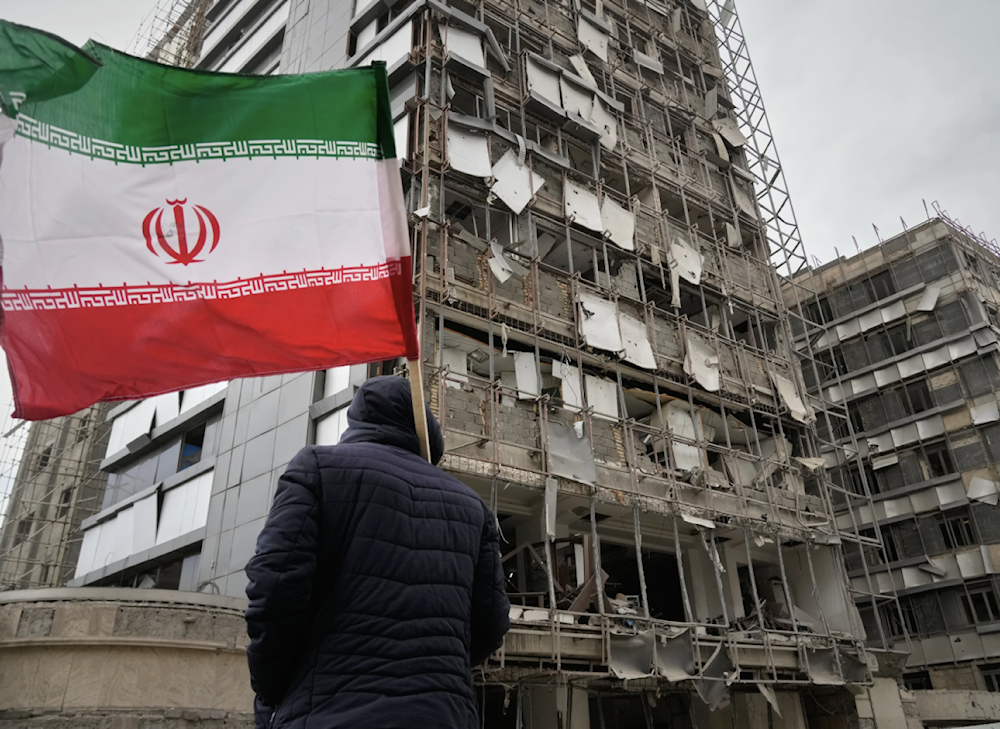
A man holds an Iranian flag as he looks at the damaged facade of Gandhi Hospital, which was hit Sunday when a strike also struck a state TV communications tower and nearby buildings across the street during the ongoing joint US-Israeli aggression on Iran on March 2, 2026. (AP)
The US-Israeli war on Iran is increasingly revealing a deep strategic incoherence, where military escalation is not matched by a clear political objective. Despite the destructive power deployed, Washington lacks a coherent plan to translate battlefield gains into lasting outcomes, Foreign Policy wrote.
From the outset, the war was justified as a means to eliminate alleged threats posed by Iran, ranging from its missile capabilities to its nuclear program, and even extending to "regime change."
Yet these overlapping goals have exposed a contradiction: Washington is pursuing maximalist ambitions without a viable strategy to achieve them.
While the US and "Israel" have relentlessly bombed Iran, their aggression has failed to produce decisive results. Instead of weakening Tehran’s resolve, the war has reinforced its incentives to resist and retaliate.
The notion that military force alone can secure political outcomes reflects a recurring miscalculation in US foreign policy, confusing destruction with victory.
No clear path forward
A full-scale invasion remains unrealistic, given Iran’s size, population, and military capacity. At the same time, a strategy of repeated strikes, often described as “mowing the lawn,” offers no lasting solution, only a cycle of aggression and retaliation.
De-escalation talks, meanwhile, face serious credibility challenges. Washington has withdrawn from previous agreements and carried out bombings during periods of dialogue, undermining trust and making any future deal unlikely.
The war has already exacted a heavy toll:
- Billions in military spending
- Disruptions to global energy markets
- Strain on US military resources
- Growing instability across the region
At the same time, Iran’s capabilities, while degraded, have not been eliminated, according to Foreign Policy. More significantly, the war has increased the likelihood of retaliation, including asymmetric responses targeting US interests.
Billions of dollars’ worth of advanced US military equipment has been destroyed or severely damaged since Washington and "Israel" launched large-scale strikes on Iran more than three weeks ago, The Wall Street Journal reported on Friday.
According to the report, the cost of damage and replacement over the first three weeks alone is estimated between $1.4 billion and $2.9 billion, including strikes on key US-linked infrastructure in the region, such as a major radar system in Qatar. Former Pentagon budget official Elaine McCusker, who has been tracking the financial impact, indicated that these losses are expected to feed into a proposed $200 billion emergency military spending request, reflecting the growing burden of the war on Washington.
A self-defeating strategy
The report points to a series of incidents that illustrate the mounting pressure on US forces. Among them was the loss of three F-15E Strike Eagle fighter jets on March 1 after being mistakenly shot down by a Kuwaiti aircraft, highlighting operational strain and coordination challenges even among allied forces. Each jet is valued at around $100 million.
In another case, an F-35A stealth fighter, one of the most advanced platforms in the US arsenal, was struck and forced into an emergency landing on March 19. Iran has said it engaged the aircraft, suggesting that even fifth-generation systems are vulnerable in a contested environment shaped by Iranian capabilities. Iran has also destroyed an E-3 Sentry AWACS.
Rather than defeating Iran, the war risks entrenching a long-term confrontation. By failing to achieve any of its objectives, Washington may have traded a manageable challenge for a more volatile and unpredictable one.
In the absence of a clear strategy, the US finds itself locked in an open-ended war, one where the costs continue to rise while the prospects for meaningful success remain uncertain.


