
US military assets worth $2.9bln damaged or destroyed in Iran war: WSJ
 4 Min Read
The Wall Street Journal reports that US forces have incurred up to $2.9 billion in losses within three weeks of the war on Iran.
-
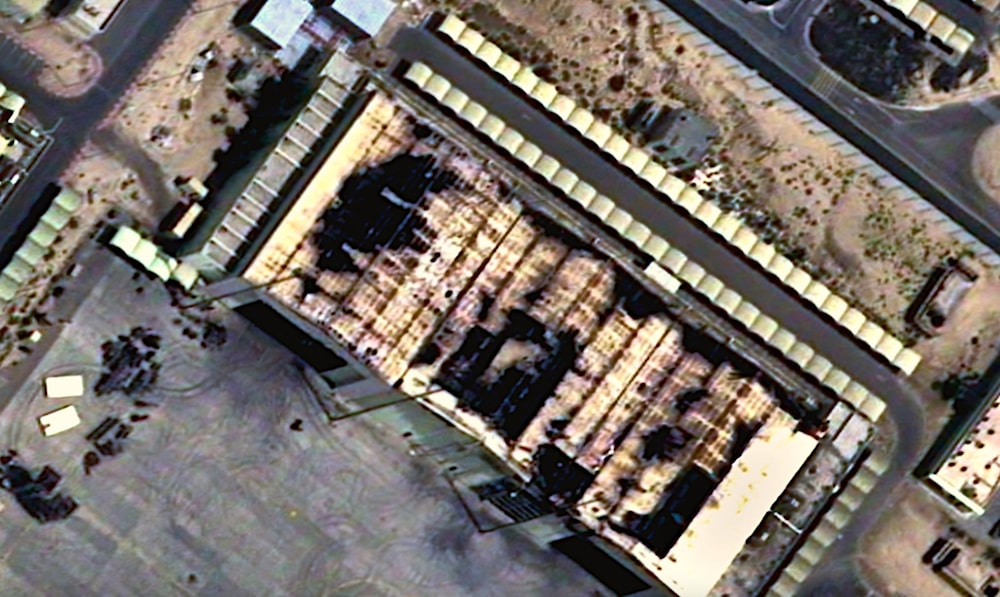
Satellite image showing extensive structural damage at Al Dhafra Air Base in the UAE following Iranian strikes on March 15, 2026. (image sourced from Soar Atlas)
Billions of dollars’ worth of advanced US military equipment has been destroyed or severely damaged since Washington and "Israel" launched large-scale strikes on Iran more than three weeks ago, The Wall Street Journal reported on Friday.
According to the report, the cost of damage and replacement over the first three weeks alone is estimated between $1.4 billion and $2.9 billion, including strikes on key US-linked infrastructure in the region, such as a major radar system in Qatar. Former Pentagon budget official Elaine McCusker, who has been tracking the financial impact, indicated that these losses are expected to feed into a proposed $200 billion emergency military spending request, reflecting the growing burden of the war on Washington.
The report points to a series of incidents that illustrate the mounting pressure on US forces. Among them was the loss of three F-15E Strike Eagle fighter jets on March 1 after being mistakenly shot down by a Kuwaiti aircraft, highlighting operational strain and coordination challenges even among allied forces. Each jet is valued at around $100 million.
In another case, an F-35A stealth fighter, one of the most advanced platforms in the US arsenal, was forced into an emergency landing on March 19. Iran has said it engaged the aircraft, suggesting that even fifth-generation systems are vulnerable in a contested environment shaped by Iranian capabilities.
Mounting system losses
Support infrastructure has also come under sustained pressure. A mid-air collision between two KC-135 Stratotankers over Iraq on March 12 resulted in the destruction of one aircraft and the deaths of six crew members. Meanwhile, Iranian missile strikes on Prince Sultan Air Base in Saudi Arabia damaged five additional tankers, further constraining US operational capacity. With the KC-135 no longer in production, Washington is expected to rely on the more costly KC-46 Pegasus to replenish its fleet.
Unmanned systems, long central to US military operations, have faced particularly heavy losses. As the Wall Street Journal reported, “More than a dozen MQ-9 Reaper drones have been lost since the war began,” with several shot down by Iranian air defenses and others destroyed on the ground. Some were also lost due to "friendly fire". The losses reflect the diminishing effectiveness of platforms once considered dominant, especially when confronted with advanced missile systems.
Iranian strikes have also targeted high-value surveillance and missile defense infrastructure across the region. A strike on an AN/TPY-2 radar tied to a THAAD system in Jordan, valued at over $300 million, and damage to the AN/FPS-132 early-warning radar at Al-Udeid Air Base in Qatar, estimated at around $1 billion, demonstrate a focus on degrading the US military’s detection and interception capabilities.
Widening war theater
Beyond individual systems, Iranian operations have extended across a wide geographic area, targeting radar, communications, and air defense infrastructure in countries hosting US forces, including Saudi Arabia, the United Arab Emirates, Bahrain, Kuwait, and Jordan. This broad scope reflects Tehran’s ability to project force across the region and challenge the network of US military positions.
Separately, the US aircraft carrier USS Gerald R. Ford was forced into port in Greece following a "fire onboard" on March 12, further affecting operational readiness, even though the incident was not directly linked to combat.
Taken together, the report points to a shifting dynamic in which relatively low-cost Iranian missiles and drones are imposing high financial and operational costs on the United States, raising questions about the sustainability of a prolonged confrontation under such conditions.
Read more: Trump admits Iran hit USS Ford carrier: 'We ran for our lives'


