
Trump claims 'regime change' in Iran as US aggression escalates
 4 Min Read
US President Donald Trump claims alleged "regime change" in Iran after weeks of US–Israeli aggression, highlighting contradictions between war rhetoric and political reality.
-
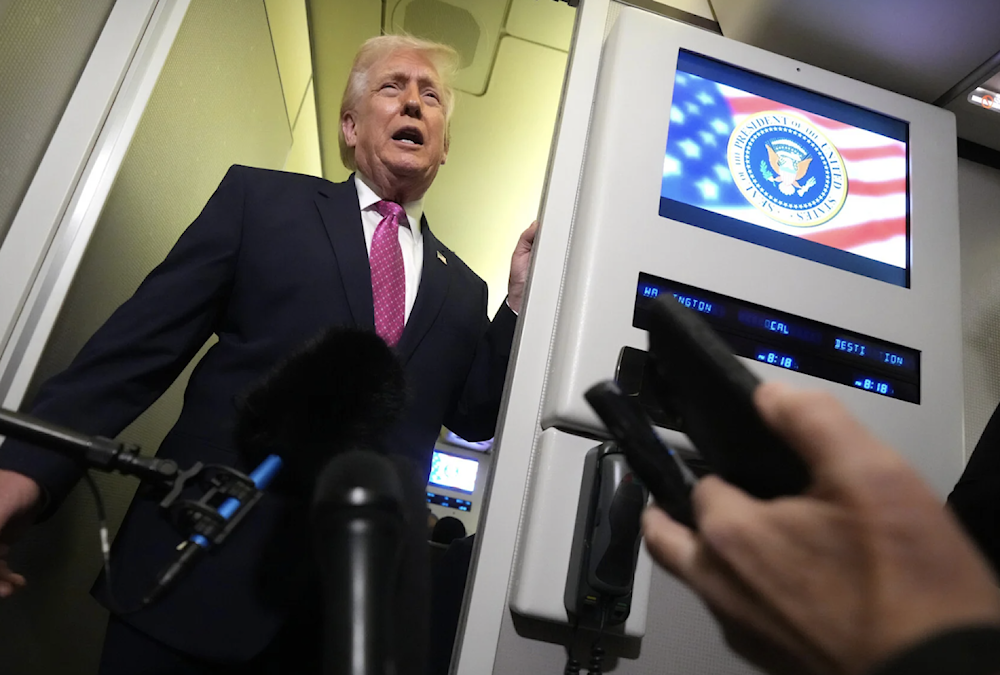
US President Donald Trump speaks to reporters aboard Air Force One en route from West Palm Beach, Florida, to Joint Base Andrews, Maryland, on March 29, 2026. (AP)
In a striking display of contradiction, US President Donald Trump claimed that Washington’s aggression alongside "Israel" on Iran has already achieved "regime change", while simultaneously expressing confidence that a deal with Tehran is within reach.
Speaking aboard Air Force One, Trump framed the martyrdom of Iranian leaders over the past month as proof of success, adding the US is now "dealing with different people", portraying the aftermath of targeted assassinations as a diplomatic breakthrough rather than a strategic failure. "I think we'll make a deal with them, pretty sure... but we've had regime change", Trump said.
Trump’s remarks effectively redefine regime change, not as political transformation, but as the outcome of sustained military aggression and assassinations.
Sayyed Mojtaba Khamenei, son of the martyred leader Sayyed Ali Khamenei, assassinated in the opening days of the war on Iran, was elected as the country's new leader, underscoring Tehran’s institutional continuity despite repeated bombardments.
Sayyed Ali Khamenei was assassinated in joint US-Israeli airstrikes, in what Israeli officials characterized as a "decapitation strike" intended to paralyze Iranian decision-making and foster a leadership transition more favorable to Western interests.
The shift in tone comes after Trump dismissed the late leader's son as an "unacceptable lightweight". Trump signaled a desire for a hand-picked successor who would align with US regional goals, warning that a continuation of anti-West policies would lead to further aggression. "We're dealing with different people than anybody's dealt with before. It's a whole different group of people. So I would consider that regime change", Trump continued.
Hormuz pressure and selective narratives
Since the start of the aggression, Iran has imposed effective control over the Strait of Hormuz, disrupting nearly one-fifth of global oil flows and sending energy markets into turmoil.
Yet Trump presented the reported passage of several oil tankers as a gesture of "respect" toward Washington, an interpretation that stands in stark contrast to the broader context of confrontation and deterrence. "They gave us, I think, out of a sign of respect, 20 boats of oil, big, big boats of oil going through the Hormuz Strait", Trump claimed, suggesting shipments would start as early as Monday morning.
The US president’s remarks highlight a familiar pattern: attack militarily, then speak of diplomacy, declare victory, then seek negotiations. Trump’s assertion of “regime change” may signal less a reality on the ground than an attempt to frame ongoing aggression as an achievement, despite the persistence of Iran’s state structure and its capacity to respond.
Iran: Trump wanted regime change, now just begging for Hormuz to open
Iran's Parliament Speaker Mohammad Bagher Ghalibaf said on Sunday, marking the 30th day of Iranian national defense against the US-Israeli aggression, that the US president's objectives have dramatically shifted since the start of the war on Iran.
"The enemy who claimed to have destroyed our air, naval, and missile forces, and had a plan for the collapse of the Islamic Republic, has now set his goal on reopening the Strait of Hormuz," Ghalibaf said.
"Reopening a strait that was open before the war has become Trump's operational dream", he said mockingly.
Ghalibaf stated that the war on Iran, which has come to be known as the Ramadan War, is now at its most critical moment. He noted that Trump is unable to secure the support of European countries, that energy markets are out of control, and that food inflation is approaching.


