
Trump backfires on Meloni as confrontation aids European unity
 3 Min Read
A confrontation between Trump and Meloni has strengthened European unity, pushing EU leaders closer together on defence, trade, and foreign policy amid global tensions.
-
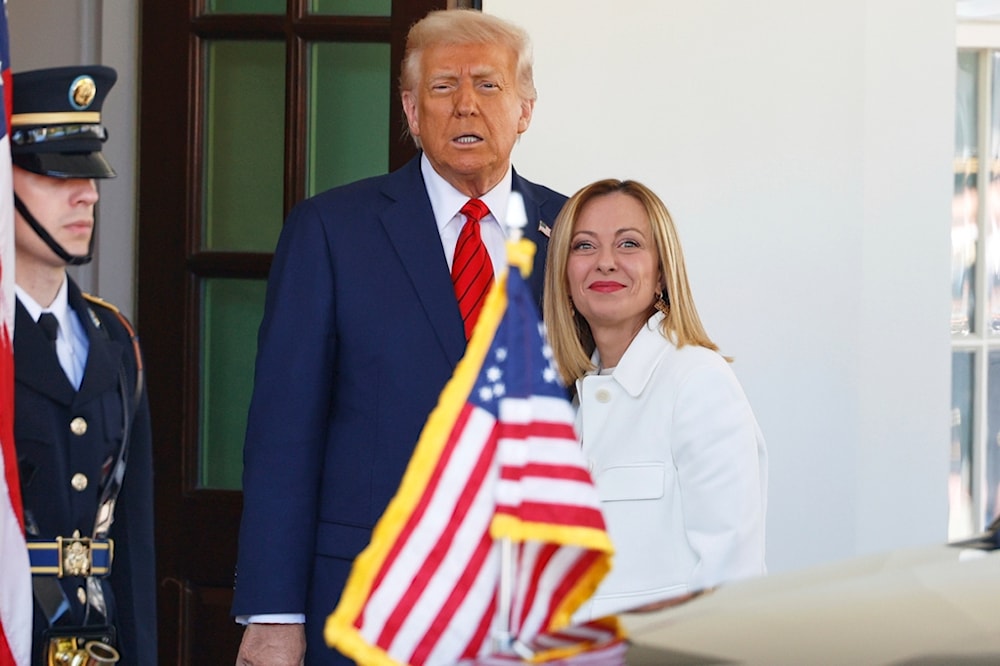
United States President Donald Trump, center, greets Italy's Prime Minister Giorgia Meloni, right, upon her arrival at the White House, April 17, 2025, in Washington. (AP)
A confrontational exchange involving United States President Donald Trump and Italian Prime Minister Giorgia Meloni has had the opposite of its intended effect, strengthening European political cohesion and accelerating coordination among key EU capitals on security, trade, and foreign policy.
The episode began after Trump questioned Italy’s reliability as a wartime partner and suggested that Italian Prime Minister Giorgia Meloni had sought his attention during diplomatic engagements.
The remarks were met with swift political and diplomatic pushback across Europe, with several leaders expressing solidarity with Meloni and dismissing the framing of Italy’s role within NATO and EU security structures.
The controversy has also helped ease earlier hesitation among European capitals regarding Meloni’s far-right politics, with her now increasingly integrated into high-level European coordination mechanisms.
Europe moves toward tighter coordination
In the aftermath of the exchange, European leaders from Germany, France, the United Kingdom, and Poland moved to reinforce consultations on defense and geopolitical strategy amid overlapping global crises, including the Ukraine war, the war on Iran, and tensions with Russia and China.
Meloni later participated in a series of high-level meetings with European counterparts, including her first bilateral summit with French President Emmanuel Macron since the COVID-19 pandemic period, signalling a notable thaw in previously strained relations.
Analysts argue that Washington’s increasingly confrontational trade and foreign policy posture has accelerated a shift in Europe toward bloc-based decision-making, particularly on tariffs and security policy.
“Europe is getting squeezed between China and America,” said Sudha David-Wilp of the German Marshall Fund, adding that European states “need to act as a bloc.”
Nationalist parties distance themselves from Trump
The political fallout has not been limited to centrist European governments. Several far-right and nationalist parties that had previously aligned with Trump’s rhetoric have begun to publicly distance themselves from him.
In France, far-right leader Jordan Bardella described Trump as “erratic” and accused the United States of “foreign interference,” while Germany’s Alternative for Germany has also criticized the US war on Iran.
Even in Hungary, where Prime Minister Viktor Orban had long been considered a key Trump ally in Europe, political setbacks have raised questions about the durability of that alignment following his defeat in recent elections.
Wider geopolitical backlash
The ripple effects of Trump’s foreign policy approach have also extended beyond the European Union. His previous remarks on Greenland prompted protests in Greenland, Denmark, and the EU, while political controversies linked to Trump-affiliated business projects have surfaced in Albania.
A recent Pew Research Center survey further underscored the political strain, showing that 83% of respondents in Italy expressed little or no confidence in Trump’s handling of foreign affairs.
Read more: Meloni says Italy only provided logistic support for war on Iran


