
Trump denies US role in South Pars strike
 3 Min Read
US President Donald Trump says "Israel" attacked Iran’s South Pars gas field without US or Qatari involvement, as conflicting reports suggest prior American knowledge of the strike.
-
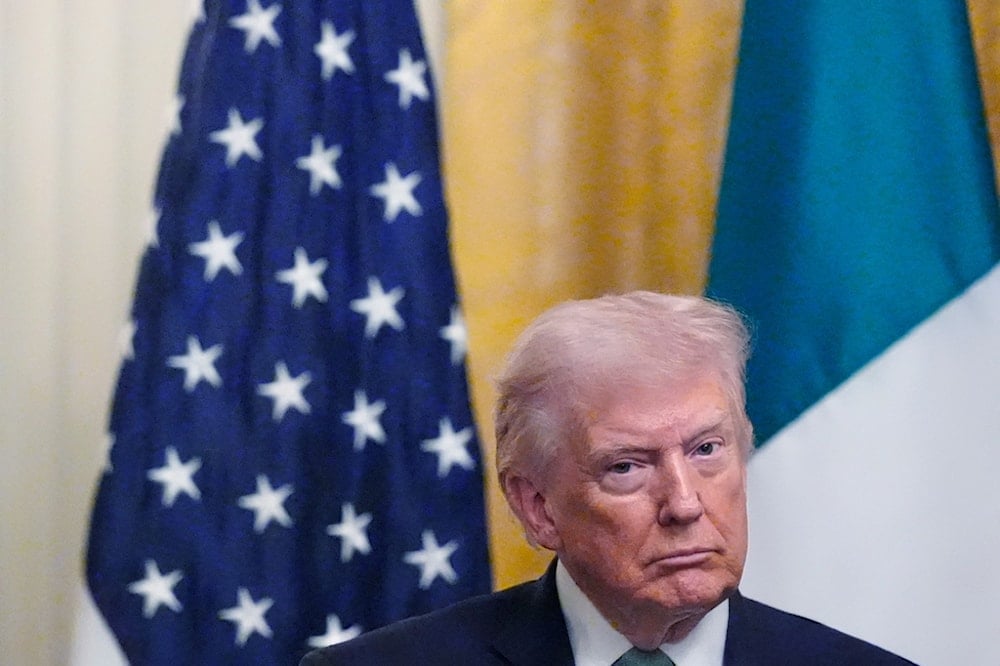
President Donald Trump listens during a shamrock presentation event with Irish Prime Minister Micheál Martin in the East Room of the White House, on St. Patrick's Day on March 17, 2026, in Washington. (AP)
US President Donald Trump has claimed that "Israel" attacked Iran’s South Pars gas field without prior knowledge or involvement from Washington or Doha, amid escalating tensions in the region.
Iranian state TV reports that phases 3, 4, 5, and 6 of the South Pars gas field were struck, marking a significant hit to key energy infrastructure.
Israeli occupation officials confirmed that they bombed Iran’s largest natural gas processing facility in Bushehr Province this morning, while Iranian reports say strikes hit South Pars and Asaluyeh, forcing several phases offline.
European gas prices jumped 6% after the attacks on Iranian gas facilities, surpassing $650 per 1,000 cubic meters for the first time since March 9, according to trading data.
Trump denies prior knowledge
In remarks posted on his Truth Social account, Trump stated that the United States was not informed in advance of the Israeli strike, emphasizing that Qatar was also unaware and had no role in the operation.
He described the attack as targeting a relatively limited section of the South Pars facility, one of Iran’s most significant energy sites.
Trump further claimed that Iran’s subsequent targeting of Qatari liquefied natural gas facilities was “unjustifiably and unfairly.”
Context: Strategic importance of South Pars and regional energy war
The South Pars field is the world's largest natural gas field, located in the Gulf area and jointly owned by Iran and Qatar. The attack on facilities in the Asaluyeh region represents a significant escalation in the targeting of Iran's energy infrastructure.
The attacks come amid a widening energy war across the region. Since the United States and "Israel" launched their aggression against Iran on February 28, Tehran has been targeting US bases and facilities in neighboring Gulf Arab countries.
As a result of the ongoing war, the price of Brent crude oil, the international standard, has surged more than 40% since the start of the war, remaining stubbornly over $100 per barrel.
Warning of escalation
The US president warned that any further Iranian attacks on Qatari energy infrastructure could trigger a severe response.
He stated that Washington, “with or without” Israeli involvement, could “completely destroy” the South Pars gas field if such attacks were repeated.
“I don’t want to authorize that level of violence and destruction,” Trump said, citing potential long-term consequences, and that he would not hesitate if Qatari facilities are targeted again.
Conflicting reports emerge
Despite Trump’s claims, US and Israeli media reports suggest otherwise.
According to the Associated Press, a source familiar with the matter said Washington had prior knowledge of the Israeli strike, though it did not directly participate.
Meanwhile, Axios correspondent Barak Ravid reported that US and Israeli officials confirmed the attack had been coordinated with American approval, aimed at increasing pressure on Iran. The report added that Trump’s tone shifted following Iran’s retaliatory strikes on energy sites in Qatar.
Earlier, Iran’s Oil Ministry announced that facilities in the Pars Special Economic Zone in Asaluyeh were struck in what it described as an American-Israeli attack, causing damage to parts of the infrastructure.
The developments mark a significant escalation in the targeting of energy infrastructure, raising concerns over broader regional fallout.


