
Trump downplays Iran war despite rising US casualties: The Atlantic
 6 Min Read
An Atlantic analysis examines the expanding US-Iran war, mounting military costs, and the Trump administration's reluctance to publicly acknowledge the war.
-
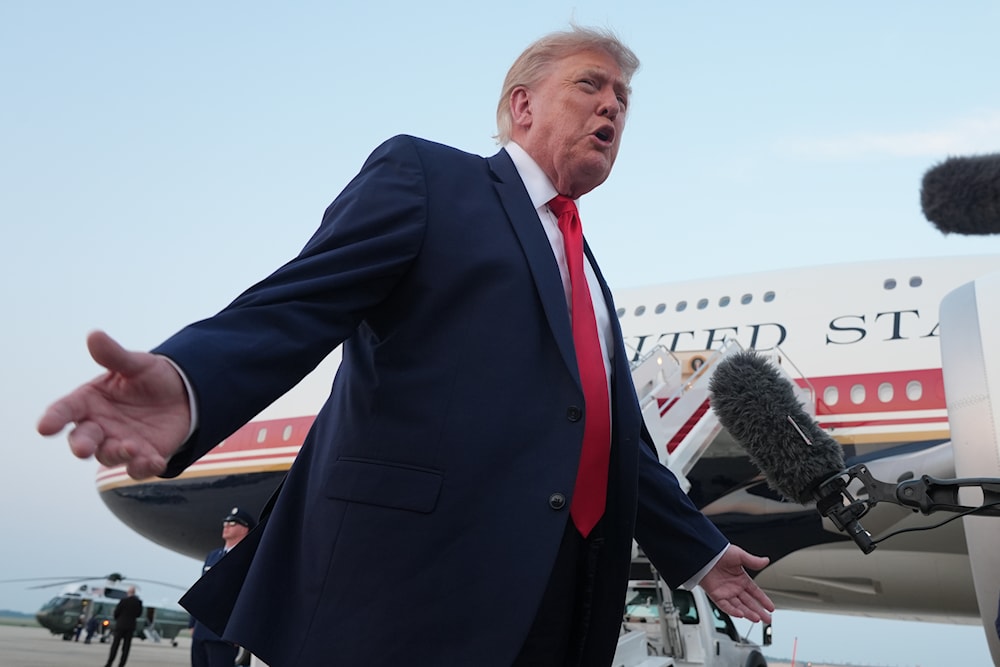
US President Donald Trump speaks to reporters as he exits Air Force One at Joint Base Andrews, Md., after attending the World Cup final soccer match on July 19, 2026. (AP Photo/Jacquelyn Martin)
The Trump administration has resumed military aggression against Iran but has largely avoided publicly acknowledging the aggression as a renewed war, according to an opinion piece published by The Atlantic.
The report said that in the 11 days since the US resumed airstrikes against Iran, neither US President Donald Trump nor senior administration officials have publicly provided detailed accounts of the operation. US forces initially targeted Iranian military facilities before expanding attacks to civilian infrastructure that the administration says is being used for military purposes.
According to congressional aides cited by The Atlantic, lawmakers had yet to receive classified briefings on the latest phase of the fighting.
Pentagon faces questions over US military strategy
The Pentagon has also not held a press briefing since May to address questions about the renewed military aggression, including its strategic objectives, the reasons for resuming the war, US military casualties, and what would constitute success.
Trump, who has repeatedly claimed that the war had already been won, scheduled a televised address to the nation last week but focused instead on election security, mentioning Iran only briefly.
“We are likewise winning big in Iran, and you will see the fruits of that labor very, very shortly,” Trump said.
War Secretary Pete Hegseth and Chairman of the Joint Chiefs of Staff General Dan Caine appeared on Capitol Hill to seek $67.1 billion in emergency military funding to replenish munitions and cover other costs, in addition to the Pentagon's $1.5 trillion regular budget request.
According to The Atlantic, neither official mentioned Iran in their opening statements, while Hegseth referred to the war as "an operation" during his testimony.
The report also highlighted the Pentagon's handling of the deaths of US service members. After two US troops were killed in Jordan by an Iranian retaliatory missile, the Pentagon initially said they had died while supporting Operation Inherent Resolve, the US campaign against ISIS. A subsequent statement said the two troops and another service member killed in Iraq had died while "supporting overseas operations," without explicitly naming Operation Epic Fury, the Pentagon's designation for the war on Iran.
US military casualties and costs mount
With those deaths included, at least 18 US service members have been killed in combat since the war began, according to the report. At least 1,700 Iranians have also been martyred, according to Iranian officials, including dozens in the previous 10 days.
Trump is scheduled to attend a ceremony at Dover Air Force Base honoring the fallen US service members. However, the president has continued to insist that the military campaign is progressing successfully, while also threatening Iran over the deaths of US personnel.
The report cited a senior US official who said initial intelligence assessments indicated that the latest US attacks had likely done little to change Iran's behavior.
According to The Atlantic, the Trump administration had expected a quick victory and did not prepare for a prolonged war. While the US military has deployed additional forces to the region, many assets, particularly Navy ships, were diverted from other theaters rather than specifically prepared for the war. The Pentagon has since extended the deployments of nearly half of those ships, increasing pressure on an already stretched force.
The United States also launched the war alongside "Israel" without seeking support in advance from other allies, the report said, adding that no country has offered to share the burden of the US blockade of the Strait of Hormuz or the protection of American forces in the region.
Trump faces pressure over war's direction
Hegseth and Caine also faced resistance on Capitol Hill over their request for funding to cover "certain aspects" of the war, estimated at $37.5 billion.
A former senior military officer cited by The Atlantic argued that the administration had rejected traditional approaches involving public communication, consultations with allies, and clearly defined objectives, leaving the United States with limited options and little international support.
The report said Trump's political allies privately acknowledge that the president faces a difficult choice: escalate the war at the risk of additional US casualties and depleted weapons stocks, or withdraw and potentially leave Iran in a stronger strategic position.
Trump has continued to signal that the US will remain engaged in the war. While meeting with the Lebanese president at the White House, he told reporters, "We're not finished at all. We're not leaving right now."
He also said the United States was planning to bomb Pickaxe Mountain over suspicions that the site houses part of Iran's nuclear program.
War risks widening across the region
According to The Atlantic, the Trump administration's apparent objective is to increase the cost to Iran of disrupting shipping through the Strait of Hormuz, while Tehran seeks to raise the cost of the US military presence in the region and prevent vessels from transiting the waterway without its permission.
A UK maritime agency said a tanker operating in the strait had been struck by an unidentified projectile, forcing its crew to abandon the vessel. US officials also said Iran had increased its targeting of American naval assets.
According to the report, Iran has adapted its tactics during the war, shifting from relatively inexpensive drones toward faster and more destructive ballistic missiles.
In one 24-hour period, Iran launched at least three ballistic missiles toward Jordan, according to the report. One video reportedly showed a missile striking a Jordanian base operated by the US, raising concerns at the Pentagon that commanders could be conserving air-defense munitions amid limited stocks.
Meanwhile, the war risks expanding further. "Ansar Allah announced its intention to enter the war", as per the analysis, and restrict parts of the Red Sea to shipping, potentially adding to pressure on global energy markets.
The war appears to be broadening rather than moving toward an end, as the report concluded, despite the White House's limited public acknowledgment of the renewed aggression.


