
While bombing Iran, Trump greenlights landmark Saudi nuclear deal: WSJ
 8 Min Read
Trump approves a 30-year US-Saudi nuclear agreement that could allow uranium enrichment in Saudi Arabia, sparking nonproliferation concerns.
-
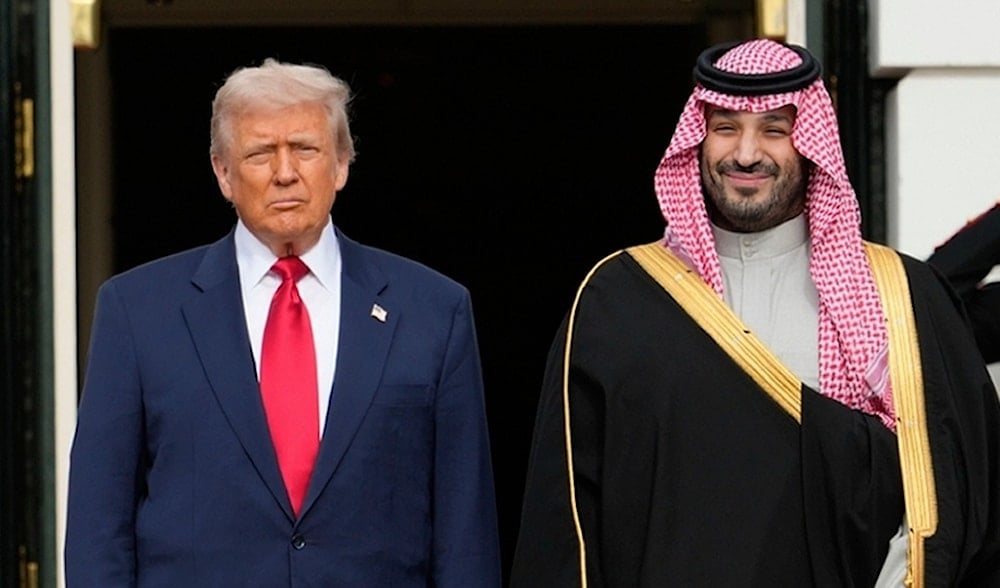
President Donald Trump stands with Saudi Arabia's Crown Prince Mohammed bin Salman on his visit to the White House, Nov. 18, 2025, in Washington. (AP)
US President Donald Trump has formally approved a landmark nuclear deal with Saudi Arabia that would provide the kingdom with a civilian nuclear program and potentially open the door to uranium enrichment on Saudi soil, according to an exclusive report by The Wall Street Journal (WSJ) citing administration officials.
The new US-Saudi nuclear agreement, which would remain in effect for 30 years, is estimated to be worth tens of billions of dollars. It is designed to give American companies a central role in developing Saudi Arabia's nuclear infrastructure while limiting the involvement of foreign competitors.
A key provision of the agreement would allow American companies to build a uranium enrichment facility in Saudi Arabia if a joint US-Saudi study determines that such a step is warranted. The arrangement would give Washington greater influence over the kingdom's nuclear program, with Trump administration officials arguing that the US role could help prevent the technology from being diverted toward military purposes.
The deal, which is expected to be submitted to Congress for review in the coming days, is likely to face opposition from lawmakers concerned about the spread of nuclear technology in the region.
Implications of US-Saudi nuclear agreement
The agreement could prove difficult for lawmakers to block because doing so would require a joint resolution and a two-thirds majority vote if Congress needed to override a potential presidential veto.
Trump approved the agreement late last week, according to the Wall Street Journal (WSJ). The accord is expected to be signed on Wednesday by US Energy Secretary Chris Wright, who discussed the deal during his first overseas trip to the region in April 2025 with his Saudi counterpart, Prince Abdulaziz bin Salman, who will also sign the agreement.
"The agreement could help revitalize the US nuclear industry, strengthen US-Saudi ties and deny Russia and China a strategically important role in the Saudi nuclear program", said Robert Einhorn, a former longtime senior State Department official who advised both Republican and Democratic administrations on nonproliferation issues.
“But unless it contains adequate constraints, including on enrichment, it could increase nuclear proliferation risks in the Middle East and beyond,” Einhorn added.
Deal could pave the way for Saudi uranium enrichment
Saudi officials have long argued that a civilian nuclear program is necessary to help the kingdom develop a domestic nuclear industry. The program would draw on unproven uranium ore deposits to meet energy needs at home, potentially freeing up more of the country's oil production for export and increasing revenues.
Saudi Arabia maintains that its nuclear ambitions are peaceful. However, Mohammed bin Salman, the de facto leader of the kingdom, said in 2018 that if Iran were to develop a nuclear weapon, Saudi Arabia would follow suit.
Westinghouse Electric and its AP1000 reactor would be among the biggest beneficiaries of the agreement. The AP1000 reactor produces about 1,100 megawatts of electricity, enough to power a midsize city or a major AI data center.
The deal's safeguards are expected to face increased scrutiny from lawmakers, particularly given concerns over the development of nuclear weapons capabilities amid the ongoing war against Iran.
Under the agreement, American companies would provide new power reactors and other nuclear technology, with some of their foreign suppliers potentially playing a secondary role.
As reactor projects move forward, US and Saudi officials would conduct a two-year study examining the potential value of uranium enrichment for the kingdom. The study would assess whether it would be commercially viable for Saudi Arabia to enrich uranium domestically rather than rely on imported nuclear fuel.
If the study concludes that domestic enrichment is warranted, American companies would build the enrichment facility under a secretive "black box" arrangement designed to prevent the transfer of sensitive enrichment technology to Riyadh.
Trump administration officials argue that the American role would prevent enriched uranium from being diverted toward military purposes and ensure that spent reactor fuel could not be reprocessed to produce a nuclear weapon.
If Washington objects to proceeding with enrichment after the study, Saudi Arabia would not be permitted to conduct enrichment, either independently or with another foreign partner, for 10 years.
Trump administration officials maintain that the central US role in the Saudi Arabia nuclear program would ensure that any enrichment activities remain peaceful.
Israeli intelligence believes Iran transferred thousands of uranium-enrichment centrifuges into tunnels deep inside a mountain last fall, The Wall Street Journal reported, citing Israeli and US officials.
— Al Mayadeen English (@MayadeenEnglish) July 21, 2026
The officials said "Israel" shared the intelligence assessment with… pic.twitter.com/iVg0aJKqxN
Critics warn of nuclear proliferation risks
Critics, however, argue that providing Saudi Arabia with a civilian nuclear program, particularly one that could include uranium enrichment or plutonium reprocessing capabilities, could encourage the spread of nuclear technology across the West Asia region.
Unlike the United Arab Emirates, Saudi Arabia has rejected the so-called "gold standard", a commitment never to enrich uranium domestically or reprocess spent nuclear fuel.
“Whither goes Saudi Arabia, so goes the United Arab Emirates, Turkey and Egypt. The idea that this will have a happy ending is delusional,” said Henry Sokolski, executive director of the Nonproliferation Policy Education Center.
Disagreements over future inspections have also intensified the debate over the Saudi Arabia uranium enrichment provision.
Saudi Arabia rejected the "Additional Protocol", an arrangement implemented by the International Atomic Energy Agency that would provide more rigorous monitoring and inspections. Trump administration officials say the separate agreement negotiated with Riyadh would still provide adequate monitoring of US-provided nuclear sites.
Critics argue, however, that the proposed framework would be insufficient to investigate suspected nuclear activities that do not involve US facilities or technology.
Deal marks shift from Biden-era conditions
The Trump administration's new deal is also controversial for foreign policy reasons.
The Biden administration had been prepared to pursue nuclear cooperation with Riyadh but conditioned such an agreement on Saudi Arabia's willingness to normalize relations with "Israel". Prospects for normalization were derailed by the Israeli genocide in Gaza, which began on October 7, 2023.
While Trump has urged Saudi Arabia and other Islamic states to join the so-called "Abraham Accords", his administration is not requiring Riyadh to establish relations with "Israel" as a condition for purchasing American nuclear technology and launching its civilian nuclear program.
Trump backs Saudi's nuclear ambitions while targeting Iran's
The US-Saudi nuclear agreement also comes as the White House continues to pressure Iran to curtail its nuclear program and surrender its supply of highly enriched uranium.
Critics argue that the agreement places the Trump administration in a difficult position as it continues to bombard Iran over its peaceful nuclear program and claims of its pursuit of a nuclear weapon, which Tehran denied, while simultaneously helping Riyadh develop a nuclear program.
Trump administration officials reject that comparison, claiming that there is no contradiction as long as the Saudi program is subject to effective safeguards.
“Rest assured, these agreements uphold the highest standards of nuclear safety and nonproliferation, while relying on the world’s best nuclear technology and scientists, designed right here in the United States,” Wright said in a statement. "Thanks to President Trump, the American nuclear renaissance is underway and will deliver long-term benefits to the American and Saudi people".
Read more: Iran urges UNSC to condemn US attack on Darkhovin nuclear facility
Congress faces challenge in blocking nuclear agreement
Democratic and Republican presidents have long resisted efforts by regional countries to enrich uranium. However, lawmakers seeking to block the deal are likely to face a difficult path.
Some members of Congress have argued that a nuclear agreement with Saudi Arabia is sufficiently sensitive to warrant a tougher congressional approval process.
In 2018, Democratic and Republican lawmakers sponsored legislation that would have blocked nuclear cooperation with Riyadh unless Congress affirmatively voted to approve it.
One of the senators who supported the higher hurdle was then-Florida Republican Senator Marco Rubio, who is now Trump's secretary of state. The legislation was never brought to a vote.
Read more: Trump seizes enriched uranium, but from Venezuela, not Iran


