
Trump faces voter regret as approval sinks amid US-Israeli war on Iran
 5 Min Read
Trump's approval declines as polls show rising voter regret and 28% disapproval over the war on Iran among his 2024 supporters.
-
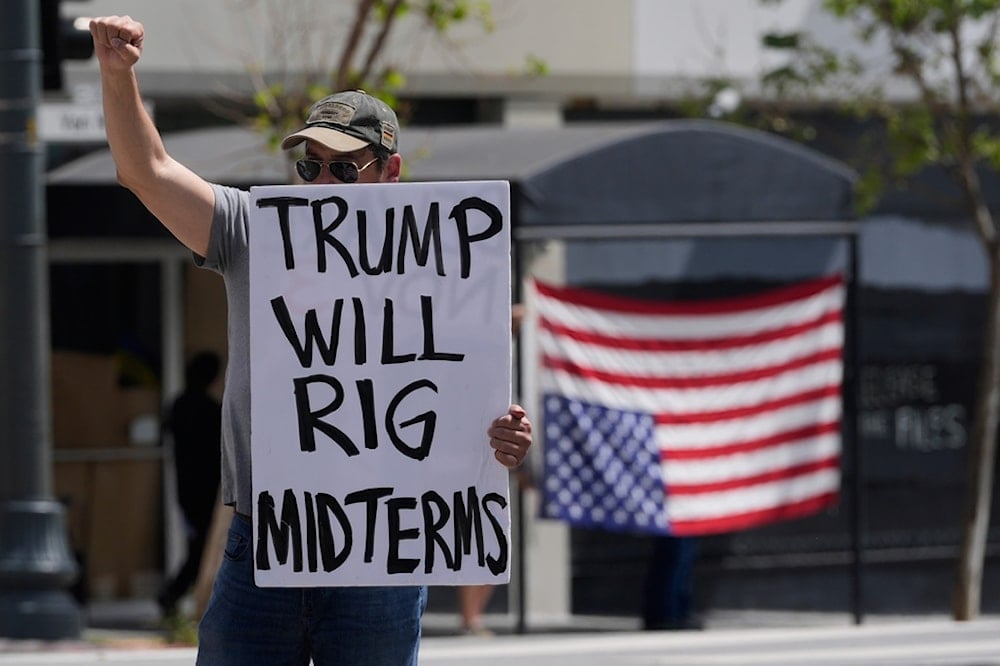
A protester holds up a sign as part of a Trump Regime Takedown rally in San Francisco, Saturday, April 4, 2026 (AP)
US President Donald Trump is facing declining approval ratings as new polling data point to growing dissatisfaction among his voter base, particularly in the context of the ongoing US-Israeli war on Iran.
Recent surveys indicate a shift in sentiment among Trump voters, with a noticeable rise in those expressing concerns, mixed feelings, or regret over their 2024 vote. A poll conducted by YouGov in partnership with the University of Massachusetts Amherst shows that the share of Trump voters who remain “very confident” in their vote has dropped from 74% in April 2025 to 62% today.
According to the same poll, 38% of Trump voters now express less certainty about their choice, compared to 19% of voters who supported Vice President Kamala Harris. An additional 21% of Trump voters say they are still confident in their decision but acknowledge having “some concerns".
The proportion of Trump voters reporting at least “mixed feelings” has also increased significantly, rising from 8% in April 2025 to 17% in recent data. While only 5% explicitly stated they regret their vote, broader indicators suggest a higher level of dissatisfaction.
When asked how they would vote again, 84% of Trump voters said they would choose him, compared to 91% of Harris voters who would repeat their choice. This suggests that a notable segment of Trump’s base would reconsider their support with hindsight.
Broader dissatisfaction
A separate poll conducted by Strength in Numbers-Verasight found that 13% of Trump voters expressed some degree of regret, including 5% who said they “strongly” regret their vote and 8% who “somewhat” regret it. This figure is roughly double the level of regret recorded among Harris voters.
The data also indicate that regret is more pronounced among younger voters and Hispanic voters within Trump’s base, with 17% of those under 30 and 16% of Hispanic respondents expressing dissatisfaction.
These figures mark a notable increase from earlier polling in 2025, when only 6–7% of Trump voters reported similar sentiments. Analysts suggest that this shift could have implications for upcoming elections if such trends persist.
Disapproval rating
Beyond voter regret, recent polling by CNN shows declining approval ratings for Trump across several major policy areas. Among his 2024 voters, 22% now disapprove of his overall performance.
Disapproval is particularly high on economic issues, with 30% dissatisfied with his handling of the economy, 39% on inflation, and 45% on gas prices. On foreign policy, 25% disapprove, while 28% specifically express dissatisfaction with his approach to Iran. Immigration, a central campaign issue, also sees 15% disapproval among his supporters.
Support has also weakened among key demographic groups. Approval among working-class white voters, a core constituency for Trump, has dropped from 63% in February 2025 to 49% in the latest CNN poll.
Implications ahead of midterm elections
The emerging trend of declining confidence and growing dissatisfaction among Trump voters could have significant political consequences. Polling suggests that between one in eight and one in six of his supporters express some level of regret or hesitation regarding their vote.
If even a portion of these voters shift away from the Republican Party in the 2026 midterm elections, analysts indicate it could reshape the electoral landscape.
While not all voters describe their sentiment as outright regret, the data reflect a broader erosion of support within Trump’s base as domestic and foreign policy challenges intensify.
Political backlash grows over Trump’s war on Iran
The decline in support comes as a growing number of US political figures sharply criticize President Donald Trump over his recent threats against Iran, in which he called for escalating attacks on critical infrastructure and demanded the reopening of the Strait of Hormuz.
The remarks have triggered alarm across Washington, with officials warning that such rhetoric signals a dangerous escalation in the ongoing US-led war on Iran.
Calls to curb presidential powers intensify
Senator Chris Murphy warned that Trump’s conduct raises serious constitutional concerns, suggesting the possibility of invoking the 25th Amendment.
“If I were in Trump’s Cabinet, I would spend Easter calling constitutional lawyers… This is completely, utterly unhinged,” he wrote, adding that the president’s decisions risk further mass casualties.
US Representative Melanie Stansbury echoed the criticism, stating, “The emperor has no clothes. Time for the #25thAmendment. Congress and the Cabinet must act.”
The emperor has no clothes.
— Rep. Melanie Stansbury (@Rep_Stansbury) April 6, 2026
Time for the #25thAmendment. Congress and the Cabinet must act. pic.twitter.com/Ad6AERp9N6
Senator Elissa Slotkin also warned that Trump’s threats could violate international law, including the Geneva Conventions and established US military doctrine. She stressed that targeting civilian infrastructure such as bridges and power plants would constitute a breach of the law of war, describing it as "irresponsible and wrong to indiscriminately kill civilians in Iran and destroy civilian infrastructure."
Slotkin further highlighted the risks for US troops, noting they could face both legal and mortal consequences, while warning that Trump’s decisions risk dragging the US into a prolonged war that undermines security, increases economic pressure, and costs American lives. She called for a negotiated end to the conflict, the reopening of the Strait of Hormuz, and the withdrawal of US forces.
Read more: 'We're fighting wars, we can't take care of daycare': Trump


