
Trump must break with 'Israel' to end war on Iran: TAC
 5 Min Read
US President Donald Trump faces mounting pressure to end the war on Iran, with analysts arguing a break from "Israel" is key to any diplomatic resolution.
-
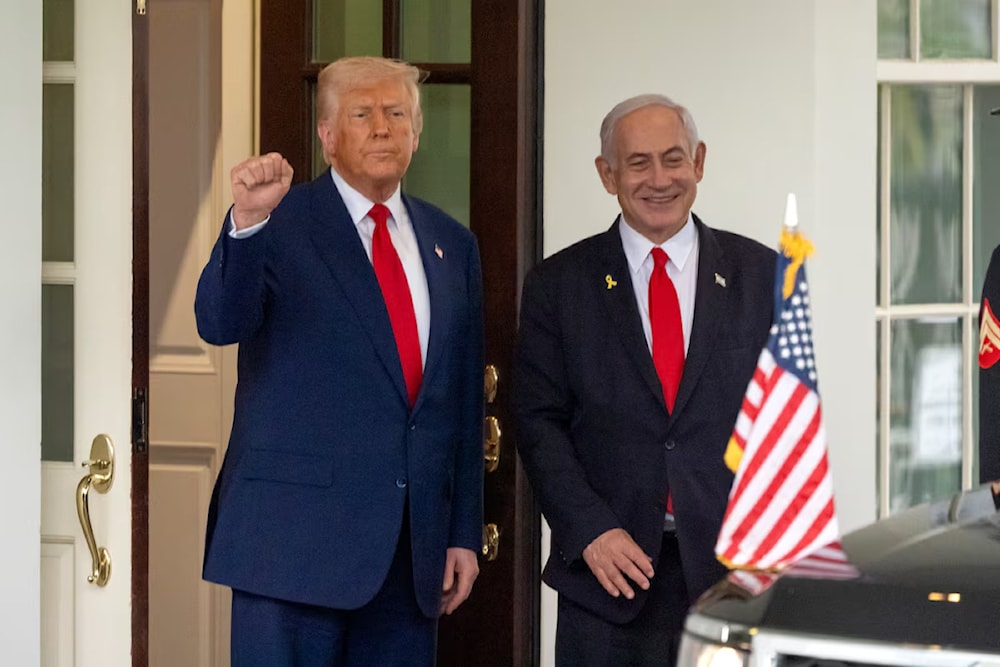
US President Donald Trump and "Israel's" Prime Minister Benjamin Netanyahu at the White House on April 27, 2025 (Mark Schiefelbein/ AP)
US President Donald Trump claims that he is optimistic about ending the war on Iran, despite continuing hostilities and escalating regional tensions through continued attacks against the Islamic Republic.
Trump, known for emphasizing positive outcomes, stated this week that “I think we’re gonna end it,” before adding, “This war has been won.” His remarks come amid ongoing military developments that suggest the aggression will continue.
Days prior, the US president stated that Washington held "very good and productive conversations" with Iran; though Iranian officials have come out and quickly denied any such talks. Analysts also voiced skepticism over such negotiations.
Andrew Day writes for the American Conservative that recent developments on the ground indicate that the war on Iran is far from over. He notes Iranian missile strikes have targeted military sites in Tel Aviv, while Tehran has continued to leverage its control over maritime routes in the Strait of Hormuz.
Analysts note that Iran retains significant leverage in determining the trajectory of the war, with Tehran signaling it will not halt its response unless the US and "Israel" face tangible consequences for their unprecedented military actions.
The US administration has adopted an escalatory tone. US Secretary of War Pete Hegseth stated that “we negotiate with bombs,” while US Press Secretary Karoline Leavitt said, “The President doesn't bluff and he is ready to unleash hell.” Trump also claimed that Iran must take the talks seriously “before it is too late, because once that happens, there is NO TURNING BACK, and it won’t be pretty!”
Read more: US allies have 'no idea' what Washington is doing in war on Iran
Iran's lawmakers have said that the Islamic Republic should stay firm on its defensive posture, stressing that Iran's "Sacred Defense" must continue until all threats are removed and any chance of new attacks on Iranian territory is eliminated.
The Iranian Parliament said in a statement that the defense should remain until all US and Israeli bases and forces in West Asia are dismantled and removed.
Analysts say 'Israel' remains key obstacle to diplomacy
Policy analysts increasingly argue that a resolution to the war on Iran hinges not only on US-Iran engagement but also on Washington’s special relationship with "Israel".
Curt Mills, executive director of The American Conservative, stated earlier this week that “This war is not going to end until President Trump says no to Israel,” pointing to the role of "Israel" in shaping US policy decisions.
Former US official Joe Kent suggested to The American Conservative that earlier diplomatic efforts between Washington and Tehran were disrupted by "Israel", which opposed terms that would have allowed Iran limited uranium enrichment for civilian purposes.
According to this view, "Israel" pushed for more maximalist demands, including zero enrichment, contributing to the collapse of negotiations that had been nearing completion.
Diplomatic path hinges on shifting US policy
Further reporting indicates that "Israel" has consistently advocated for sustained military pressure on Iran. Day writes that Israeli Prime Minister Benjamin Netanyahu has long urged a US aggression against Tehran and continues to support an extended campaign.
Analysts warn that actions taken during the war, including targeting figures linked to diplomacy, have reduced the likelihood of negotiations. However, some experts believe that a negotiated settlement remains possible if the US adjusts its approach. Trita Parsi, of the Quincy Institute, told The American Conservative that sanctions relief and security guarantees would be necessary to reach an agreement, adding that both sides require a framework that allows them to claim strategic gains.
He also warned that prolonging the war risks eliminating viable diplomatic off-ramps.
Tehran says that the cards are in its hands regarding the path to end this war, with the spokesperson for Iran’s General Staff, Brigadier General Abolfazl Shekarchi, saying that Iran has shown both military strength and popular resilience, highlighting that “the victorious state is the one that sets the terms for ending the war.”
An Iranian source told Tasnim on Thursday that Tehran responded to a recent 15-point proposal by the US, setting the conditions for any potential end to the war, including an immediate halt to assassination operations, the establishment of binding guarantees to prevent a renewed aggression, and the provision of clearly defined compensation and reparations.
The source also told the Iranian media outlet that the response includes calls for a comprehensive cessation of hostilities across all fronts, extending to all Resistance groups involved in the fight throughout the region.
Read more: Path toward settlement between Iran, US highly complicated: Exclusive
Trump faces political and strategic constraints
Reports indicate that tensions exist between US and Israeli priorities regarding Iran. Concerns have emerged that any agreement acceptable to Tehran may fall short of "Israel’s" objectives.
However, analysts caution that while Trump has previously resisted pressure from "Israel", sustaining such a position remains uncertain amid domestic and geopolitical considerations.
As the war on Iran continues, the ability of the US to recalibrate its approach toward "Israel" may determine whether any form of diplomatic resolution remains achievable.


