
Trump name removed from Kennedy Center; national park plaques restored
 6 Min Read
Federal courts upheld a ruling that the Kennedy Center's board lacked the authority to alter the institution's congressionally established name.
-
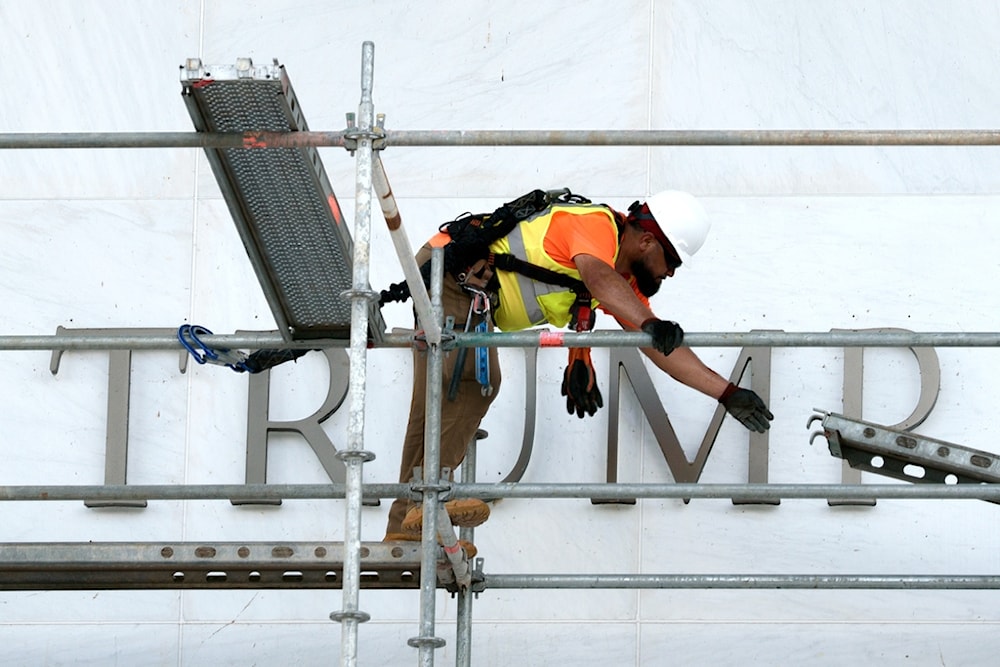
A worker constructs scaffolding in front of the John F. Kennedy Center for the Performing Arts sign in Washington, Friday, June 12, 2026 (AP)
Workers removed US President Donald Trump's name from the exterior of the John F. Kennedy Center for the Performing Arts overnight after courts rejected a series of last-minute efforts to halt a judicial order requiring the venue to restore its original name, The Guardian reported.
Crews arrived at the performing arts center in the early hours of Saturday and dismantled the lettering added to the building months earlier, following a ruling that the center's board lacked the authority to alter the institution's congressionally established name.
The removal came after US District Judge Christopher Cooper ruled that the addition of Trump's name was unlawful. In a lengthy opinion issued last month, Cooper concluded that the official designation of the center could not be changed by its board of trustees.
"Congress gave the Kennedy Center its name," the judge wrote in his 94-page opinion, "and only Congress can change it."
The dispute stems from a decision taken in December by a board appointed after Trump assumed control of the institution earlier this year. The board voted unanimously to rename the venue, adding the president's name to that of former US President John F. Kennedy, for whom the center serves as a national memorial.
Legal challenge
The lawsuit was brought by Joyce Beatty, a Democratic lawmaker from Ohio and an ex-offico member of the Kennedy Center board, who argued that the renaming violated federal law governing the institution.
In addition to challenging the name change, the lawsuit also targeted plans by the Trump-backed board to close the Kennedy Center for roughly two years to carry out a major renovation project reportedly valued at more than $250 million.
Cooper ultimately sided with the plaintiffs, finding that the board had exceeded its legal authority. He ordered the removal of Trump's name from signage, branding, and official materials and temporarily blocked the proposed closure.
Appeals rejected
Despite the ruling, attorneys representing Trump and the Kennedy Center sought emergency intervention to prevent the order from taking effect.
In a filing before the appeals court, Justice Department lawyers argued, "It does not make sense to alter the centre's name and signage now, only to potentially revert the name again after what should be a successful appeal."
Both requests were denied, clearing the way for the court-ordered changes.
By the time the legal challenges were exhausted, the Kennedy Center had already begun removing references to Trump's name from its website, promotional material, and communications.
Workers then arrived overnight to take down the exterior lettering. Supporters of the ruling gathered outside the building as the operation proceeded, chanting slogans and applauding when the signage was removed.
The administration later sought additional time to comply with the court order, citing severe weather concerns that it said could endanger workers carrying out the removal. Beatty criticized the request, describing it as "inexcusable" and part of "a pattern of non-compliance," according to court filings.
Trump reshapes institution
The controversy emerged after Trump moved earlier this year to reshape the Kennedy Center's leadership, removing trustees appointed by former President Joe Biden and installing allies before assuming the role of chairman.
Following the court's decision, Trump signaled that he was stepping back from direct involvement in the venue, while the board indicated it would continue pursuing legal avenues to challenge the ruling.
The case has become one of the most prominent legal disputes over Trump's efforts to reshape cultural institutions during his second term. At its core is a broader constitutional question over whether an appointed board can alter the identity of a congressionally created national memorial without approval from lawmakers.
Wider cultural battles
The Kennedy Center dispute comes amid a broader series of legal battles involving the administration's approach to historical and cultural institutions.
In a separate case, a federal judge recently ordered the administration to restore historical and scientific material removed from public monuments and national park sites following a March 2025 executive order titled "restoring truth and sanity to American history."
The directive instructed federal agencies to review exhibits and displays that the administration argued promoted a distorted interpretation of American history. Conservation groups later alleged that the policy led to the removal or modification of material addressing slavery, civil rights, Indigenous history, and climate change.
Selective narrative by administration
Ruling in favor of the plaintiffs, US District Judge Angel Kelley wrote: "Under the guise of promoting American dignity, this administration seeks to share a limited history by ordering the removal of all signs, displays, and interpretive exhibits at national parks that do not align with its preferred narrative, thereby telling half-truths."
Reacting to the decision, Alan Spears of the National Parks Conservation Association said, "Americans count on national parks to help us understand our full, rich history. Stories of triumph and tragedy alike deserve to be told out loud at parks."
Emily Thompson of the Coalition to Protect America's National Parks added, "National parks exist to preserve and interpret the full American story, not just the parts that make some politicians comfortable. This ruling will help ensure that remains the case."
Separately, the Kennedy Center faces additional scrutiny after the Washington National Opera filed a lawsuit alleging that approximately $17 million in donor funds intended for the opera company had been withheld, adding to growing controversy surrounding the institution's governance under its current leadership.
The administration has been given 21 days to comply with the order regarding national park exhibits while appeals in both cases continue.
Read more: US passports to feature Trump's image for 250th anniversary


