
Trump names Louisiana Gov. as first-ever special envoy to Greenland
 5 Min Read
US President Donald Trump names Jeff Landry as Greenland envoy with an explicit mission to make the Danish territory part of the US.
-
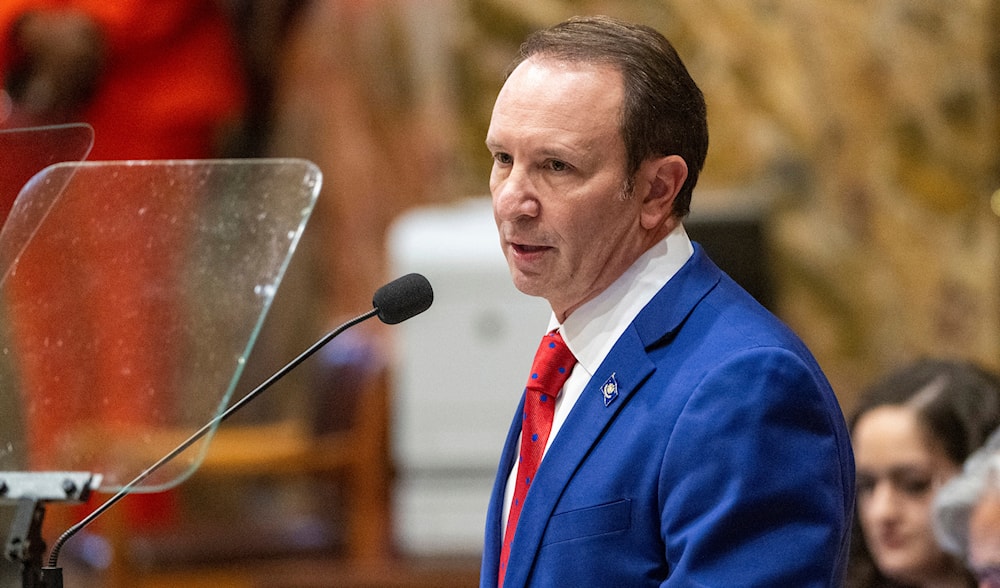
Gov. Jeff Landry speaks during the start of the special session in the House Chamber on January 15, 2024, in Baton Rouge, La. Landry called for the special session only a few hours after taking office. (Michael Johnson/The Advocate via AP, Pool)
The White House announced on Sunday that Louisiana Governor Jeff Landry will serve as a newly created US special envoy to Greenland, marking an unprecedented diplomatic appointment as US President Donald Trump intensifies his campaign to bring the Danish territory under American control.
Trump described Landry as someone who "understands how essential Greenland is to our National Security" and will advance US interests for "the Safety, Security, and Survival of our Allies." The Louisiana governor, who assumed office in January 2024, confirmed the volunteer role would not interfere with his gubernatorial duties through 2028.
In a social media post thanking Trump for the appointment, Landry declared, "It's an honor to serve you in this volunteer position to make Greenland a part of the US."
Thank you @realDonaldTrump! It’s an honor to serve you in this volunteer position to make Greenland a part of the U.S. This in no way affects my position as Governor of Louisiana!
— Governor Jeff Landry (@LAGovJeffLandry) December 22, 2025
Strategic calculations behind the push
Washington's intensified focus on Greenland stems from converging military and economic factors. The island already hosts Pituffik Space Base in its northwest, a critical early-warning installation that monitors ballistic missiles and satellites as part of NORAD's defense architecture. As Arctic ice retreats, new maritime corridors are opening along Russia's Northern Sea Route, positioning Greenland as a commanding presence over future trade pathways between Asia and Europe.
The territory also holds substantial reserves of rare earth elements and critical minerals essential for electric vehicles, renewable energy infrastructure, and advanced weapons systems. These resources are becoming increasingly accessible as warming temperatures expose previously ice-locked deposits, alongside potential oil and gas reserves that energy companies have long monitored.
Security analysts frame Trump's language through a Monroe Doctrine lens: preventing Russia or China from establishing any military foothold near North American territory. However, Trump's approach diverges sharply from traditional alliance management, openly refusing to rule out the use of military force or economic coercion, even against a NATO ally like Denmark.
The Arctic's strategic importance has surged as melting ice transforms the geography and exposes resources. Summer sea ice has declined roughly 50% since the late 1970s, with scientists projecting largely ice-free summers ahead under current warming trajectories. Russia built new bases and radar installations along its Arctic coastline, while China positions itself as a "near-Arctic state" seeking influence over shipping routes and resource projects.
European, Danish resistance
European officials have responded to repeated Trump calls for the US annexation of Greenland with unified opposition. European Council President António Costa pledged full support to Denmark, emphasizing that territorial integrity represents an "essential issue" for the bloc. Danish and Greenlandic governments have repeatedly declared the island "not for sale and never will be for sale," with Greenland's Prime Minister Múte Egede linking the dispute to decolonization and self-determination principles.
Copenhagen summoned the US ambassador in August following reports that individuals connected to Trump conducted covert influence operations in Greenland. A recent assessment by the Danish Defence Intelligence Service explicitly identified American economic pressure and threats of force against allies as emerging risk factors shaping Arctic security dynamics.
Policy analysts across Europe describe the situation as geopolitical bullying that puts both EU sovereignty norms and NATO cohesion to the test. While many European defense experts acknowledge concerns over Russian and Chinese activity in the Arctic, they argue that such challenges should be managed through existing alliance frameworks rather than through territorial acquisition.
Public opinion reflects this stance, whereby 78% of Danes oppose any transfer of Greenland to American control, with 41% now viewing the United States as a threat, a dramatic shift in one of Europe's historically most pro-American societies.
Greenlanders themselves show even stronger opposition, with 85% rejecting the prospect of joining the United States. Only 6% favor US control, despite broad support for eventual independence from Denmark. Trump's rhetoric has paradoxically accelerated independence debates while strengthening resolve that Greenland's future must be determined in Nuuk, not Copenhagen or Washington.
Landry's controversial profile
The Louisiana governor brings a polarizing record to his new diplomatic role. As state attorney general and now governor, Landry has characterized climate change as a "hoax" while aggressively promoting oil, gas, and petrochemical expansion. He led legal challenges against offshore drilling restrictions and EPA oversight of Louisiana's "Cancer Alley," a heavily polluted industrial corridor disproportionately affecting Black communities.
Civil rights and environmental justice advocates criticize his support for laws criminalizing protests near energy infrastructure and efforts to obtain communications between EPA officials, environmentalists, and journalists. His administration has appointed officials with ties to fossil fuel industries to key regulatory positions.
Pro-industry groups view these policies as creating favorable business conditions, as climate and public health organizations warn that they worsen environmental burdens in vulnerable communities and undermine climate adaptation in one of America's most at-risk states.


