
Trump reinstates Iran blockade, vows to 'guard' Strait, fees included
 6 Min Read
Trump reinstates a naval blockade on Iran, a 20 percent levy on all Hormuz cargo, and a US "guardian" role over the Strait of Hormuz.
-
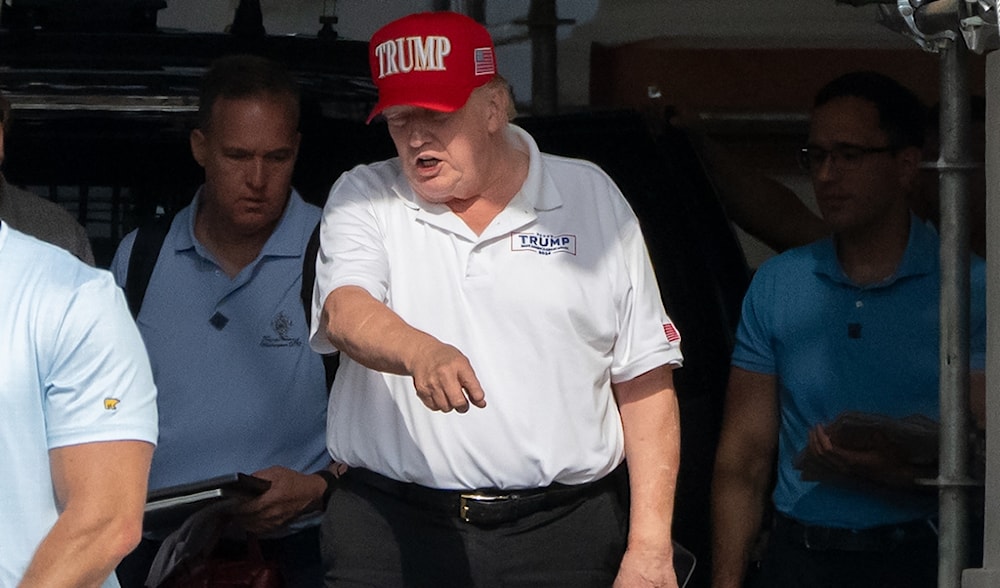
US President Donald Trump stands at the North Portico of the White House, Saturday, July 11, 2026, in Washington (AP)
US President Donald Trump announced that the US will reinstate the naval blockade on Iran, while insisting the Strait remains "OPEN, and will remain OPEN, with or without Iran."
In a Truth Social post shared on Monday, Trump explained that the blockade applies to Iran’s ships or customers, preventing them from "entering or leaving," while "all other countries will have fair and open use of the Strait."
He also said that the US will now be known as "THE GUARDIAN OF THE HORMUZ STRAIT," and demanded, "as a matter of FAIRNESS," a 20% reimbursement on cargo passing through the strategic waterway to cover "safety and security" costs. This policy, he said, would "begin immediately".
Trump had said earlier on Monday that Washington would "probably" take over the Strait of Hormuz outright, telling Fox News' "Fox & Friends" that the United States would become the waterway's "guardian" and should be reimbursed for the role.
"We're going to keep the strait, and we'll probably run it. We'll become the guardian of the strait. Maybe we'll call it the guardian angel of the strait. And we should be reimbursed for that," Trump said in the phone interview.
"We're going to guard it. We're going to get paid for guarding it, a lot of money," he added, arguing that "the other nations are very wealthy. They're on our side, and we can't be expected to do that for nothing."
Pressed further in the same interview, Trump was blunter about his intentions for the waterway, one of the world's most critical chokepoints for oil shipments. "We're taking over the Strait. They have nothing. They've got nothing," he said, referring to Iran.
⚡️JUST IN: Trump says the US will Keep the Strait of Hormuz and other Countries must Pay for it
— Iran Observer (@IranObserver0) July 13, 2026
"We are going to Keep the Strait. But now we will make Money" pic.twitter.com/pCiHNhePbe
Trump blames Iran for collapse of Hormuz agreement
Trump used the interview to deflect blame to Tehran for the breakdown of the Islamabad Memorandum, the ceasefire framework signed in mid-June that was meant to end hostilities and reopen the Strait to commercial shipping over a 60-day negotiating window.
"We had a deal. It was a done deal, and then they broke it. They always break it. We've had 10 deals with these people, and so we're just going to hit them very hard," Trump said.
Iran's closure of the Strait has remained in place since Tehran announced it on Saturday, citing unauthorized transit, contrary to the provisions of the MoU. Tehran said Sunday that passage would resume once "stability and calm" were restored.
Read more: IRGC destroys strategic US facilities in Bahrain, Kuwait, Jordan
A pattern of broken US commitments
Trump's claim that Iran "always" breaks agreements omits the precedent that defines Washington's own record on Iran.
The United States unilaterally withdrew from the 2015 nuclear agreement in 2018 while the International Atomic Energy Agency was still certifying Iranian compliance, discarding a functioning, internationally verified deal for no violation on Iran's part.
That pattern has repeated inside the current war. Iran's Foreign Ministry spokesman Esmaeil Baghaei said this month that under the fifth clause of the Islamabad Memorandum, Iran is responsible for determining arrangements for the safe passage of ships through the Strait, while "the United States has challenged this clause and, in practice, violated the agreement's structure through its unilateral actions and attacks against Iran."
Washington has also violated the memorandum's provisions on halting military operations across all fronts, including Lebanon, where Israeli attacks on the South continued after the ceasefire took hold, and its provisions on respect for sovereignty and territorial integrity.
Concretely, it was Washington that rescinded Iran's oil-export licence, reversing the memorandum's only tangible economic benefit for Tehran, and it was Trump who unilaterally declared the entire agreement "over" from the sidelines of a NATO summit, rather than through any negotiated mechanism.
Strait of Hormuz not Washington's to take
The Strait of Hormuz is not international waters awaiting a guardian, as its shipping lanes run through the sovereign territorial waters of Iran and Oman, not the United States', at a point where the two countries' twelve-nautical-mile territorial seas overlap.
Washington is not a party to the UN Convention on the Law of the Sea, the very framework it invokes to demand "freedom of navigation," and has no coastal claim to the Strait whatsoever.
There is no legal mechanism, under UNCLOS or any other instrument, by which the US can unilaterally assume "guardianship" of waters belonging to two other sovereign states, one of them a nominal US security partner of more than two centuries' standing.
'Reimbursement' for me, 'extortion' for thee
Trump's demand that "wealthy" nations pay Washington to "guard" Hormuz cannot be reconciled with the US position of the past several months.
When reports surfaced that Oman was discussing a joint traffic-management arrangement with Iran, potentially including a fee structure, Trump did not welcome the idea of Gulf states organizing their own security arrangement.
He threatened Oman directly, telling reporters, "The Strait is going to be open to everybody. It's international waters, and Oman will behave just like everybody else, or we'll have to blow them up."
US Treasury Secretary Scott Bessent followed with an explicit sanctions threat, warning that Washington "will aggressively target any actors involved, directly or indirectly, in facilitating tolls for the Strait" and that "any willing partners will be penalized."
A toll or management system for Hormuz is treated by Washington as extortion when proposed by Iran or Oman, and as a legitimate service fee the moment Trump proposes the US collecting it alone.


