
Trump revives Monroe Doctrine to push back China in the Americas
 5 Min Read
Trump is escalating pressure across Latin America in an effort to reassert US dominance and curb China's expanding economic and strategic influence in the Western Hemisphere.
-
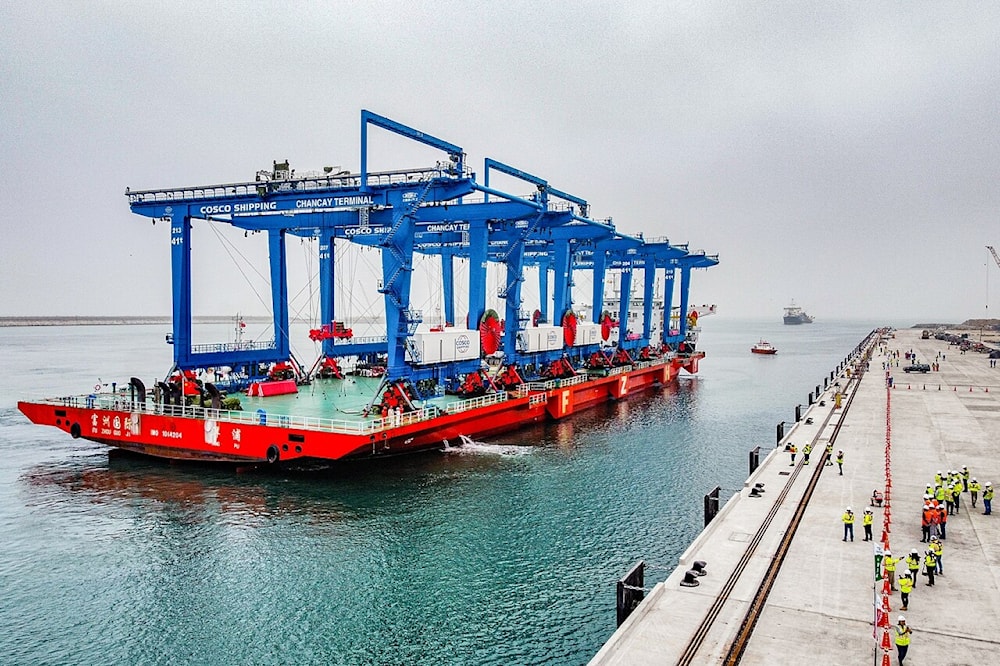
Port of Chancay, a shipping terminal located in Chancay, Peru, pictured before its opening in 2024. (Wiki Commons)
An analysis by Politico on Friday examines how countering China has become the central organizing principle behind US President Donald Trump's assertive approach toward Latin America and the broader Western Hemisphere.
While the administration has publicly framed its regional actions around migration, narcotics trafficking, and border security, officials and former advisers say the deeper strategic objective is to curb Beijing's growing economic and political foothold across the Americas.
At the heart of this strategy is a shared belief among senior Trump officials that dominance in the hemisphere is essential to US security. Alexander Gray, who served as chief of staff of the National Security Council during Trump’s first term, described the mindset bluntly: "You can’t defend the homeland without being predominant in the hemisphere." From that foundation, he added, "You can project power outward to focus on the other major theater of competition, which is the Indo-Pacific."
That outlook unites figures who otherwise represent different wings of the administration, including US Secretary of State Marco Rubio, Vice President JD Vance, Deputy Chief of Staff Stephen Miller, and Under Secretary of Defense for Policy Elbridge Colby. Despite varying views on US global engagements, they converge on the assessment that China poses the primary long-term challenge to American power.
Reviving the Monroe Doctrine
According to a State Department spokesperson quoted in the report, "China’s economic expansion into the Western Hemisphere, especially via companies controlled or influenced by the [Chinese Communist Party] and the [People’s Liberation Army], poses risks to US national security and prosperity." The White House framed the broader effort as a revival of the Monroe Doctrine.
As spokesperson Anna Kelly put it, "As President Trump outlined in his National Security Strategy, the administration is reasserting and enforcing the Monroe Doctrine to restore American preeminence in the Western Hemisphere, counter adversaries, control migration, and stop drug trafficking." She added, "His approach has been successful; narcotics trafficking by land and by sea has effectively stopped, and our border is secure from illegal drugs and criminals."
Concrete steps cited in the report include the apprehension of Venezuelan leader Nicolás Maduro, whose government has maintained close oil trade ties with Beijing. Carrie Filipetti, a former Trump-era official, said different factions within the administration backed the move for different reasons. "The isolationists saw [the capture of Maduro] as an extension of US national security and domestic issues," she explained. "The people who are concerned about China saw it as an important means of countering China’s shadow fleet and other involvements in the Western Hemisphere." She added, "And then the hawks were interested in making sure that Venezuela was free and democratic. So all of them agreed on that kind of gunboat diplomacy once he was apprehended."
Beyond Venezuela, the administration has intensified pressure on Cuba, challenged Panama, the first Latin American country to formally join China’s Belt and Road Initiative, and taken a confrontational tone toward Brazil, Beijing’s largest trade partner in the region. Trump has also argued that the United States must "own" Greenland to prevent China and Russia from establishing strategic footholds there.
Despite preparing for a cordial visit to Beijing focused on trade recalibration and access to rare earth minerals, Washington has escalated tariffs on Chinese goods to as high as 145 percent in recent months. Chinese retaliation through restrictions on critical minerals prompted a partial easing, but the broader rivalry remains intact.
Strategic backlash
Critics warn that a forceful revival of hemisphere-first dominance may prove counterproductive. Leland Lazarus, a former US Southern Command official, cautioned that "The Trump administration’s heavy-handed policies may push countries to acquiesce to US demands in the short term, but in the long term, it could burn bridges with the region that will absolutely open up opportunities for China going forward." He added that "Invoking the Monroe Doctrine and reimposing US dominance in the region is going to leave a really bad taste in the mouths of people in the long term."
Economic realities complicate Washington’s effort. China’s trade with Latin America reached $565 billion in 2025, outpacing the United States. Twenty-two of 33 Latin American and Caribbean nations have signed onto infrastructure projects under the Belt and Road framework. As Jorge Heine, Chile’s former ambassador to Beijing, noted, "The fastest growing region in the world today is not the United States, it’s not Europe, it’s Asia, and particularly China." He questioned the logic from a regional perspective: "That’s where the growth opportunities are, so if you were a Latin American minister of economic affairs, why would you want to give that a miss?"
Though Washington has expanded funding for development finance tools and protected certain trade agencies from federal cuts, experts say building credible alternatives to Chinese infrastructure financing will take time. Former US diplomat Brian Nichols acknowledged the structural disadvantage: "It still takes a long time to get a multi-billion dollar project through all of that process and we are not as nimble as the Chinese are yet."
The Politico report concludes that while Trump may publicly soften rhetoric toward Chinese President Xi Jinping, competition in the Western Hemisphere is likely to intensify. The administration appears convinced that securing dominance in the Americas is a prerequisite to confronting Beijing on the global stage, even if that pursuit risks alienating regional partners.
Read more: US hawks push for nuclear arms race by weaponizing seismic data


