
Trump’s claims on Iran war face credibility crisis
 4 Min Read
Donald Trump’s repeated false statements on the war on Iran fuel concerns over credibility amid escalating tensions and ongoing negotiations.
-
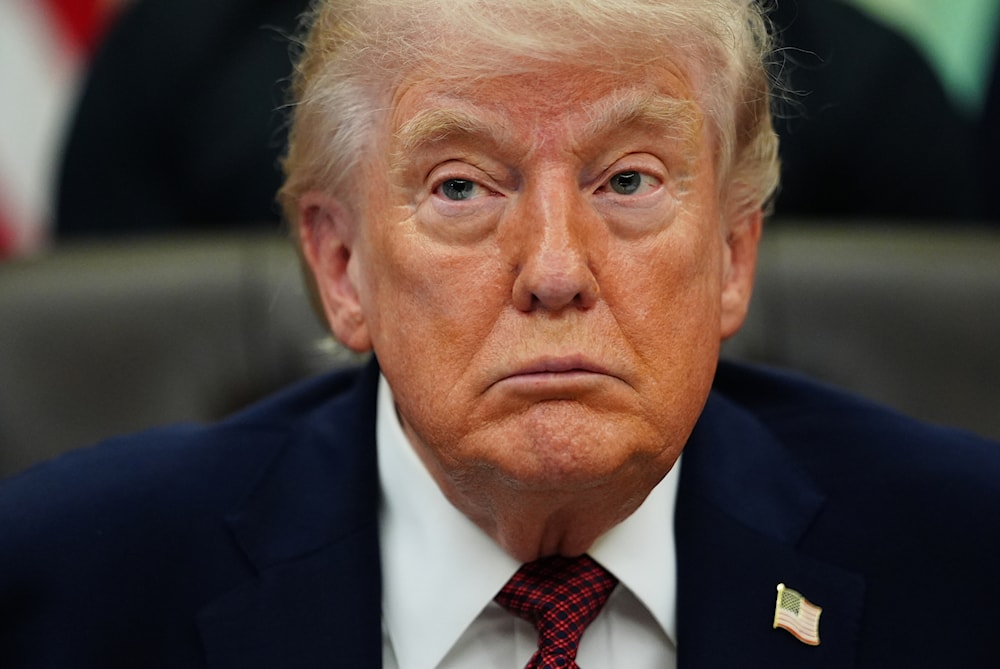
President Donald Trump listens to speeches before signing an executive order in the Oval Office of the White House on April 18, 2026, in Washington. (AP Photo/Julia Demaree Nikhinson)
US President Donald Trump’s false claims on the Iran war have increasingly raised concerns about the credibility of US diplomacy.
On Monday morning, Trump told The New York Post that Vice President JD Vance was already en route to Pakistan for negotiations with Iran. “They’re heading over now,” Trump said. “They’ll be there tonight, [Islamabad] time.”
However, the statement was quickly contradicted. Sources familiar with Vance’s plans told CNN that the vice president was expected to depart on Tuesday, with talks scheduled to begin on Wednesday. Shortly afterward, Vance’s motorcade was seen at the White House.
While such an inaccuracy might appear minor, it reflects a broader pattern of misinformation surrounding the administration’s handling of the Iran file.
Pattern of misinformation on the Iran war
Trump’s remarks are part of an accelerating trend of inaccurate or unverified statements related to the war and the ceasefire negotiations. Analysts have pointed to a growing credibility gap in official communications.
Eric Brewer, a former National Security Council counterproliferation official, wrote on social media that “one of the big differences between the current round of US-Iran diplomacy and prior rounds is that this administration and the President in particular are unreliable narrators.”
He added that while Iran analysts are accustomed to parsing conflicting narratives, “we’ve never had to contend with a US president that is so outspoken and prone to exaggeration, fabrication, and outright lies.”
Disputed claims on the Strait of Hormuz
On Friday, Trump claimed that the situation in the Strait of Hormuz had been resolved, stating that Iran had agreed never to close the waterway again.
In reality, developments on the ground contradicted this assertion. Iranian Foreign Minister Abbas Araghchi had indicated that maritime access would remain limited to specific routes near Iran’s coastline. Additional restrictions required vessels to obtain approval from Iran’s Revolution Guards and pay transit fees.
Within a day, Iranian authorities announced the closure of the strait once again, further undermining Trump’s claims.
False statements about Iran’s military and nuclear policy
Trump has also made several inaccurate statements about Iran’s military capabilities and nuclear program.
On Thursday, he claimed that the pope had endorsed Iran’s right to possess nuclear weapons. No such statement was made by Pope Leo XIV, who has consistently opposed nuclear armament.
In separate interviews, Trump asserted that Gulf states were not expected to be targeted by Iran and claimed that Iran’s military was effectively “gone.” Both claims conflicted with widely held assessments that Iran retained operational military capabilities and that regional escalation remained a significant risk.
Contradictions in US-Iran talks
Confusion has also extended to the composition of US diplomatic efforts. Trump stated on Sunday that JD Vance would not participate in negotiations in Pakistan for security reasons. Shortly afterward, US officials indicated that Vance would, in fact, lead the delegation.
Trump has further claimed that Iran agreed to sweeping concessions, including an "unlimited" halt to nuclear activities and the cessation of support for regional allies such as Hamas and Hezbollah.
When asked whether Iran had agreed to permanently stop uranium enrichment, Trump responded: “They’ve agreed to everything.”
These claims were met with skepticism from analysts and were explicitly denied by Iranian officials. A spokesperson for Iran’s Foreign Ministry stated, "Enriched uranium is as sacred to us as Iranian soil and will not be transferred anywhere under any circumstances".
Credibility gap in US leadership
Iranian officials also rejected Trump’s assertions. Mohammad Bagher Ghalibaf stated that the US president had made multiple false claims within a short period.
Despite Trump’s repeated assertions, the accuracy of his claims regarding ongoing negotiations remains unclear.
As US-Iran tensions continue, the credibility of public messaging has emerged as a central issue. Until concrete outcomes are confirmed, competing claims from both Washington and Tehran are likely to remain a source of uncertainty in assessing the trajectory of the war.


