
Trump’s Iran narrative collapses under its own weight: The Mirror
 4 Min Read
An analysis of Trump’s Iran narrative shows that geopolitical strategy appears increasingly secondary to shifting messaging and political framing.
-
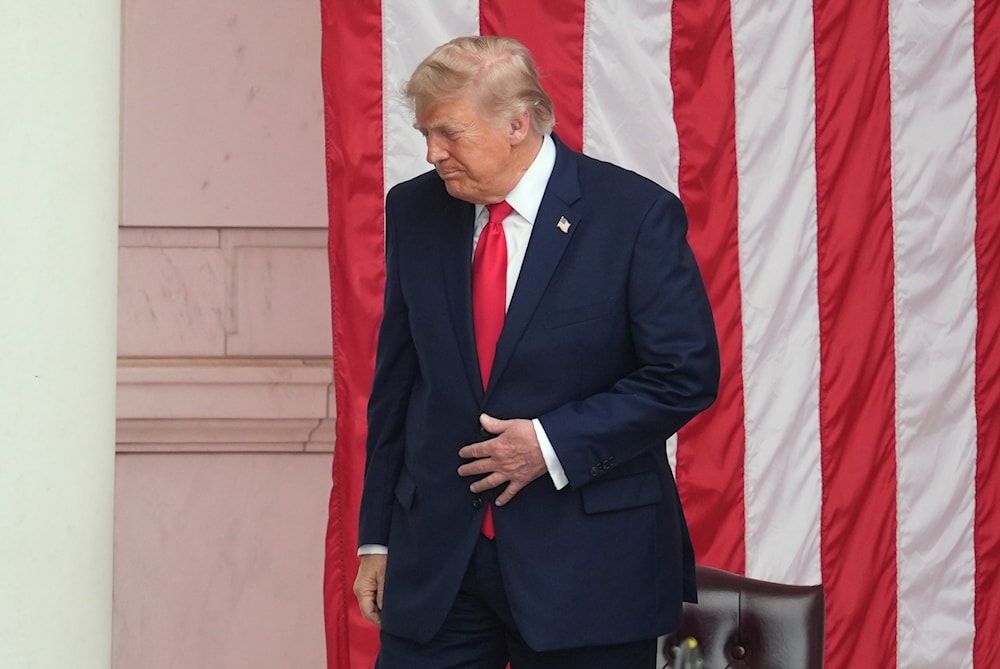
US President Donald Trump departs after speaking during the 158th National Memorial Day Observance coinciding with the nation's 250th anniversary, at the Memorial Amphitheater in Arlington National Cemetery on May 25, 2026, in Arlington, Va. (AP)
The narrative surrounding the US-Israeli war on Iran has shifted sharply amid growing scrutiny of claims made by US political leadership and evolving geopolitical realities in West Asia.
According to an analytical piece by The Mirror on Monday, the report argued that what was once framed as a decisive escalation and overwhelming US pressure on Iran is now increasingly being questioned as diplomatic and strategic outcomes appear more complex and less conclusive than initially portrayed.
For months, US President Donald Trump has publicly promoted a narrative of overwhelming US success, portraying Iran as strategically weakened and its military capabilities significantly diminished. His messaging consistently emphasized collapse within Tehran’s leadership and asserted dominance over Iranian military infrastructure, presenting a picture of near-total American control of the escalation, according to The Mirror.
However, several reports have proved otherwise, and recent acknowledgements have introduced a more restrained assessment, including references suggesting Iran’s military capacity remained largely intact, a notable shift from earlier rhetoric.
At the center of the broader geopolitical tension remains the Strait of Hormuz, one of the world’s most critical energy chokepoints. Iran’s ability to exert influence over the Strait continues to serve as a significant leverage point in global energy markets, reinforcing its strategic position despite external pressure. This dynamic has complicated Western efforts to fully dictate the terms of escalation or containment in the region, the report argued.
Tehran has maintained its negotiating position while leveraging regional instability risks to reinforce its diplomatic and strategic influence.
US Defense rhetoric and escalation framing
US defense leadership, including War Secretary Pete Hegseth, reinforced a strongly assertive public posture throughout the war, emphasizing dominance and military resolve. However, this rhetoric has increasingly been contrasted with on-the-ground strategic outcomes, where outcomes appear less definitive than public messaging suggests, The Mirror revealed.
The current phase of the war is increasingly defined by competing narratives rather than clear military outcomes.
While political messaging continues to emphasize strength and control, the underlying geopolitical reality reflects a more complex balance of leverage, risk, and mutual constraint. The result is a diplomatic environment where perception and strategy often diverge, and where long-term outcomes remain unsettled.
Iranian missile sites restored
In a related context, CNN reported on Monday that Iran has swiftly dug out its buried arsenals, an effort that experts say highlights the limits of the US-Israeli strikes during the war on the country.
This makes Iran set to launch a significantly larger number of long-range missiles at "Israel" and countries across West Asia from which any possible aggression might be launched, if the war is resumed, according to the experts.
For weeks, strikes by the United States and "Israel" restricted Iran’s access to its underground missile sites merely by destroying roads and burying tunnel entrances, according to CNN.
But satellite images reviewed by the American network show how Iran has used equipment as simple as bulldozers and dump trucks to counter those costly campaigns, suggesting that Tehran’s missile capabilities cannot be destroyed just by targeting tunnel entrances, the experts said.
Trump has repeatedly pointed to Iran’s arsenal of missiles as a reason for the war, with its destruction being one of the key goals. That said, in a March post to Truth Social, Trump listed “completely degrading Iranian Missile Capability, Launchers, and everything else pertaining to them” as one of five “objectives” of the US-Israeli war on Iran.
Although experts believe Iran still has around 1,000 missiles stored in underground sites, no one is capable of quantifying Iran's arsenal, especially amid the country's homegrown capabilities, despite Western reports otherwise.


