
Trump's tariffs on Canada, Mexico threaten US global power: Report
 9 Min Read
Trump's tariffs on Canada and Mexico are straining North American trade ties and weakening a strategic partnership central to US global power, a report by Foreign Affairs said.
-
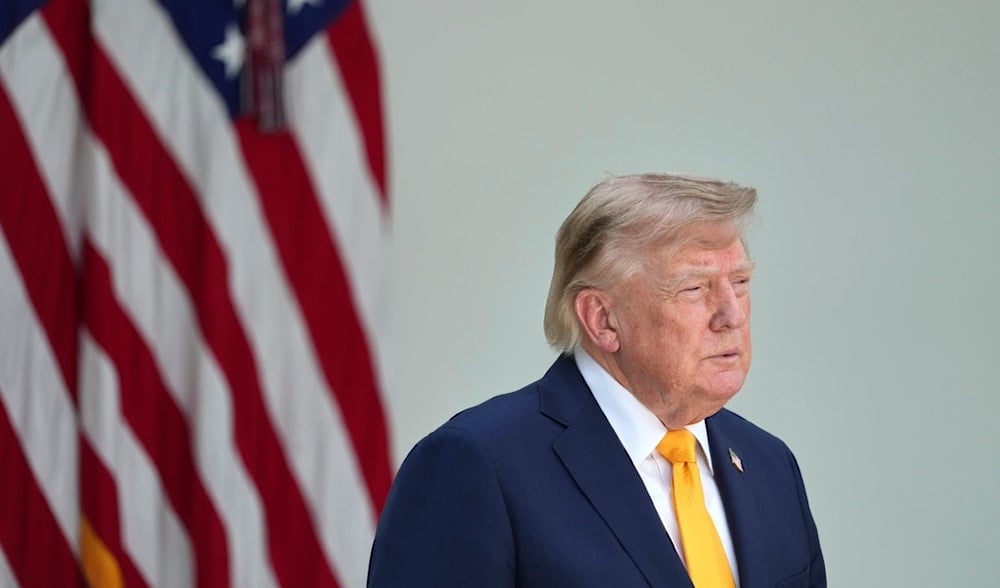
President Donald Trump listens during a back to school event in the Rose Garden of the White House, Monday, Aug. 24, 2026, in Washington. (AP)
Donald Trump's tariffs on Canada and Mexico, along with threats of economic coercion and military intervention, are undermining a strategic partnership that has strengthened US global power for generations, Robert B. Zoellick wrote in a Foreign Affairs analysis.
By treating its closest neighbors as adversaries, Zoellick said Washington risks weakening the economic ties, continental security arrangements, and geopolitical advantages that have long supported its international influence.
In Canada, Trump's high tariffs and repeated suggestions that the country become the United States' “51st state” have been perceived as attacks on its economy and independence. In Mexico, economic pressure and threats of military intervention have revived longstanding concerns about US dominance.
North American cooperation took generations to build. In the nineteenth century, Washington competed with European powers, Mexico, and Indigenous peoples for continental dominance. As the United States became a global power in the twentieth century, it shifted its attention to Europe, the Asia-Pacific, and West Asia. By the end of the Cold War, US presidents increasingly recognized the strategic importance of stronger continental ties.
Ronald Reagan articulated this principle in 1979: “The key to our own future security may lie in both Canada and Mexico becoming much stronger than they are today,” he explained. “It is time we stopped treating our nearest neighbors as foreigners.”
According to the author, geography gives the United States an advantage over other major powers. China and Russia each have 14 neighbors, many with difficult relations, while India must manage relations with six, including a nuclear-armed rival. The United States borders two comparatively friendly countries and has direct access to two vast oceans.
Cooperation with Canada and Mexico strengthens security, attracts investment, and creates a vast market combining natural resources, skilled labor, and technology. It also helps address criminal networks, migration, and environmental threats. Trump's confrontational approach is pushing Washington's natural partners away and weakening a foundation of US global strategy.
The historical foundations of US continental power
William Seward, US secretary of state from 1861 to 1869, recognized that good relations with neighboring countries could expand American influence. He argued that to have “control of this continent is to be . . . the controlling interest in the world.” While negotiating the US purchase of Alaska in 1867, he observed that Alaska and the Aleutian Islands “extend[ed] a friendly hand to Asia.”
Seward believed American power could grow through economic ties rather than territorial expansion alone. He opposed the US war with Mexico and later prevented an invasion intended to depose the French-installed Habsburg ruler, arguing that it would provoke hostility. Mexicans removed the ruler themselves in 1867.
That year, the Canadian Confederation formed partly to deter a possible US invasion. Seward chose arbitration over escalation in resolving wartime claims against the United Kingdom. His vision rested on voluntary integration: commerce, he maintained, would become the new “god of boundaries.” His biographer, Ernest Paolino, called this idea Seward's “law of imperial gravity.”
The restoration of Mexican President Benito Juarez and the creation of the Canadian Confederation raised hopes for a more integrated continent, but Seward's vision faded as Washington turned elsewhere, Zoellick said.
From continental instability to cooperation
The Mexican Revolution of 1910 shattered assumptions of continental stability. A decade of violence and attacks on US property prompted two American military expeditions into Mexico. In 1917, Germany secretly offered Mexico help recovering Arizona, New Mexico, and Texas if it sided with Berlin should the United States enter World War I; British intelligence intercepted the proposal.
During the 1920s, Washington stabilized relations with Mexico's one-party authoritarian system. Political scientist Pamela Starr described the US approach as accepting Mexican autonomy, but “within limits.” As long as Mexico did not threaten US security, Washington would refrain from interfering in its internal affairs.
This arrangement lasted roughly five decades. Between 1942 and 1964, the US Bracero Program issued approximately 4.6 million guest-worker permits to Mexicans, helping meet labor demands in agriculture, railroads, and other industries.
Canada also became a sovereign North American partner. The countries expanded cross-border trade during the 1920s and 1930s. After World War II, Canada fought alongside the United States in Korea and supported NATO, the United Nations, and the postwar trade system. They later developed the St. Lawrence Seaway, built an Arctic radar network, and established a duty-free integrated automobile market in 1965.
How North American trade integration reshaped the continent
North American integration accelerated under Reagan, whose outreach to Canadian Prime Minister Brian Mulroney encouraged Ottawa to propose a free trade agreement in 1985. The two countries reached an agreement in 1987, and the US Congress approved it the following year.
Mexican President Carlos Salinas proposed a similar agreement to US President George H. W. Bush in 1990, seeking investment and relief from debt and economic stagnation. Canada joined negotiations in 1991, and the three countries signed the North American Free Trade Agreement (NAFTA) in 1992.
For Washington, NAFTA marked a step toward reconciliation with Mexico, wary of the United States since losing half its territory in the war ending in 1848. Mexico hoped the agreement would accelerate economic and political transformation through stronger investment protections and closer institutional ties.
Bush called NAFTA “the beginning of a new era,” part of “a new world order” that would help the United States “prepare for the challenges and opportunity of the next century.” The administration expected NAFTA to boost commerce and facilitate cooperation on immigration, the environment, and drug trafficking while respecting national sovereignty.
President Bill Clinton secured congressional approval with strong Republican support and extended a loan during Mexico's 1995 peso crisis to prevent instability from spreading. After September 11, President George W. Bush introduced measures to facilitate secure commercial transit across both borders.
The economic and strategic benefits of North American trade
NAFTA expanded cross-border investment, manufacturing, and infrastructure. In 2000, six years after it took effect, US unemployment fell to 3.8%, while inflation declined, productivity increased, and real wages rose.
US-Canadian trade in goods and services grew from $169 billion in 1988 to approximately $900 billion in 2024. US-Mexican trade approached $1 trillion, compared with less than $100 billion before NAFTA.
Investment also expanded substantially. US direct investment in Canada rose from $61 billion before NAFTA to approximately $750 billion, while Canadian investment in the United States increased from $27 billion to about $500 billion. US investment in Mexico grew from $15 billion to roughly $130 billion–$150 billion, while Mexican investment in the United States rose from $1 billion to between $40 billion and $50 billion.
The relationship benefits the United States directly: it supplies as much as 60% of Canada's imports and about 40% of Mexico's. By comparison, the United States receives only six to seven cents of every additional dollar China spends on imports.
NAFTA's architects also hoped development would reduce migration. The number of Mexican-born US residents rose from about 760,000 in 1970 to nine million in 2000. By 2010, net Mexican migration had fallen to zero, and Mexico had become an important US immigration enforcement partner.
Trump sought to dismantle NAFTA during his first term but ultimately renegotiated it, replacing the agreement with the United States–Mexico–Canada Agreement (USMCA) in 2020. The pact modernized digital trade rules and introduced labor complaint procedures, but complex auto requirements weakened global competitiveness and reduced investor protections in Mexico.
Trump's tariffs threaten US-Canada and US-Mexico relations
Although the USMCA is not scheduled to expire until 2036, uncertainty is discouraging investment in Canada and Mexico. In 2026, the Trump administration declined to approve an extension through 2042 and sought greater freedom to disregard the agreement.
In 2025 and 2026, Washington imposed high tariffs on Canadian automobiles, steel, aluminum, iron, metal-intensive equipment, lumber, and pharmaceuticals, citing national security concerns. The measures have strained relations with Canada, given decades of industrial integration and more than a century of close military cooperation. The designation of Canadian imports as a national security threat has reinforced concerns that Washington no longer respects the partnership.
A breakdown in US ties with Canada and Mexico would carry serious strategic consequences. Together, the three countries have almost half a billion people, skilled workers, integrated infrastructure, competitive industries, advanced technology, and abundant energy resources.
The author advised that Washington should cooperate with Canada on Arctic and maritime security, minerals, trade, and technology. Canada's AI expertise, research capabilities, and energy resources complement those of the United States.
Washington also has an interest in helping Mexico strengthen its institutions. Corruption persists across government, courts, police forces, and schools, while criminal enterprises exploit institutional weaknesses. US intelligence and technological support could improve security and the rule of law, strengthening Mexico as a partner.
From Seward to Reagan, the Bush presidents, and Clinton, US leaders recognized that a strong North America provides a strategic anchor in an uncertain world. Trump's drive for dominance and zero-sum approach to economics depart from that tradition.
The next US president, Zoellick stated, will have an opportunity to reverse course by rebuilding constructive relations with Canada and Mexico, respecting their sovereignty, and recognizing that cooperation serves American interests better than coercion. Preserving the North American partnership is not merely a trade policy priority; it is central to maintaining US global power.
Read more: World could overpay $160 bln due to US import tariff hike


