
Carney backs new EU alliance, dismisses Trump tariff threat
 4 Min Read
Canadian Prime Minister Mark Carney backed closer strategic integration with the EU and welcomed the bloc’s proposed "associate membership" for Canada while rejecting US pressure over Ottawa's European ties.
-
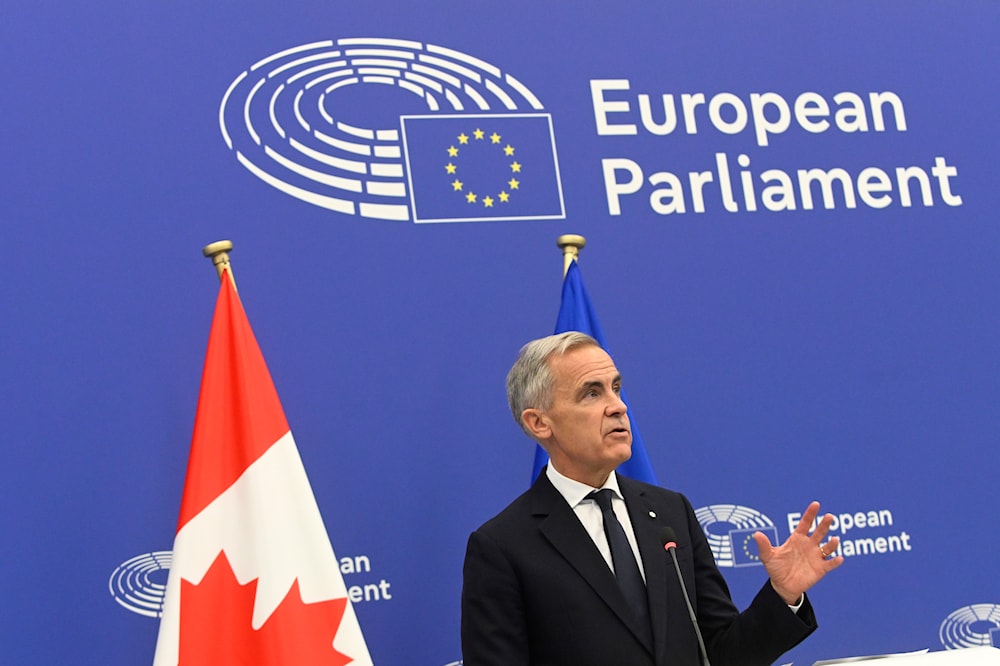
Canada's Prime Minister Mark Carney speaks during a press conference at the European Parliament in Strasbourg, eastern France, Thursday, Sept 17, 2026 (AP)
Canadian Prime Minister Mark Carney has called for a deeper strategic alliance between Canada and the European Union, welcoming Brussels’ proposal for an unprecedented form of “associate membership” while rejecting US pressure over Ottawa’s growing ties with Europe.
Addressing the European Parliament in Strasbourg on Thursday, Carney presented closer cooperation with the 27-member bloc as a way for both sides to strengthen their economic and strategic independence amid mounting international tensions.
“Europe and Canada are stronger together,” Carney said, as lawmakers gave the Canadian prime minister a standing ovation.
His remarks followed European Commission President Ursula von der Leyen’s proposal a day earlier to open the possibility of Canada becoming the EU’s first “associate member,” a category that currently has no formal basis in the bloc’s treaties.
Carney rejects US pressure over EU ties
The proposal quickly drew opposition from US President Donald Trump, who described the prospect as “laughable” and threatened Europe with additional trade measures if Washington considered the initiative hostile.
Trump said the United States could impose “very serious tariffs” or “stop trading with Europe” if the arrangement moved forward under what he viewed as unfavorable circumstances.
Carney, however, rejected the suggestion that Washington could determine Canada’s international partnerships.
“No one is going to dictate our culture, or with whom we can strike agreements internationally,” he told reporters following his address.
Canada, EU seek strategic autonomy
Canada has been seeking to diversify its economic and strategic relationships as its trade dispute with the United States deepens, while the EU has likewise faced tensions with Washington over tariffs and other areas of policy.
Both Ottawa and Brussels have stressed that the initiative should not be interpreted as an alliance directed against the United States.
Von der Leyen said the proposed partnership was “not against anyone else, but for our common strength,” while Carney presented closer coordination between Canada and Europe as a means of reinforcing their ability to withstand outside economic and political pressure.
“We do not seek power to dominate others,” Carney said, arguing that closer cooperation could “create a beacon for other democracies”.
“We are pursuing resilience so no one, no one can control our open markets, impair our sovereignty, threaten our territorial integrity, or undermine our freedoms, our democracies, our rule of law,” he added.
Canada, EU eye deeper economic and strategic integration
Carney outlined a broad range of sectors in which Ottawa and Brussels could expand cooperation, including artificial intelligence, defense production, critical minerals, energy, digital commerce, space technology and payment systems.
Canada could also become a larger supplier of strategic resources and energy to Europe, including liquefied natural gas and hydrogen “at large scale”, according to Carney.
He additionally called for the two sides to develop “seamless digital trade” and expand opportunities for young Canadians and Europeans to study and work across the Atlantic.
Von der Leyen had laid out similar priorities in her State of the European Union address, proposing greater integration of Canadian and European defense industries, a technology partnership and expanded Arctic cooperation.
EU associate membership remains undefined
The exact meaning of associate membership remains unresolved. Unlike full EU membership, the proposed status does not currently exist in the bloc’s treaties, and European governments would still have to determine what rights, obligations and institutional arrangements such a partnership would entail.
Carney nevertheless said Canada “welcomes this ambition”, signaling Ottawa’s willingness to explore the proposal.
The initiative is expected to feature prominently when Canadian and European leaders meet at an EU-Canada summit in Montreal next month, where the two sides are expected to further define the scope of their expanding partnership.
Read more: Buy Canadian movement reshapes grocery amid Canada-US trade war


